The Habit Loop: Engineering Personal Growth
Golden Hook & Introduction
SECTION
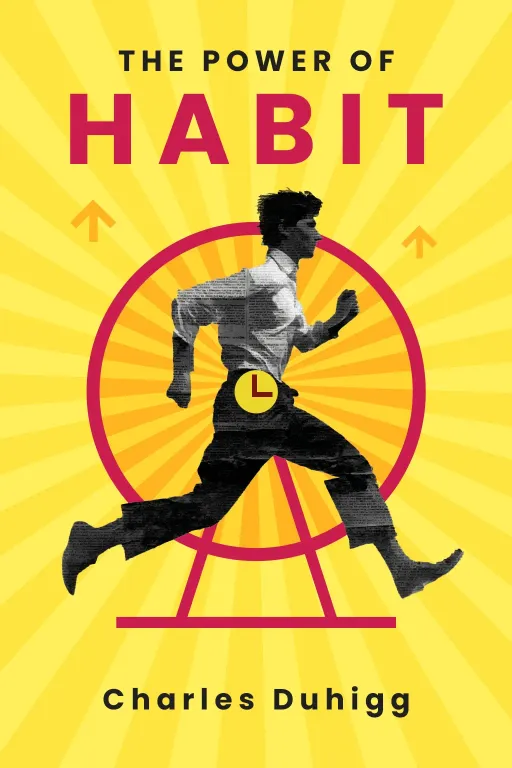
Nova: How much of your day is truly a choice? As a founder, a parent, a busy professional... we pride ourselves on making smart decisions. But what if I told you that research from Duke University found that over 40% of our daily actions aren't decisions at all? They're habits. They're autopilot. And today, with Frank Wu, the co-founder of the personal growth AI platform Aibrary, we're going to look under the hood. We're going to deconstruct the science of our own programming, using Charles Duhigg's masterpiece, "The Power of Habit," as our guide.
Nova: Today we'll dive deep into this from two powerful perspectives. First, we'll explore the hidden neurological 'code' that runs our daily lives, the habit loop. Then, we'll discuss the ultimate life-hack for busy people: the concept of 'keystone habits' that can trigger massive positive change with minimal effort. Frank, it's so great to have you here to help us decode this.
Frank Wu: Thanks, Nova. It's great to be here. That 40% figure is exactly what we obsess over at Aibrary. It's the invisible architecture of our lives, and if you can understand that architecture, you can start to rebuild it. It's the difference between living by default and living by design.
Deep Dive into Core Topic 1: Deconstructing the Habit Loop
SECTION
Nova: Exactly. And to rebuild it, we first need the blueprint. Duhigg introduces this through the incredible, almost unbelievable, story of a man known in scientific literature as Eugene Pauly. Frank, this story is wild.
Frank Wu: I'm ready. Lay it on me.
Nova: Okay, so picture this: Eugene is a 71-year-old man who contracts a severe case of viral encephalitis. The virus basically eats away a part of his brain called the medial temporal lobe. The result is catastrophic amnesia. He can't retain any new information for more than about a minute. He can't remember his doctor's name, can't recall what he ate for breakfast, he can't even sketch a map of his own house where he's lived for decades.
Frank Wu: That's devastating. So his ability to form new memories is completely gone.
Nova: Completely. But then his wife, Beverly, starts noticing something bizarre. Every morning, Eugene gets up, gets dressed, and goes for a walk. He leaves the house, walks around the same block, and comes right back to the front door. Perfectly. But if you were to stop him mid-walk and ask him which house is his, he wouldn't have a clue.
Frank Wu: Whoa. So he's navigating without a conscious map in his head. How is that possible?
Nova: That's the million-dollar question that fascinated the scientists studying him. They discovered that while the part of his brain for memory was destroyed, a different, more primitive part was perfectly fine: the basal ganglia. And this is where habits live. Through a series of clever experiments, they proved Eugene could still form habits. They'd show him two plastic toys, one red and one blue, and say "pick one." One was always the "correct" one. He'd guess, and they'd tell him if he was right. He never remembered the sessions, but after a few weeks, he was picking the correct object 85% of the time. When they asked him how, he'd just say, "It's here somehow or another," and point to his head.
Frank Wu: That's incredible. It proves that habit isn't memory. It's a physical, neurological pathway. It makes me think about building new skills. We often think we need to 'memorize' the steps, but what this suggests is we actually need to build the through sheer repetition.
Nova: You've nailed it. And Duhigg breaks down that pathway into a simple, three-step process he calls the Habit Loop. First, there's a, a trigger that tells your brain to go into automatic mode. For Eugene, it might have been the sight of his front door. Second, there's the, which is the behavior itself—the walk. And third, there's the, which helps your brain figure out if this particular loop is worth remembering for the future.
Frank Wu: It's like our brains are running a simple 'if-then' statement. If 'Cue,' then 'Routine,' to get 'Reward.' From an AI and product design perspective, that's a pattern you can work with. The real challenge for something like Aibrary is, how do you reliably detect the 'cue' from someone's digital or real-world footprint? And even more importantly, what is the reward?
Nova: That's the key, isn't it? The reward is often not what we think. Duhigg gives the example of his own afternoon cookie habit. He thought the reward was the sugary cookie. But after experimenting—trying a donut, then an apple, then just a coffee—he realized the cookie wasn't it. The real reward he was craving was the social interaction he got from chatting with colleagues in the cafeteria.
Frank Wu: So the routine—buying the cookie—was just a vehicle for the real reward. That's a huge insight. With technology, we often think the reward is a notification or a checkmark on a to-do list. But those are superficial. The real reward has to be a genuine feeling of relief, or focus, or connection. The technology's job is to facilitate the routine and then, crucially, help you that you've received the real, emotional reward. That's how you close the loop and strengthen the pathway.
Deep Dive into Core Topic 2: Keystone Habits
SECTION
Nova: I love that connection to closing the loop. Because once we understand that basic code, the next question is, which loop do we focus on? As you know better than anyone, we're all busy. We can't change 20 habits at once. This brings us to what might be the most powerful concept in the book for any leader, founder, or parent: the keystone habit.
Frank Wu: The one that unlocks everything else.
Nova: Precisely. And the story Duhigg uses to illustrate this is just epic. It's 1987, and Alcoa, a massive aluminum manufacturer, is in trouble. Profits are down, morale is low. They bring in a new CEO, a former government bureaucrat named Paul O'Neill. His first meeting with Wall Street investors is legendary.
Frank Wu: I can imagine. They're all expecting to hear about synergy and cost-cutting.
Nova: Exactly. Instead, O'Neill gets up and says, "I want to talk to you about worker safety." The room goes dead silent. He doesn't mention profits once. One investor ran out of the room, called his top clients and said, "The board put a crazy hippie in charge of Alcoa. Sell everything!" He thought O'Neill was going to destroy the company.
Frank Wu: That's a bold opening move. So what was his logic?
Nova: His logic was brilliant. O'Neill believed the key to fixing Alcoa was attacking one thing: its terrible safety record. His thesis was that to make the company the safest in the world, they would have to understand injuries happened. And to do that, they'd have to understand the manufacturing process better than anyone else. He instituted a single, radical rule: any time a worker was injured, the president of that unit had to report it to O'Neill himself, the CEO, within 24 hours, and present a plan for ensuring it never happened again.
Frank Wu: Wow. That's not just a rule, that's a bomb thrown into the corporate hierarchy. A vice president would have to get a call in the middle of the night and immediately get information from a floor manager, who had to get it from a worker.
Nova: You see it! It completely short-circuited the old, rigid communication habits. Suddenly, ideas for improving safety—which were often also ideas for improving efficiency—were rocketing up the chain of command. The focus on safety, this one keystone habit, created a cascade of other positive habits: better communication, streamlined processes, higher quality control, and a culture of excellence.
Frank Wu: He re-engineered the company's nervous system. That's such a powerful example of systems thinking. O'Neill didn't just say 'be safer.' He created a new for the entire organization. The cue was an injury. The routine was this radical, cross-hierarchical communication. And the reward was not just a safer plant, but a more efficient and profitable one.
Nova: And the results were staggering. Within a year of O'Neill taking over, Alcoa's profits hit a record high. By the time he retired, the company's market capitalization was five times larger than when he started. All by focusing on one keystone habit.
Frank Wu: It's about finding the domino that knocks over all the others. As a founder, you're constantly fighting fires. The temptation is to tackle every problem at once. O'Neill's story suggests the opposite: find the thing that, if you fix it, will indirectly solve ten other things. For a startup, maybe the keystone habit isn't 'increase sales.' Maybe it's 'every team member must talk to one customer every week.' That single habit could improve the product, boost morale, and drive sales.
Nova: And it applies to our personal lives, too. Duhigg points to studies showing that exercise is a classic keystone habit. When people start exercising regularly, they often start eating better and feeling less stressed, without consciously trying to.
Frank Wu: It even makes me think about my 3-year-old daughter. What's the keystone habit for a toddler? It's probably not a complex command like 'clean your room.' Maybe it's something incredibly simple, like 'we put one toy away before we get out a new one.' That one small routine could teach responsibility, order, and focus, which would have a ripple effect on everything else.
Synthesis & Takeaways
SECTION
Nova: That's a perfect, real-world example. So, we have these two incredible ideas from the book. First, the basic code of our behavior is this simple Cue-Routine-Reward loop, which our brain uses to save energy, as we saw with Eugene Pauly.
Frank Wu: And second, as Paul O'Neill so brilliantly demonstrated, we don't need to rewrite all our code at once. We just need to find that one keystone habit that creates a powerful chain reaction.
Nova: So for someone listening, who feels overwhelmed by all the things they want to improve, what's the first step?
Frank Wu: I think it's a two-step process for personal engineering. First, diagnose a habit by finding the cue and the real reward. Then, before you just try to swap out the routine, ask a bigger question: 'Is there a habit I could build that would make this other bad habit irrelevant?' For example, instead of just fighting the habit of late-night snacking, maybe the keystone habit is eating a protein-rich family dinner together every night at 6 PM. That might solve the snacking problem and improve family connection at the same time. You're looking for leverage.
Nova: That's a brilliant, practical way to frame it. So, for everyone listening, here’s the challenge from the book's appendix. Take one habit you want to change. For the next few days, just be a scientist. When the urge for that habit hits, grab a notebook or your phone and write down the cue. Ask yourself five things: Where am I? What time is it? What's my emotional state? Who else is around? And what action immediately preceded this urge?
Frank Wu: Just collecting that data, without judgment, is a huge step.
Nova: It is. Because once you isolate that cue, you've found the start of the loop. And that is the first, most powerful step to taking control and beginning to live by design. Frank, this has been an absolutely fantastic conversation. Thank you so much for helping us unpack these ideas.
Frank Wu: The pleasure was all mine, Nova. It's a topic I could talk about all day.