The Power of Habits: Small Changes, Remarkable Results.
Golden Hook & Introduction
SECTION
Nova: What if I told you that the secret to achieving your biggest dreams isn't about grand gestures or Herculean willpower, but about something so small, it's almost invisible?
Atlas: Oh, I like that. That’s definitely not what most people think. We’re usually told to 'go big or go home,' right? Like, if you’re not overhauling your entire life on January 1st, you’re not serious.
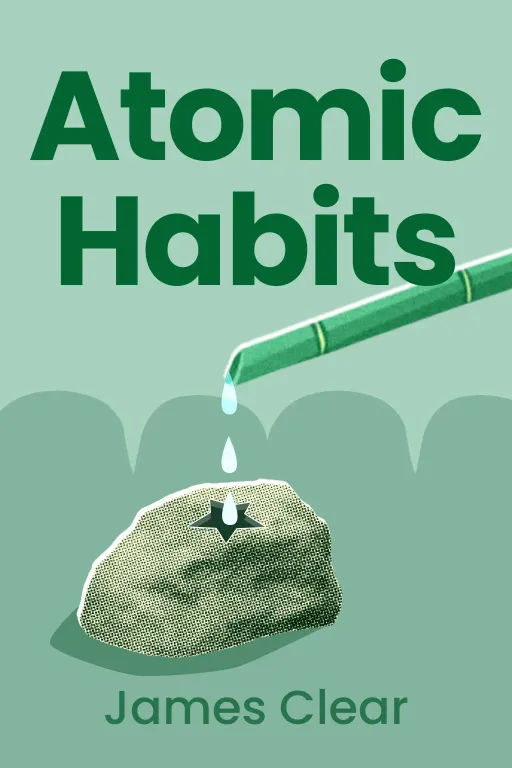
Nova: Exactly! And that mindset is precisely what derails so many of us. Today, we’re diving into the astonishing power of habits, drawing insights from two foundational texts that have completely reshaped our understanding: James Clear’s widely acclaimed "Atomic Habits" and Charles Duhigg’s Pulitzer-winning investigative deep-dive, "The Power of Habit."
Atlas: So, we’re talking about the blueprints for not just things differently, but for someone different, aren’t we? Clear, the personal development guru, gives us the actionable steps, while Duhigg, the investigative reporter, unearths the scientific 'why' behind it all.
Nova: Absolutely. Clear’s genius lies in his ability to distill complex behavioral science into a practical, science-backed framework. He's all about engineering your environment and your actions so that good habits become inevitable and bad ones, well, impossible.
Atlas: That sounds a bit out there. 'Impossible'? For someone who's spent years trying to break certain patterns, that's a bold claim. But I’m intrigued. Where do we even begin with making something so powerful, almost... frictionless?
The 'Atomic' Approach: Making Good Habits Inevitable
SECTION
Nova: We begin with the 'atomic' approach. James Clear argues that true transformation rarely happens in giant leaps. It's the accumulation of these tiny changes—atomic habits—that compound over time, producing remarkable results. He presents four laws of behavior change: make it obvious, make it attractive, make it easy, and make it satisfying.
Atlas: So you’re saying it’s not about willpower, but about engineering? For our listeners who are curious learners, always looking for systems, this flips the script on self-improvement. We often blame ourselves when we fail, thinking we lack discipline.
Nova: Exactly! It’s less about your motivation and more about your environment. Let’s take something simple: wanting to read more. Instead of saying, "I'm going to read a book a week," which feels like a huge leap, Clear would say, "Make it obvious." Put the book on your pillow, right where you can’t miss it before bed. Then, "make it attractive"—maybe pair it with a cozy blanket and a cup of tea.
Atlas: Oh, I see. So it’s stacking the deck in your favor. But what about "make it easy"? That sounds like an excuse to not really push yourself.
Nova: Not at all. "Make it easy" is the two-minute rule. If you want to run, you don't commit to a 30-minute jog. You commit to putting on your running shoes for two minutes. If you want to meditate, you sit down for two minutes. The goal isn't the performance; it's showing up. It’s about building the identity of a runner or a meditator.
Atlas: That’s a great way to put it. It’s like, you’re not trying to run a marathon on day one, you’re just trying to become someone who. That makes sense. For deep thinkers, the identity shift is often more powerful than the immediate outcome.
Nova: Precisely. And then, "make it satisfying." This is crucial. Our brains are wired for immediate gratification. If a habit isn't immediately rewarding, we tend to drop it. So, after those two minutes of reading, you might check off a box on a habit tracker, or allow yourself a small, immediate reward. The satisfaction reinforces the behavior.
Atlas: So basically you’re saying, if we want to build a new habit, we need to design a system where the cue is unavoidable, the action is appealing, the effort is minimal, and the reward is instant. That sounds like a powerful framework for anyone trying to cultivate consistency, whether it's learning a new skill or improving their health.
Unpacking the 'Habit Loop': Understanding Why We Do What We Do
SECTION
Nova: And that naturally leads us to the second key idea we need to talk about, which often acts as the underlying engine for these atomic changes: Charles Duhigg's "habit loop." Duhigg, coming from an investigative journalism background, dissects the science behind how habits actually form and operate in our brains.
Atlas: I’m curious. If Clear gives us the 'how to build,' what does Duhigg's 'habit loop' tell us about the 'why we do what we do'? Is it all just subconscious programming?
Nova: In essence, yes. The habit loop consists of three parts: a cue, a routine, and a reward. The cue is the trigger that tells your brain to go into automatic mode and which habit to use. The routine is the behavior itself—physical, mental, or emotional. And the reward is what your brain gets from the routine, which helps it remember that loop in the future.
Atlas: So, it’s like our brains are constantly looking for shortcuts? Like a mental autopilot?
Nova: Exactly. Think about something simple, like checking your phone. The cue might be a notification, or just a moment of boredom. The routine is grabbing your phone and scrolling. The reward is a hit of dopamine from new information, or the temporary distraction from boredom. Over time, this loop becomes so ingrained, you do it without thinking.
Atlas: Wow, that’s kind of heartbreaking, but also incredibly insightful. So, if we’re essentially wired for these loops, does that mean we're just automatons? How much agency do we really have if our brains are just following cues? For our listeners who crave intellectual challenge, this raises a profound question about free will.
Nova: That’s the beauty of understanding the loop, Atlas. Duhigg reveals that while we can’t erase habits, we can change them. The key is to identify the cue and the reward, and then consciously. For instance, if your cue is stress and your reward is a cigarette, you can keep the cue and the reward, but swap the cigarette for a walk, or a deep breathing exercise.
Atlas: So the power isn't in stopping the loop, but in it? That makes a lot of sense, especially for someone who's tried to just 'stop doing' something and found it nearly impossible. It’s about understanding the underlying need that the habit is fulfilling.
Nova: Precisely. Duhigg illustrates this with fascinating case studies, from how Alcoholics Anonymous helps people identify and replace their drinking routines, to how Procter & Gamble used the habit loop to launch Febreze. They found the cue for Febreze wasn't bad smells, but the of cleaning, and the reward was a fresh, pleasant scent signaling a job well done.
Atlas: That’s incredible. That shows how understanding these loops isn't just about personal change; it applies to organizations and even society. It’s about engineering behavior at a much larger scale, which for a curious learner, truly expands the scope of what we think of as 'self-improvement.'
Synthesis & Takeaways
SECTION
Nova: So, bringing these two brilliant minds together, we see a powerful synergy. Clear gives us the practical, step-by-step guide to building positive systems, making the desired actions almost inevitable through his four laws. Duhigg provides the deep neurological and psychological understanding of habits form, and how we can strategically interrupt and re-engineer those loops.
Atlas: For our listeners who are always seeking deeper understanding and continuous improvement, this really shifts the paradigm, doesn't it? It moves beyond simplistic ideas of 'just try harder' and gives us a scientific, actionable roadmap. It’s about designing our lives, rather than just living them reactively.
Nova: Exactly. It’s about focusing on systems rather than just goals, and understanding that by engineering our environment and our responses to cues, we can cultivate continuous improvement. True transformation isn't an event; it's a process, built one tiny, consistent action at a time.
Atlas: That’s actually really inspiring. So, for someone listening right now, wanting to take that first step, what’s the one tiny action they can take today?
Nova: Here’s your tiny step: Identify just one small habit you want to cultivate. For the next week, commit to practicing it for just two minutes each day. Don’t aim for perfection, aim for consistency. It could be reading, meditating, stretching, or planning your day. Just two minutes.
Atlas: Just two minutes. That sounds ridiculously achievable, yet knowing the science behind it, I can see how that small commitment becomes the cornerstone of something much, much bigger. It's about building momentum, isn't it?
Nova: It's all about momentum. And watch what happens when those tiny actions compound.
Nova: This is Aibrary. Congratulations on your growth!