Building Unbreakable Habits for Lasting Wellness
Golden Hook & Introduction
SECTION
Nova: Atlas, quick, give me your five-word review of 'willpower.' Go!
Atlas: Oh, man. 'A fleeting, beautiful, exhausting, myth.'
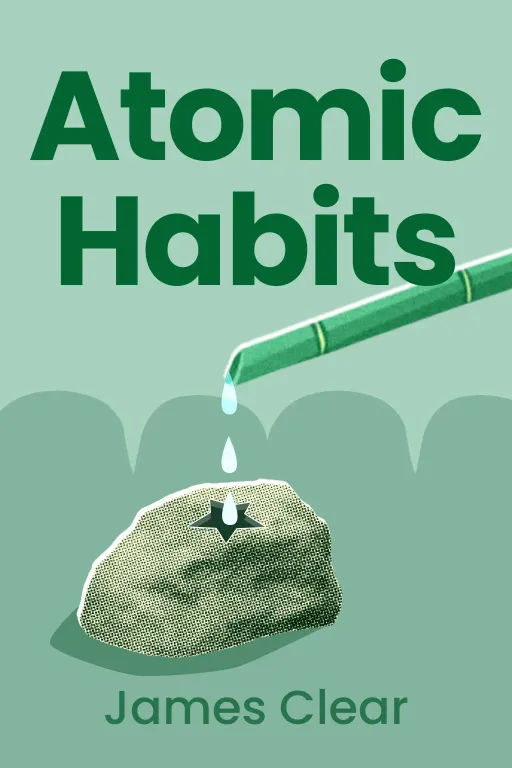
Nova: Ha! 'Myth' is right! I love that. Because today, we're tearing down the myth of willpower and revealing the true architects of lasting change. We’re diving deep into the fascinating world of habits, drawing insights from foundational works like James Clear's "Atomic Habits," Charles Duhigg's "The Power of Habit," and BJ Fogg's "Tiny Habits."
Atlas: That's a powerful trio. And I imagine a lot of our listeners, especially those who are always pushing boundaries and exploring new knowledge, have felt that frustration of setting a big goal, only to see it crumble because 'willpower' just… vanishes.
Nova: Exactly. And what's truly remarkable about these authors, particularly James Clear, is that he didn't just write a self-help book; he built a system. Clear, a weightlifter and entrepreneur, actually started documenting his own habit experiments and insights on his blog for years before 'Atomic Habits' became the global phenomenon it is. He spent years dissecting how tiny, almost imperceptible shifts can compound into monumental results, which is a surprisingly counter-intuitive approach for a world obsessed with grand gestures.
Atlas: That's a great point. It’s not just theory, it's lived experience distilled into a practical framework. So, we're not talking about some abstract philosophical debate here, but rather a blueprint for real change.
The Architecture of Automatic Actions
SECTION
Nova: Precisely. Let's start with what we're calling "The Architecture of Automatic Actions." This is where Clear and Duhigg really shine, demonstrating that successful change isn't about brute force, it's about designing your environment and understanding the underlying mechanics of behavior.
Atlas: Okay, so, 'architecture of automatic actions.' That sounds incredibly intentional, almost like we're coding ourselves. But wait, isn't that just another way of saying 'discipline'?
Nova: Not at all, and that’s the crucial distinction. Discipline implies a constant internal struggle. What these books reveal is that our environment is the silent, often invisible, director of our choices. James Clear, in 'Atomic Habits,' gives us this brilliant four-step framework: make it obvious, make it attractive, make it easy, and make it satisfying.
Atlas: Make it obvious, attractive, easy, satisfying. So, for someone wanting to drink more water, it's not about 'I need to remember to drink water,' it's about... what?
Nova: It’s about putting a glass of water on your nightstand the night before, so it’s the first thing you see when you wake up. Maybe you get a really cool, insulated water bottle you love carrying around. You keep it within arm's reach while you work, so you don't even have to get up. And when you finish it, you give yourself a tiny, internal 'win' – like a mental 'yay!' or a pat on the back.
Atlas: Oh, I like that. The mental 'yay!' It’s so simple, but it makes sense. We’re constantly seeking little rewards. But how does this connect with Duhigg’s 'habit loop' from 'The Power of Habit'? Does it just layer on top?
Nova: Absolutely, it's the perfect complement. Duhigg breaks down the habit loop into three parts: the cue, the routine, and the reward. The cue is the trigger – that glass of water on your nightstand. The routine is the behavior itself – drinking the water. And the reward is that feeling of hydration, or that mental 'yay!' Duhigg shows us that if you understand this loop, you can hack it.
Atlas: So, if I'm trying to break a bad habit, say, mindlessly checking my phone, I need to identify my cue, interrupt the routine, and find an alternative reward. But what if the cue is just… boredom? How do you make boredom less obvious?
Nova: That’s where the 'architecture' comes in. If boredom is your cue, you don't try to fight the boredom. You change the environment so that when boredom strikes, the phone isn't the easiest or most obvious routine. Maybe you put your phone in another room, or you have a book open right next to you, or even a crossword puzzle. You're making the desired behavior easier and the undesired behavior harder.
Atlas: That sounds rough, but I get it. It’s about engineering your choices rather than relying on sheer willpower to resist. It’s like setting up guardrails on a road instead of just hoping you don’t drive off a cliff.
Nova: Exactly! It’s about building systems, not just setting goals. And these systems, these architectures, are so powerful because they work in the background, subtly guiding your behavior without you even having to think about it. It taps into the idea that humans are creatures of least resistance. We'll always choose the easiest path. So, make the good path the easiest one.
The Power of Tiny: Micro-Habits for Macro-Change
SECTION
Nova: And speaking of making things easy, this naturally leads us to our second core idea: "The Power of Tiny." This concept, championed by BJ Fogg in 'Tiny Habits,' takes the 'easy' factor to an extreme, arguing that the smaller the habit, the more likely you are to stick with it.
Atlas: Now that you mention it, 'Tiny Habits.' I've heard that phrase, and it almost sounds too simple. Like, how can something tiny actually make a huge difference? Aren't we supposed to be making big, bold changes?
Nova: That's the common misconception, isn't it? We're conditioned to believe that monumental change requires monumental effort. But Fogg's research, and what Clear also emphasizes, is that consistency trumps intensity. Fogg's method is deceptively simple: choose a tiny healthy habit, attach it to an existing routine, and immediately celebrate your success.
Atlas: So, for our water example, it would be: 'After I turn on the coffee maker, I will drink one sip of water, and then I'll internally say 'Yay!' or 'Good job!'.'
Nova: Precisely! The 'sip of water' is almost comically small, but that’s the point. It’s so small that you can't fail. And the celebration, no matter how small, wires your brain for success, creating that positive feedback loop. Fogg, a behavioral scientist at Stanford, spent years studying how to make behavior change 'sticky.' He realized that motivation is fleeting, but capability and prompts are constant. By making the behavior tiny, you drastically increase your capability, making motivation almost irrelevant in the early stages.
Atlas: That makes me wonder, though. If the habit is so tiny, like one sip of water, how does that ever scale up to 'lasting wellness'? Are we just sipping water for the rest of our lives?
Nova: That’s the magic! The tiny habit is just the entry point, the foot in the door. Once you’ve consistently performed that tiny habit for a while, it becomes automatic. And when it's automatic, you can then naturally increase it. That one sip becomes a glass, then two, then a whole bottle. Or, that one push-up becomes two, then five, then a full workout. It's about building identity, not just achieving an outcome. You're not just someone who drinks water; you become someone who is hydrated and healthy.
Atlas: So you’re saying the tiny habit isn't the goal itself, it's the mechanism to the person who does the bigger thing? That’s actually really inspiring. It shifts the focus from a daunting task to a simple act of self-identity.
Nova: Exactly. And Fogg emphasizes the immediate celebration. It's not about waiting for a big reward at the end of the month. It's about giving your brain that hit of dopamine right after the tiny action, reinforcing the behavior instantly. This is crucial for making the habit stick. It's like training a puppy – immediate positive reinforcement is far more effective than delayed gratification.
Atlas: I can definitely relate to that. We're all looking for that quick hit, that instant feedback. So, instead of fighting human nature, we’re harnessing it.
Synthesis & Takeaways
SECTION
Nova: And that's really the profound insight connecting all these works: lasting change isn't about battling human nature with willpower; it's about understanding and designing around it. It's about recognizing that our environment and the systems we create are far more powerful than any fleeting surge of motivation.
Atlas: So basically you’re saying, if you want to build unbreakable habits for lasting wellness, stop trying to 'try harder.' Instead, make the good choices obvious, attractive, easy, and satisfying. And when you start, start ridiculously small.
Nova: That's the blueprint. It's about focusing on the process, not just the outcome. It’s about falling in love with the boredom of consistency. Because those tiny, consistent actions, when compounded over time, are what truly transform lives. They’re the hidden levers to profound, lasting personal growth.
Atlas: That completely reframes how I think about personal change. It’s less about monumental struggle and more about intelligent design. I love that. For our curious listeners out there, what’s one tiny step they could take right after listening to this episode to put these ideas into action?
Nova: Here’s a simple one: choose healthy habit you want to start, no matter how small. Maybe it's drinking that glass of water, or doing one ten-second stretch. Attach it to an existing routine, like "After I brush my teeth..." And then, immediately after, give yourself that small, joyful celebration. A mental 'Yay!' or a quiet 'Good for me!' See how that tiny win feels, and notice how it starts to re-wire your day.
Atlas: That’s a perfect, actionable challenge. It’s not overwhelming, it’s not intimidating, and it leverages everything we just talked about.
Nova: Because congratulations, you just started building an unbreakable habit.
Atlas: This is Aibrary. Congratulations on your growth!