From Data to Diagnostics: Bridging AI with Patient Care.
Golden Hook & Introduction
SECTION
Nova: Forget everything you think you know about AI taking over your doctor's job. What if it's actually giving them back their humanity?
Atlas: Whoa, that's a bold statement, Nova. We hear so much about AI replacing roles, automating everything. Giving humanity? That's a counter-narrative I'm intrigued by.
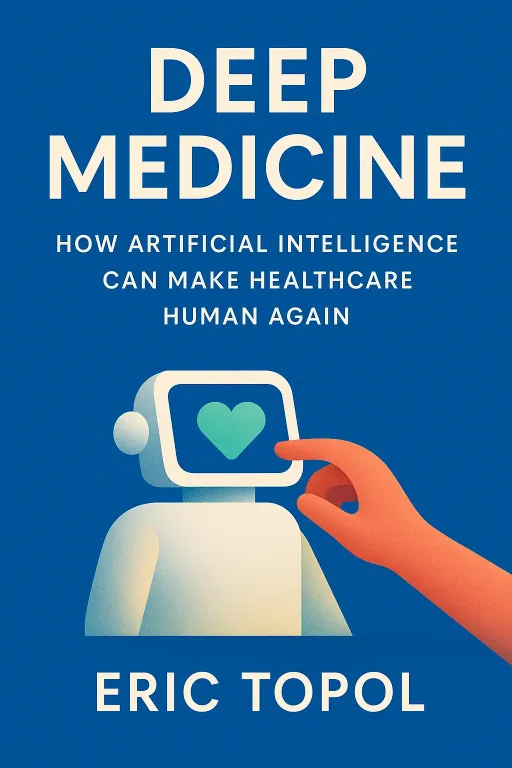
Nova: Absolutely, Atlas! Today, we're dissecting the brilliant insights of Dr. Eric Topol, a renowned cardiologist, geneticist, and one of the most influential voices in digital medicine. He's not just a theoretician; he's spent decades at the bedside and at the forefront of medical innovation. His seminal works, and, offer a unique, deeply human perspective on how technology can truly serve health. His advocacy for patient-centric care has reshaped conversations globally.
Atlas: Okay, so Topol, a working doctor, is saying AI isn't the cold, calculating replacement we fear, but a tool for deeper connection. That's a fascinating reframe, especially for anyone looking to innovate in healthcare. How does that even begin to work?
AI as an Augment for Clinical Empathy and Diagnostic Precision
SECTION
Nova: It begins by understanding that a significant portion of a clinician's day is consumed by mundane, repetitive, and data-heavy tasks. Think about it: sifting through mountains of lab results, imaging scans, electronic health records, genomic data. It's a cognitive overload that often leaves precious little time for genuine human interaction. Topol, in, argues that AI can liberate doctors from this drudgery.
Atlas: I know that feeling. For anyone trying to build solutions, the sheer volume of data can be paralyzing. So, AI handles the "busy work," but where does the "humanity" come in? Is it just about doctors having more free time?
Nova: It's far more profound than just free time, Atlas. While time a factor, the real magic lies in AI's ability to identify patterns invisible to the human eye. Imagine AI analyzing vast datasets – your wearable data, your genomic sequence, every single blood test result, every image – and spotting nascent signs of disease years before conventional methods, or even a highly trained specialist, could.
Atlas: Can you give a concrete example? Like, what kind of patterns are we talking about that a human doctor, no matter how brilliant, would actually miss?
Nova: Absolutely. Consider early-stage cancers. AI algorithms trained on millions of images can detect microscopic anomalies in scans that are easily overlooked by the human eye, even a radiologist's. Or in cardiology, AI can sift through continuous heart rhythm data from wearables to predict an impending arrhythmia or even heart failure with remarkable accuracy, long before symptoms manifest. This isn't just about faster diagnosis; it's about and diagnosis, which is often the difference between treatable and untreatable.
Atlas: That's incredible. So, it's not simply automating what a doctor already does; it's extending their perceptual capabilities, giving them a kind of medical superpower. But for someone innovating in this space, it almost sounds too good to be true. Are there any inherent downsides to this hyper-efficiency? Or ethical considerations we should be aware of, especially when building these solutions where an algorithm might be seeing things a human can't?
Nova: That's a critical question for any innovator, and Topol addresses it head-on. The downside isn't in the AI's capability itself, but in how we implement it. If we design AI to simply replace human judgment, we lose vital nuance. The ethical considerations are paramount: how do we ensure data privacy, algorithmic bias, and maintain accountability? Topol emphasizes that AI should be a, providing insights that augment the doctor's intelligence, allowing them to make more informed decisions. It frees them from the "noise" of data, so they can focus on the "signal" of human suffering, empathy, and personalized care. It allows for deeper, more meaningful conversations because the doctor isn't buried in data entry; they're interpreting the AI's insights and applying their wisdom and compassion.
Patient Empowerment through AI and Digital Health
SECTION
Atlas: That’s a crucial point, Nova, about augmentation rather than replacement. It leads us directly into Topol's second key insight from his other seminal work,: the profound shift in power dynamics towards the patient.
Nova: Exactly. For too long, healthcare has been paternalistic, with the doctor as the sole gatekeeper of information. Topol argues that the digital revolution, fueled by AI and mobile technology, is fundamentally changing this. He envisions a patient-centric world where individuals are empowered with unprecedented control over their own health data and medical decisions.
Atlas: So, how does this actually work? Is it just about having an app that shows your blood pressure, or is it deeper? What does 'control over health data' really mean for someone managing a chronic condition, or even just trying to stay healthy?
Nova: It's far deeper than a simple app. Imagine a comprehensive digital twin of your health: all your genomic data, your microbiome, continuous biometric data from wearables, every lab test, every imaging study, every physician's note – all aggregated and presented in an understandable way, accessible to. AI helps make sense of this deluge of information. It can flag potential issues, suggest personalized preventive measures, or even help you track the efficacy of treatments. This isn't just about passive monitoring; it's about.
Atlas: That sounds revolutionary. It puts the patient at the center, transforming them from a passive recipient of care to an active participant. But what about data privacy? And the digital divide? Not everyone has access to these technologies, or the literacy to understand complex health data. Are we creating new inequalities, even with the best intentions? That's a concern for any architect building these systems.
Nova: Those are absolutely valid concerns, and Topol acknowledges them directly. He's a strong advocate for robust data security and privacy regulations. And the digital divide is a real challenge that requires thoughtful, inclusive design and public health initiatives to bridge. His point is that the potential for personalized, preventive, and equitable medicine is so immense that we address these challenges. The benefits – where individuals can truly partner with their healthcare providers, making informed choices about their own well-being – far outweigh the risks if managed carefully. It's about designing solutions with these ethical and access considerations baked in from the very beginning, ensuring that innovation truly serves.
Atlas: It sounds like it's a tightrope walk – leveraging the power of AI while safeguarding privacy and ensuring equitable access. It's a vision that requires not just technological brilliance, but profound foresight and ethical responsibility.
Synthesis & Takeaways
SECTION
Nova: Precisely. The core message from Topol's work, and our discussion today, is that AI's true power in healthcare lies not in replacing human capabilities, but in augmenting them. It makes doctors more precise and more empathetic, and it empowers patients to be proactive stewards of their own health. It’s about leveraging data to create a healthcare system that is both deeply scientific and deeply human.
Atlas: That’s a powerful synthesis. Thinking about our listeners, especially the innovators and healers out there who are driven to make a tangible difference, what's one immediate challenge they could identify where AI could genuinely bridge that gap between raw data and real patient impact, echoing Topol's vision?
Nova: That's the perfect question, Atlas. My challenge to our listeners is this: identify one specific diagnostic challenge in healthcare that AI could address. Perhaps it's early detection of a particular disease, or better predicting patient response to a specific treatment. Then, outline the specific types of data you would need to begin building a solution. Even a tiny step in that direction can lead to monumental change.
Atlas: I love that. Start small, think big, and always keep the patient at the center. It’s about envisioning real-world impact, not just theoretical advancements.
Nova: Exactly. It's an exciting time to be at the intersection of AI and patient care. The future of medicine is not just intelligent; it's compassionate.
Atlas: What an insightful journey into the future of healthcare.
Nova: Always a pleasure, Atlas.
Nova: This is Aibrary. Congratulations on your growth!