The 'Perfect' Trap: Why Good Enough is Often Better for Agent Engineering.
Golden Hook & Introduction
SECTION
Nova: What if I told you that in the world of cutting-edge Agent engineering, your relentless pursuit of perfection is actually slowing you down, draining your resources, and actively preventing you from creating real value?
Atlas: Whoa, Nova, that's a bold claim right out of the gate! I mean, as engineers, isn't 'perfection' the north star? The ideal we're always striving for, especially when building complex, intelligent systems?
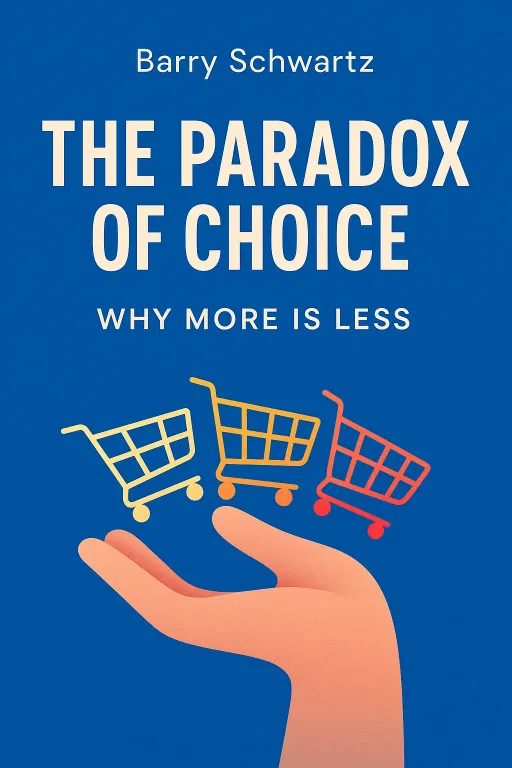
Nova: It absolutely feels that way, doesn't it? It's deeply ingrained. But today, we're diving into this counter-intuitive idea, drawing heavily from the profound insights of two seminal works: Barry Schwartz's "The Paradox of Choice" and Daniel Kahneman's "Thinking, Fast and Slow."
Atlas: Those are big names in psychology and economics. How do they connect to building intelligent agents? It's not immediately obvious.
Nova: Exactly! Schwartz, a renowned psychologist, meticulously dissects how an abundance of options can lead to unhappiness and inaction. He shows how 'maximizers,' those who seek the absolute best, often end up less satisfied than 'satisficers,' who are content with 'good enough.' And Kahneman, a Nobel laureate in Economics, uncovers the deep-seated cognitive biases that often lead us to overcomplicate decisions, pulling us away from simpler, more effective paths. While written for broader audiences, their core arguments provide a startlingly precise lens through which to examine our Agent engineering workflows. The truth is, many of us, especially in demanding fields like Agent engineering, have a blind spot when it comes to perfection.
Golden Hook & Introduction
SECTION
Nova: What if I told you that in the world of cutting-edge Agent engineering, your relentless pursuit of perfection is actually slowing you down, draining your resources, and actively preventing you from creating real value?
Atlas: Whoa, Nova, that's a bold claim right out of the gate! I mean, as engineers, isn't 'perfection' the north star? The ideal we're always striving for, especially when building complex, intelligent systems?
Nova: It absolutely feels that way, doesn't it? It's deeply ingrained. But today, we're diving into this counter-intuitive idea, drawing heavily from the profound insights of two seminal works: Barry Schwartz's "The Paradox of Choice" and Daniel Kahneman's "Thinking, Fast and Slow."
Atlas: Those are big names in psychology and economics. How do they connect to building intelligent agents? It's not immediately obvious.
Nova: Exactly! Schwartz, a renowned psychologist, meticulously dissects how an abundance of options can lead to unhappiness and inaction. He shows how 'maximizers,' those who seek the absolute best, often end up less satisfied than 'satisficers,' who are content with 'good enough.' And Kahneman, a Nobel laureate in Economics, uncovers the deep-seated cognitive biases that often lead us to overcomplicate decisions, pulling us away from simpler, more effective paths. While written for broader audiences, their core arguments provide a startlingly precise lens through which to examine our Agent engineering workflows. The truth is, many of us, especially in demanding fields like Agent engineering, have a blind spot when it comes to perfection.
The Psychological Traps of Perfectionism
SECTION
Atlas: So you're saying that aiming for the absolute best, which sounds like a virtue, can actually be a hindrance? That feels almost heretical in an engineering context.
Nova: It does, doesn't it? But think about Schwartz's "Paradox of Choice." He illustrates this with something as simple as choosing a jam. Give people too many options, and they're less likely to buy any, and if they do, they're less happy with their choice. Maximizers, by constantly searching for the 'perfect' jam, spend more time, energy, and mental anguish, only to often feel regret. They believe there's always a better option just around the corner.
Atlas: I can definitely relate to that when I'm trying to pick a new library or framework. You look at all the options, the benchmarks, the community support, and suddenly an afternoon is gone, and you haven't even written a line of code.
Nova: Precisely. Now, amplify that to designing a sophisticated Agent. You’re not just picking a jam; you’re deciding on architectures, prompt engineering strategies, data pipelines, integration points. Each decision point becomes a potential rabbit hole for maximization. Then, layer on Kahneman's insights from "Thinking, Fast and Slow." Our brains are wired with cognitive biases. We might fall prey to the sunk cost fallacy, pouring more resources into a feature because we've already invested so much, even if the returns are diminishing. Or confirmation bias, where we only seek out information that validates our belief that the tweak will finally make it perfect.
Atlas: Hold on, but in Agent engineering, isn't 'maximization' just good engineering practice? Aren't we supposed to aim for the best, for robust, reliable systems? What if 'good enough' means missing a critical edge case, or a vulnerability that could compromise the entire system? That sounds like a recipe for disaster for the types of robust and scalable systems our listeners are trying to build.
Nova: That's a crucial distinction, Atlas. And it's why we emphasize embrace of 'good enough,' not sloppiness. "Good enough" means meeting a to deliver value, not cutting corners on essential functionality or security. Imagine a team endlessly refining an Agent's prompt for a niche internal task—say, summarizing daily stand-up notes. They spend weeks trying to get it to understand every single nuance, every inside joke, every obscure acronym perfectly. Meanwhile, a competitor ships a functional, 80%-accurate version of a similar agent, captures market share, and starts gathering real-world data to improve. The 'perfect' solution, in this case, became the enemy of the solution.
Atlas: That's a bit like trying to build a rocket that can go to Mars on the first try, when a simple satellite could provide immediate, valuable data from orbit. I get it. The pursuit of perfect can lead to analysis paralysis and delayed launches.
The Psychological Traps of Perfectionism
SECTION
Atlas: So you're saying that aiming for the absolute best, which sounds like a virtue, can actually be a hindrance? That feels almost heretical in an engineering context.
Nova: It does, doesn't it? But think about Schwartz's "Paradox of Choice." He illustrates this with something as simple as choosing a jam. Give people too many options, and they're less likely to buy any, and if they do, they're less happy with their choice. Maximizers, by constantly searching for the 'perfect' jam, spend more time, energy, and mental anguish, only to often feel regret. They believe there's always a better option just around the corner.
Atlas: I can definitely relate to that when I'm trying to pick a new library or framework. You look at all the options, the benchmarks, the community support, and suddenly an afternoon is gone, and you haven't even written a line of code.
Nova: Precisely. Now, amplify that to designing a sophisticated Agent. You’re not just picking a jam; you’re deciding on architectures, prompt engineering strategies, data pipelines, integration points. Each decision point becomes a potential rabbit hole for maximization. Then, layer on Kahneman's insights from "Thinking, Fast and Slow." Our brains are wired with cognitive biases. We might fall prey to the sunk cost fallacy, pouring more resources into a feature because we've already invested so much, even if the returns are diminishing. Or confirmation bias, where we only seek out information that validates our belief that the tweak will finally make it perfect.
Atlas: Hold on, but in Agent engineering, isn't 'maximization' just good engineering practice? Aren't we supposed to aim for the best, for robust, reliable systems? What if 'good enough' means missing a critical edge case, or a vulnerability that could compromise the entire system? That sounds like a recipe for disaster for the types of robust and scalable systems our listeners are trying to build.
Nova: That's a crucial distinction, Atlas. And it's why we emphasize embrace of 'good enough,' not sloppiness. "Good enough" means meeting a to deliver value, not cutting corners on essential functionality or security. Imagine a team endlessly refining an Agent's prompt for a niche internal task—say, summarizing daily stand-up notes. They spend weeks trying to get it to understand every single nuance, every inside joke, every obscure acronym perfectly. Meanwhile, a competitor ships a functional, 80%-accurate version of a similar agent, captures market share, and starts gathering real-world data to improve. The 'perfect' solution, in this case, became the enemy of the solution.
Atlas: That's a bit like trying to build a rocket that can go to Mars on the first try, when a simple satellite could provide immediate, valuable data from orbit. I get it. The pursuit of perfect can lead to analysis paralysis and delayed launches.
The Strategic Embrace of 'Good Enough' in Agent Engineering
SECTION
Nova: Exactly. So, if perfection is a trap, how do we actually our mindset, especially for architects and practitioners driven by creating real business value and not just elegant code? This is where the concept of "satisficing"—a term coined by Herbert Simon, another Nobel laureate—becomes our strategic weapon. It’s about finding a solution that is "good enough" to achieve its purpose, rather than endlessly chasing an elusive "best."
Atlas: Okay, so how does an architect or a full-stack engineer this? What are the practical steps to identify "good enough" rather than just stopping early and leaving a flawed system? Because for me, and I imagine for many of our listeners, the drive to perfect is almost an instinct.
Nova: It absolutely is, and it requires a conscious shift. First, it starts with defining your Minimum Viable Agent, or MVA. What's the smallest, most functional agent that delivers core value? Don't build for every edge case initially. Second, embrace timeboxing and iteration. Set strict deadlines for initial versions, even if they're not 'perfect.' Ship, gather feedback, then iterate. This isn't about being sloppy; it's about informed iteration. Your users provide better data for improvement than any internal thought experiment.
Atlas: So, instead of trying to predict every possible scenario an Agent might encounter, you build a functional core, release it, and let real-world interactions guide the next set of optimizations. That makes a lot of sense for speed, but how does 'good enough' align with building Agent systems? Isn't initial perfection often seen as the foundation for future stability, especially when you're building out an architecture?
Nova: That's an excellent question, and it's a common misconception. Often, what we perceive as 'initial perfection' is actually for problems that might never materialize. By launching a 'good enough' MVA, you quickly learn what needs to be stable and scalable. You get real data on bottlenecks, user patterns, and critical failure modes. This allows you to build targeted, truly stable, and scalable solutions based on empirical evidence, rather than theoretical assumptions.
Atlas: So, instead of building a battleship when you only need a speedboat, you build the speedboat, see where it needs armor, and then reinforce it strategically based on what you learn in the water.
Nova: Exactly! Think of an Agent designed to automate customer support. A 'perfect' approach might try to handle 100% of all possible queries from day one, leading to months of development. A 'good enough' approach might launch an Agent that effectively handles 80% of common queries. This allows the business to immediately realize value, and the engineering team gets invaluable data on the remaining 20% of complex queries. They can then build a targeted, robust, and stable solution for those edge cases, rather than trying to solve for everything upfront and delaying value for months. This strategic 'good enough' delivers more value faster, and often, the resulting system is stable because its evolution is data-driven, not assumption-driven.
The Strategic Embrace of 'Good Enough' in Agent Engineering
SECTION
Nova: Exactly. So, if perfection is a trap, how do we actually our mindset, especially for architects and practitioners driven by creating real business value and not just elegant code? This is where the concept of "satisficing"—a term coined by Herbert Simon, another Nobel laureate—becomes our strategic weapon. It’s about finding a solution that is "good enough" to achieve its purpose, rather than endlessly chasing an elusive "best."
Atlas: Okay, so how does an architect or a full-stack engineer this? What are the practical steps to identify "good enough" rather than just stopping early and leaving a flawed system? Because for me, and I imagine for many of our listeners, the drive to perfect is almost an instinct.
Nova: It absolutely is, and it requires a conscious shift. First, it starts with defining your Minimum Viable Agent, or MVA. What's the smallest, most functional agent that delivers core value? Don't build for every edge case initially. Second, embrace timeboxing and iteration. Set strict deadlines for initial versions, even if they're not 'perfect.' Ship, gather feedback, then iterate. This isn't about being sloppy; it's about informed iteration. Your users provide better data for improvement than any internal thought experiment.
Atlas: So, instead of trying to predict every possible scenario an Agent might encounter, you build a functional core, release it, and let real-world interactions guide the next set of optimizations. That makes a lot of sense for speed, but how does 'good enough' align with building Agent systems? Isn't initial perfection often seen as the foundation for future stability, especially when you're building out an architecture?
Nova: That's an excellent question, and it's a common misconception. Often, what we perceive as 'initial perfection' is actually for problems that might never materialize. By launching a 'good enough' MVA, you quickly learn what needs to be stable and scalable. You get real data on bottlenecks, user patterns, and critical failure modes. This allows you to build targeted, truly stable, and scalable solutions based on empirical evidence, rather than theoretical assumptions.
Atlas: So, instead of building a battleship when you only need a speedboat, you build the speedboat, see where it needs armor, and then reinforce it strategically based on what you learn in the water.
Nova: Exactly! Think of an Agent designed to automate customer support. A 'perfect' approach might try to handle 100% of all possible queries from day one, leading to months of development. A 'good enough' approach might launch an Agent that effectively handles 80% of common queries. This allows the business to immediately realize value, and the engineering team gets invaluable data on the remaining 20% of complex queries. They can then build a targeted, robust, and stable solution for those edge cases, rather than trying to solve for everything upfront and delaying value for months. This strategic 'good enough' delivers more value faster, and often, the resulting system is stable because its evolution is data-driven, not assumption-driven.
Synthesis & Takeaways
SECTION
Atlas: That's actually really profound. It flips the script on what it means to be a high-performing engineer or architect. It's not about endlessly polishing; it's about intelligently delivering.
Nova: Precisely. The "perfect" trap is real, and 'good enough' is not a compromise; it's a strategic weapon for value creation and accelerated progress in the dynamic world of Agent engineering. It allows you to break free from analysis paralysis and actually ship, learn, and innovate.
Atlas: So, for our listeners who are architects, full-stack engineers, and value creators, the deep question from our discussion today is: where in your current Agent engineering workflow are you over-optimizing, and how could a 'good enough' approach accelerate your progress and unlock new breakthroughs?
Nova: It's about recalibrating your standards for impact and speed, not lowering them. It's about understanding that in a rapidly evolving field, a deployed, iterating solution beats a perfectly envisioned, perpetually delayed one every single time.
Atlas: Embracing 'good enough' isn't just about finishing faster; it's about freeing up your intellectual energy to actually and create those breakthrough systems, rather than getting stuck in the weeds of diminishing returns. It's about moving from being a maximizer of effort to a maximizer of impact.
Nova: This is Aibrary. Congratulations on your growth!
Synthesis & Takeaways
SECTION
Atlas: That's actually really profound. It flips the script on what it means to be a high-performing engineer or architect. It's not about endlessly polishing; it's about intelligently delivering.
Nova: Precisely. The "perfect" trap is real, and 'good enough' is not a compromise; it's a strategic weapon for value creation and accelerated progress in the dynamic world of Agent engineering. It allows you to break free from analysis paralysis and actually ship, learn, and innovate.
Atlas: So, for our listeners who are architects, full-stack engineers, and value creators, the deep question from our discussion today is: where in your current Agent engineering workflow are you over-optimizing, and how could a 'good enough' approach accelerate your progress and unlock new breakthroughs?
Nova: It's about recalibrating your standards for impact and speed, not lowering them. It's about understanding that in a rapidly evolving field, a deployed, iterating solution beats a perfectly envisioned, perpetually delayed one every single time.
Atlas: Embracing 'good enough' isn't just about finishing faster; it's about freeing up your intellectual energy to actually and create those breakthrough systems, rather than getting stuck in the weeds of diminishing returns. It's about moving from being a maximizer of effort to a maximizer of impact.
Nova: This is Aibrary. Congratulations on your growth!