The Hidden Cost of Too Much Choice: Why Simplicity Wins in Business
Golden Hook & Introduction
SECTION
Nova: Every business believes more choice equals more sales. It's almost a mantra, isn't it? "Give the customer options!" But what if I told you that very belief is costing you customers, creating decision paralysis, and building a mountain of unnecessary complexity?
Atlas: Hold on. That sounds almost heretical in our consumer-driven world. We're constantly told that variety is the spice of life, and that more options empower us. Are you saying we've been fundamentally misunderstanding customer psychology?
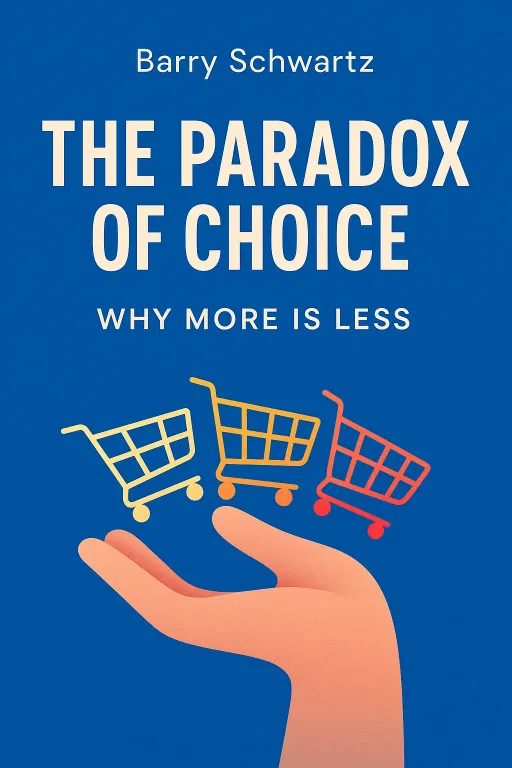
Nova: Absolutely. Today, we're flipping that conventional wisdom on its head as we delve into the insights from two incredibly influential thinkers. First, we're exploring the profound work of American psychologist Barry Schwartz and his seminal book, "The Paradox of Choice." Schwartz, whose TED Talk on this subject has been viewed millions of times, really challenged the economic assumption that more choice always leads to better outcomes.
Atlas: Oh, I like that. A psychologist wading into economics to tell us we're doing it wrong. That has "deep analysis" written all over it. And the second thinker?
Nova: Then we'll bring in Eric Ries, the entrepreneur and author who popularized the 'lean startup' movement. He fundamentally changed how new businesses are built and products are developed by advocating for minimal viable products and validated learning. These two, from different fields, converge on the surprising power of simplicity.
The Paradox of Choice: When More Leads to Less
SECTION
Nova: So, let's start with Schwartz. His core argument is that while some choice is good and essential for well-being, an overwhelming abundance of options can actually lead to decision paralysis, regret, and decreased happiness. It sounds counter-intuitive, doesn't it? We crave freedom, but too much freedom becomes a burden.
Atlas: It’s like being in a massive library with every book ever written, and you just want to find one good story. The sheer volume makes it impossible to even start. But how did Schwartz really prove this? What’s the concrete evidence?
Nova: He's famous for what's become known as the "Jam Study." Imagine a gourmet food store. Researchers set up a tasting booth offering samples of jam. On some days, they displayed 24 different varieties of jam. On other days, they only displayed 6 varieties.
Atlas: Okay, so more jams, more sales, right? That’s what every marketing textbook would tell you.
Nova: Exactly what you'd expect! But here’s the twist: the table with 24 jams attracted more initial interest; more people stopped to look. However, when it came to actually buying, only 3% of those who stopped at the 24-jam table made a purchase. Now, at the 6-jam table, fewer people stopped initially, but a whopping 30% of them actually bought jam!
Atlas: Whoa. That's a tenfold difference in conversion. That's almost unbelievable. So, people were drawn in by the of more choice, but then completely overwhelmed when it came to making a decision.
Nova: Precisely. The sheer cognitive burden of evaluating 24 options, the fear of making the "wrong" choice, the potential for regret – it all conspired to make people walk away empty-handed. They preferred to buy nothing rather than risk choosing sub-optimally. It's not just about jams, either. Think about choosing a mobile phone plan, a streaming service, or even, for our listeners who dissect historical impacts, choosing which specific historical lens to apply to a complex event. The more options you have, the more effort it takes, and the higher the likelihood of decision fatigue.
Atlas: That makes me wonder about the intellectual cost. For a seeker of truth, constantly having to sift through an endless array of information sources, each with its own bias and perspective, can feel like that jam aisle. You’re paralyzed by the sheer volume, wondering if you’re missing the definitive source, or if you’ve chosen the ‘wrong’ interpretation.
Nova: And that's exactly the deeper insight. It's not just consumer goods; it's a fundamental psychological principle. For instance, studies have shown that when employees are offered too many retirement plan options, their participation rates actually drop. The perceived benefit of choice is outweighed by the psychological cost of making a complex decision.
The Power of Simplicity: Lean Principles in Action
SECTION
Nova: So, if too much choice is bad, what's a business to do? This is where Eric Ries and "The Lean Startup" offer a brilliant, practical counterpoint. Ries, coming from the tech startup world, essentially built a methodology around intentionally reducing choices and features.
Atlas: I’m curious. That sounds a bit like going against the grain of typical business growth, which often means adding more features, more services, more... everything. How does simplifying actually lead to growth?
Nova: It's about focusing on what truly matters to the customer, and validating those core assumptions with minimal features first. Ries popularized the concept of a "Minimal Viable Product," or MVP. The idea is to create the simplest possible version of your product that delivers core value, get it into users' hands quickly, and then learn from their actual behavior.
Atlas: Can you give an example? Because it sounds like a recipe for a bare-bones, unappealing product that won't attract anyone.
Nova: Think about the early days of Dropbox. Before they built any complex software, the founder, Drew Houston, created a simple video demonstrating how file synchronization would work. It wasn't a product; it was just a video. But it showed the core value proposition. They put that video on a landing page, and within a day, their beta waiting list exploded from 5,000 to 75,000 people.
Atlas: That's a powerful way to validate demand without building anything yet. They offered one "choice" – sign up for this simple, clear solution – rather than presenting a complex array of features.
Nova: Exactly. They simplified the offering to its absolute essence, allowing users to make an incredibly easy decision: "Yes, I want this simple, clear file synchronization," or "No, I don't." This focus on a core, validated need, rather than building out every possible feature that a customer want, dramatically reduces the complexity for both the business and the customer. Nova's Take on this: Simplifying customer choices can boost engagement and satisfaction, making your product or service more appealing and easier to adopt.
Atlas: So, it's not about being primitive, but being deliberate. It’s about offering clarity instead of confusion. I imagine this applies beyond just startups. What about established companies? For a historian, it feels like a return to some fundamental principles of good craftsmanship, where focus and quality trump sheer quantity.
Nova: Absolutely. Think about Apple, especially in its resurgence under Steve Jobs. They drastically cut down their product lines, focusing on a few core, beautifully designed, and highly functional products. They didn't offer a thousand different computer models; they offered a handful of really good ones. This simplification reduced decision fatigue for consumers and allowed Apple to focus its engineering and marketing efforts, leading to better products and clearer brand identity. It's about understanding that a well-defined, focused offering often feels more premium and more trustworthy than an endless, confusing catalog.
Synthesis & Takeaways
SECTION
Nova: So, what we've discovered today is that the conventional wisdom "more choice equals more sales" is often a mirage. Barry Schwartz shows us the psychological burden of too many options, leading to paralysis and regret. And Eric Ries offers a compelling solution: embracing simplicity, focusing on core value, and making it easier for customers to say "yes."
Atlas: That’s actually really inspiring. It redefines what "value" means in a product or service. It's not just about features, but about the clarity and ease of engagement. For anyone who analyzes complex systems, this idea of intentional reduction to enhance function is profoundly resonant. It echoes principles you see in elegant engineering or even philosophical minimalism.
Nova: It’s a powerful shift in mindset. Instead of asking, "What else can we add?" businesses should be asking, "What can we remove to make this clearer, more impactful, and easier to choose?" The tiny step for listeners today is incredibly simple, yet profoundly effective: look at your product or service offerings. Can you reduce the number of choices by just one or two, making the decision easier for your customers?
Atlas: And I imagine the benefits aren't just for the customer. Simpler offerings often mean simpler operations, less inventory, clearer messaging. It seems like a win-win. Could this lead to more ethical leadership, where companies prioritize the well-being of their customers' cognitive load over simply maximizing options?
Nova: Precisely. It’s about more thoughtful design, more intentional business. When you simplify, you're not just making a product; you're making a better experience, and often, a better business. The profound insight here is that true freedom isn't found in endless choice, but in the clarity that allows us to choose well.
Atlas: That gives me chills. A profound thought for a profound topic. We’d love to hear how you’ve simplified choices in your own life or business. Connect with us on social media and share your insights. We’re always looking for those unique perspectives and intellectual inspirations.
Nova: This is Aibrary. Congratulations on your growth!