The Hidden Cost of Too Much Choice: Why Simplicity Wins in Business
Golden Hook & Introduction
SECTION
Nova: What if I told you that the very thing designed to make you happier—an endless buffet of options—is actually making you miserable? Think about it: every streaming service, every coffee shop menu, every online store. More choice, more anxiety, less satisfaction. It's a modern dilemma.
Atlas: Whoa. That’s a bold claim, Nova. I mean, on the surface, more choice always sounds like freedom, like empowerment. We’re told to give people options, right? This feels… counter-intuitive, especially for anyone trying to build something or offer a service.
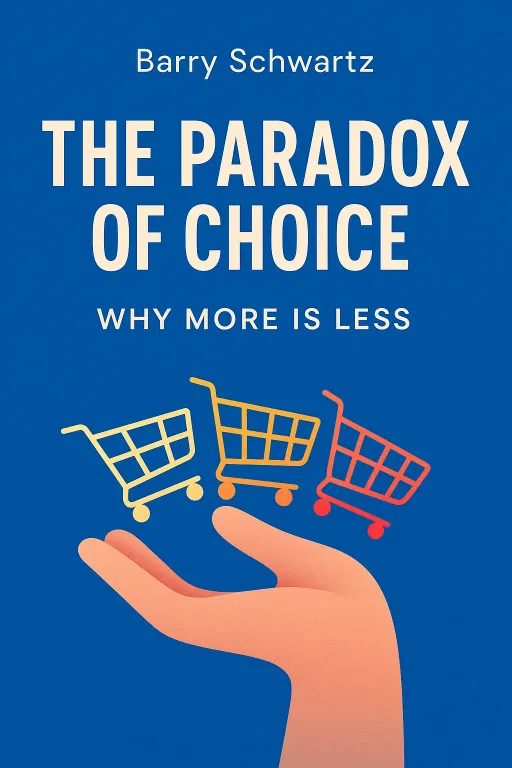
Nova: Exactly, Atlas! And that's precisely what we're dissecting today. We’re diving into a concept made famous by psychologist Barry Schwartz in his groundbreaking book,. Schwartz really challenged decades of consumer wisdom, showing us why abundant options can actually be detrimental. And then, we'll see how Eric Ries, with his methodology, offers a powerful, practical antidote to this modern predicament.
Atlas: Okay, so Schwartz tells us too much choice is bad, and Ries gives us a way to it? But how can something as seemingly positive as more options truly be a problem? For listeners who are constantly seeking depth and understanding, this sounds like stripping away the nuance.
The Paradox of Choice: Why More Options Lead to Less Satisfaction
SECTION
Nova: It’s a fantastic question, and it gets right to the heart of the "Paradox of Choice." Schwartz argues that while some choice is good, an overwhelming abundance of options leads to three main problems: decision paralysis, regret and anticipated regret, and decreased satisfaction. People become so overwhelmed by the sheer volume that they can't make a decision at all, or they make one and then immediately regret it, wondering if they chose the 'best' option.
Atlas: Oh, I know that feeling! Like standing in the cereal aisle for ten minutes and still walking away with nothing, or picking a movie on a streaming service and spending more time browsing than watching. That resonates.
Nova: Absolutely. It's a universal experience. But Schwartz wasn't just theorizing. He and his colleagues conducted fascinating experiments to prove this. One of the most famous is the jam study.
Atlas: The jam study? Tell me more.
Nova: So, picture this: a high-end grocery store. Researchers set up two tasting booths for exotic jams. One booth offered 24 different varieties of jam. The other, only 6. Now, logically, you’d expect the booth with 24 jams to be more popular and lead to more sales, right? More options, more appeal.
Atlas: Right? That's what every business strategy textbook would preach. More variety, cast a wider net.
Nova: Precisely. And initially, the 24-jam booth attract more interest. About 60% of shoppers stopped by. But here's the kicker: only 3% of those people actually made a purchase. Now, at the booth with only 6 jams? Fewer people stopped, about 40%, but a staggering 30% of them actually bought jam.
Atlas: Whoa. That's a huge difference! So, more interest, but significantly less conversion. It’s like window shopping versus actually buying.
Nova: Exactly. The cause was clear: too many options overwhelmed customers. The process involved shoppers at the 24-jam table feeling the immense pressure of choosing the 'perfect' jam from a seemingly endless array. They overthought it, worried about making the 'wrong' choice, and eventually, many just gave up, abandoning the decision altogether.
Atlas: That sounds rough. So the outcome wasn't just less sales, it was higher customer anxiety, and probably a feeling of "I just wasted my time" for those who walked away empty-handed. But wait, how does this apply to someone in, say, a high-stakes tech environment trying to pick a new software solution, where every feature feels critical and the stakes are much higher than jam? It's not just about preference there, it's about functionality.
Nova: That's a brilliant point, Atlas. Because the psychological impact scales. In your tech example, the increased expectations become immense. If you pick software with 100 features, and only use 20, you might feel like you made a bad choice, or you're missing out on the other 80. The self-blame if the choice isn't perfect, the constant nagging feeling of 'what if I'd picked the other one?'—that’s the regret. And the opportunity cost of rejected options, all those other software packages you choose, looms large. It’s not just about the jam; it's about the cognitive load and the emotional toll.
The Lean Approach to Simplicity: Focusing on What Truly Matters
SECTION
Nova: If the "Paradox of Choice" tells us what to do, then Eric Ries's gives us a powerful framework for what. Ries, coming from the tech world, championed the idea of the "minimal viable product," or MVP, and validated learning. His approach is all about reducing the initial choices presented to users by focusing on what truly matters.
Atlas: So, the "lean" approach isn't just about being cheap or cutting corners, it's about being smart with choice, right? For a seeker of truth, this sounds like stripping away the noise to find the essence. But how does a business, or even an individual, figure out what those 'minimal features' are without guessing?
Nova: You've hit on it perfectly. It's not about being cheap; it's about being efficient and customer-centric. Ries emphasizes validating your core assumptions with the absolute minimal set of features required to deliver value and learn from real users. A classic example of this is how Dropbox, the file-sharing service, initially launched.
Atlas: Dropbox? They’re huge now. How did they start lean?
Nova: Well, before they had a fully functional product, before they even wrote much code, founder Drew Houston had a problem: demonstrating seamless file synchronization was incredibly difficult. Building a full beta would take months, maybe years, and a huge investment. So, he didn't.
Atlas: He didn't build it? What did he do?
Nova: He made a video. A simple, three-minute video demonstrating exactly how Dropbox work. It showed the core functionality: files seamlessly syncing across devices. The cause was simple: Houston wanted to validate the need for his idea without spending years building a complete, complex product.
Atlas: That’s brilliant. So the video, rather than a fully functional but complex beta, clearly communicated the single, most important benefit.
Nova: Exactly. The process was that this video, a prototype of the user experience, allowed them to gauge interest and collect sign-ups for a product that barely existed yet. The outcome? Massive sign-ups overnight, proving market demand for a simplified solution to a common problem. It completely avoided the trap of building too many features nobody wanted, which, ironically, would have added too many choices for early adopters and potentially killed the product before it even launched.
Atlas: That makes me wonder, how would a business or a leader today identify that 'minimal' core offering? It seems like it takes a lot of discipline to add more.
Nova: It absolutely does, Atlas. It's about identifying the absolute core problem you're solving for your customer and delivering just enough to solve that, then iterating based on real user feedback. It’s about reducing the initial cognitive load on the user and, frankly, the development load on the creator. My take is that simplifying customer choices like this boosts engagement and satisfaction, making your product or service more appealing and easier to adopt. It respects the customer's time and attention.
Synthesis & Takeaways
SECTION
Nova: So, it's a powerful combination: recognizing the danger of too much choice, and then proactively designing for simplicity using lean principles. It’s about understanding human psychology and then building with intention.
Atlas: So, we're not just talking about less choice for the sake of it, right? It's about respecting the customer's cognitive bandwidth and delivering clarity. It's about leadership that prioritizes impact over abundance. This really makes me reflect on how historical decision-making might have been influenced by either too many options or the clarity of a lean approach.
Nova: Precisely, Atlas. It's about recognizing that clarity is a gift, and simplicity is a competitive advantage. The "Tiny Step" we can all take from this is to look at your product or service offerings, or even your own daily routines. Can you reduce the number of choices by one or two, making the decision easier for your customers or yourself? It’s often the hardest thing to do, but the most rewarding.
Atlas: And perhaps, beyond business, where in our own lives are we paralyzed by too many options, and what could we gain by simplifying? That’s a profound thought.
Nova: Indeed. It's a journey from overwhelming options to empowering clarity.
Atlas: This is Aibrary. Congratulations on your growth!