The 'Decision Fatigue' Trap: Why More Choices Lead to Worse Outcomes
Golden Hook & Introduction
SECTION
Nova: What if the biggest obstacle to your brilliant strategic thinking isn't a lack of options, but having too many of them?
Atlas: Hold on, Nova. That sounds almost heretical to anyone who prides themselves on comprehensive analysis. Isn't more information, more choice, always better for making a truly impactful decision?
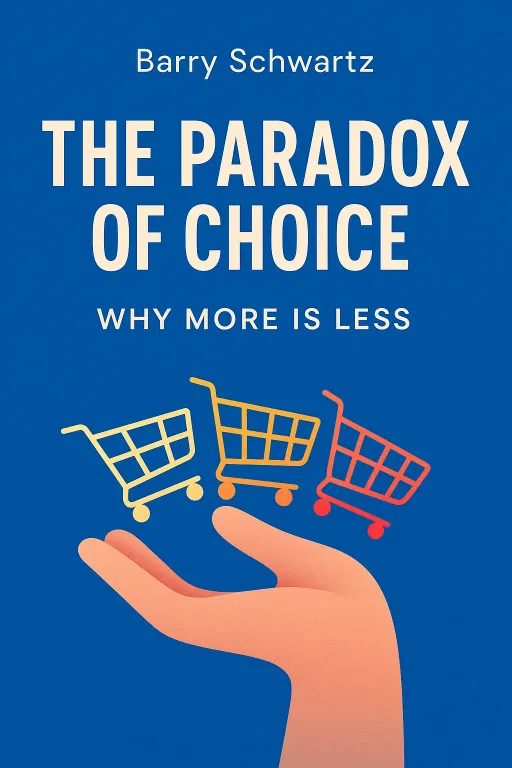
Nova: That's precisely the paradox we're unraveling today, Atlas. We're diving into a concept that challenges that very assumption, drawing heavily from two groundbreaking works: Barry Schwartz's seminal book, "The Paradox of Choice," and the hugely influential "Nudge" by Nobel laureate Richard H. Thaler and Cass R. Sunstein.
Atlas: Oh, I've heard of "Nudge." Thaler's work in behavioral economics really shifted perspectives on how we make decisions, and "The Paradox of Choice" became a cultural touchstone, sparking conversations far beyond academia, influencing everything from product design to public policy. It truly changed how we think about choice itself.
Nova: Absolutely. And when you realize how profoundly choice impacts our cognitive energy, you start to see how streamlining decisions isn't just about efficiency; it's about preserving your analytical power for where it truly matters. Today, we're going to explore why having too many options often leads to worse outcomes, and then we'll discuss tactical insights from behavioral science on how to simplify our decision-making and focus our analytical power.
The Paradox of Choice: Why More Leads to Less
SECTION
Atlas: So you're saying that my meticulously curated list of 20 potential software solutions might actually be working against me? That’s a tough pill to swallow for someone who values a thorough, systematic approach.
Nova: It’s a completely counterintuitive truth, isn't it? Barry Schwartz, a psychologist, meticulously laid out this argument in "The Paradox of Choice." He observed that while we crave freedom and believe more options equate to more freedom and better outcomes, the opposite often holds true. Instead, we experience something called "decision fatigue" or "choice overload."
Atlas: Decision fatigue. I know that feeling. It’s like mentally hitting a wall after a day of back-to-back meetings, each requiring a high-stakes choice. But what's the psychological mechanism behind it? Why do abundant options become a burden rather than a blessing?
Nova: Well, it's multifaceted. One key aspect is the sheer cognitive load. Every additional option requires processing, comparison, and evaluation. This drains our mental energy. Another significant factor is the increase in "opportunity cost." When you choose one thing out of many, you're acutely aware of all the good things you're choosing. This leads to higher expectations, greater regret, and ultimately, less satisfaction with the choice you make.
Atlas: That makes sense. It’s not just about the decision itself, but the lingering "what ifs" and the feeling that you might have missed out on something better.
Nova: Exactly. And Schwartz illustrates this beautifully with his famous "jam experiment." Imagine a gourmet food store. In one scenario, researchers set up a display with 24 different kinds of jam. In another, they offered only 6 kinds. Now, which display do you think attracted more attention?
Atlas: Logic would suggest the 24-jam display. More options, more interest, right?
Nova: You'd think so, and initially, more people stop at the larger display. But here's the kicker: when it came to actually making a purchase, customers who saw the 6-jam display were ten times more likely to buy jam than those who saw the 24-jam display. Ten times!
Atlas: Wow. That's a staggering difference. So, the sheer volume of choice, even for something as pleasant as jam, led to paralysis. It prevented action.
Nova: Precisely. The cause was the overwhelming number of options. The process was cognitive overload, the fear of making the "wrong" choice, and the perceived opportunity cost of all the delicious jams not chosen. The outcome? Decision paralysis and significantly lower sales. It’s a powerful illustration of how too much of a good thing can become detrimental.
Atlas: I can definitely relate that to strategic planning. When you’re faced with an infinite number of potential paths, each with its own merits and risks, the process of even to commit can be paralyzing. It feels like you need to analyze every single permutation to ensure optimal impact.
Nova: And that's where the deep thinker, the analytical architect, can be particularly susceptible. Your drive for precision and optimal outcomes can actually trap you in this cycle of endless evaluation, ultimately leading to less optimal decisions or, worse, no decision at all. It saps the energy you need for execution and innovation.
Nudging Towards Clarity: Tactics for Simplified Decision-Making
SECTION
Nova: So, if the problem is clear – too many choices lead to bad outcomes – the natural next question is, how do we escape this trap? How do we simplify without feeling like we’re losing control or making less informed decisions?
Atlas: I'm curious. For someone who thrives on structured solutions and systematic approaches, how do we design our way out of this? It sounds like we need some tactical insights.
Nova: That's where "Nudge" comes into play. Thaler and Sunstein explore how subtle interventions, or "nudges," can guide people towards better decisions without restricting their freedom of choice. It's about designing the environment, the "choice architecture," in a way that makes the optimal path the easiest path.
Atlas: Okay, so it’s not about removing options entirely, but about making certain options more prominent or easier to access. Can you give an example of how this plays out in the real world?
Nova: Absolutely. One of the most compelling examples revolves around retirement savings. In many companies, employees traditionally had to actively "opt-in" to their 401 plans. This meant filling out forms, making decisions about contribution percentages, and choosing investment vehicles. Despite the obvious benefits, participation rates were often low.
Atlas: I imagine the cognitive load of all those choices, plus the inertia of not doing anything, would be a huge barrier.
Nova: Exactly. So, what Thaler and Sunstein proposed, and what many companies implemented, was a simple "nudge": they changed the default. Instead of opting, employees were automatically enrolled into the 401 unless they actively chose to.
Atlas: Oh, I see! So the cause was a change in the default setting. The process leveraged human inertia and the tendency to stick with the path of least resistance. And the outcome?
Nova: Dramatically increased participation rates in retirement savings. This subtle change, this "nudge," significantly improved people's financial well-being without forcing them or taking away their choice to opt-out. It’s not about coercion; it's about making the desired behavior the default.
Atlas: That’s a perfect example of how small, clever design choices can have a massive impact. For us analytical architects, the question becomes: how do we apply this to ourselves? How do we "nudge" our own decision-making processes to streamline and focus our energy?
Nova: That’s the real strategic insight here. First, you can consciously limit your options. Our "Tiny Step" for today is to identify one recurring decision where you feel overwhelmed by options and consciously limit your choices to three before making a selection. This isn't about arbitrary restriction; it's about forcing creative constraint.
Atlas: So, if I'm trying to decide on a new project management tool, instead of researching 15, I'd force myself to narrow it down to three strong contenders from the outset? That makes sense. It focuses the analytical power on comparing truly viable options, rather than sifting through endless possibilities.
Nova: Precisely. You're designing your own choice architecture. Another way is to create "decision defaults" for yourself. For instance, for routine decisions, establish a rule: "Unless there's a compelling reason otherwise, I will always choose X." This frees up mental bandwidth for the novel, high-impact decisions that truly require your deep analytical skills. It's about being intentional with your cognitive energy.
Atlas: I like that. It’s about being precise with our focus. By systematizing the minor decisions, we can truly bring our full intellectual capacity to bear on the challenges that will create the most tangible impact. It’s not about being less thorough; it’s about being strategically thorough.
Synthesis & Takeaways
SECTION
Nova: So, what we've uncovered today is that while we often equate more choice with more freedom and better outcomes, the reality is often the opposite. The paradox of choice leads to decision fatigue, regret, and paralysis.
Atlas: And the antidote isn't to eliminate choice, but to become a better "choice architect." By understanding how nudges work, we can design our environments and our processes to simplify decisions, both for ourselves and for others.
Nova: Absolutely. It’s about leveraging our deep thinking not just to analyze options, but to analyze. It's a meta-level strategic move that conserves your most valuable resource: your cognitive energy. Think of it as energy management for your brain. By streamlining the minor, recurring decisions, you're preserving your capacity for the truly innovative, impactful choices that define your growth and leadership.
Atlas: That’s a powerful reframing. It shifts decision-making from a draining chore to an empowering act of strategic resource allocation. So, for our listeners who are aiming to make a significant impact, the tiny step is clear: identify one recurring decision where you feel overwhelmed, and for the next week, limit your options to just three. See how that changes your experience.
Nova: And reflect on how this small change allows you to direct your analytical power more effectively. It’s not about less thinking; it’s about smarter, more focused thinking.
Atlas: It’s about choosing wisely, even when it comes to choosing how many choices you consider.
Nova: This is Aibrary. Congratulations on your growth!