Unlocking Your Brain's Full Potential: The Cognitive Science of Breakthrough Thinking
Golden Hook & Introduction
SECTION
Nova: Atlas, I was reading this article the other day, and it talked about how the average person makes something like 35,000 decisions a day. Thirty-five!
Atlas: Whoa, Nova, that's a number designed to induce immediate decision fatigue. My System 1 brain is already screaming 'Too many choices!'.
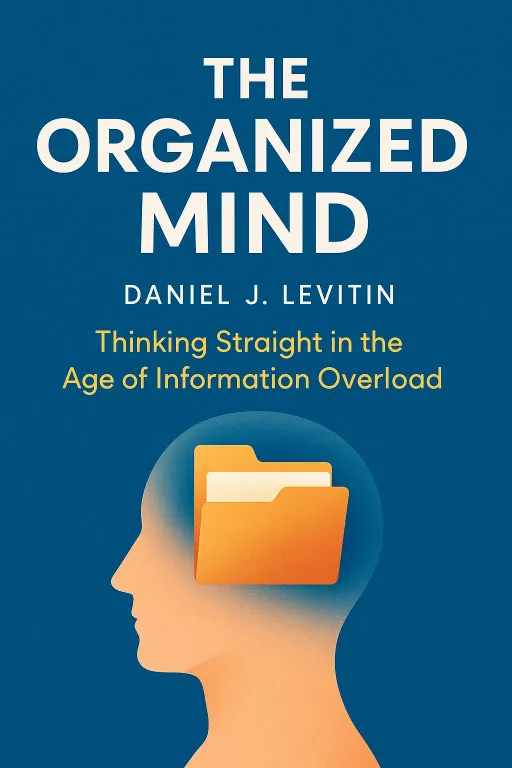
Nova: Exactly! It makes you wonder how many of those decisions are actually, you know, decisions. And that's what we're diving into today with two incredible minds: Daniel Kahneman, author of “Thinking, Fast and Slow,” and Daniel J. Levitin, who penned “The Organized Mind.” Kahneman, a Nobel laureate in Economic Sciences, completely revolutionized our understanding of how we make choices, essentially creating the field of behavioral economics. It's fascinating how his work, often done in collaboration with Amos Tversky, challenged the very foundations of rational choice theory.
Atlas: So, we're talking about the secret architecture of our minds, and how to hack it. I'm already in.
The Brain's Operating Systems: System 1 vs. System 2
SECTION
Nova: Absolutely. And the first big idea, the one that really sets the stage, comes from Kahneman: the concept of System 1 and System 2 thinking.
Atlas: Okay, System 1 and System 2. Can you break that down for us? Because it sounds like my brain has multiple personalities, and I'm not entirely sure which one's driving.
Nova: Well, in a way, it does! Think of System 1 as your intuition, your gut reaction. It’s fast, automatic, effortless, associative, and often emotional. It operates constantly, making quick judgments. Like when you see a scary face, you instantly feel fear. You don't have to think about it. Or when you read the word 'cat,' you immediately think of a furry animal.
Atlas: So, it’s the brain's autopilot. The one that handles all the routine stuff without me having to consciously engage? Like driving a familiar route, or tying my shoes.
Nova: Precisely. It’s incredibly efficient, and it’s what allows us to navigate the world without being overwhelmed by every single stimulus. But, and here’s the rub, it’s also prone to biases and can jump to conclusions. It’s excellent at pattern recognition, but not so great at complex logic.
Atlas: Okay, so if System 1 is the fast, intuitive autopilot, then System 2 must be... the slow, deliberate co-pilot? The one I call in for parallel parking or calculating a tip.
Nova: That’s a fantastic analogy! System 2 is slow, effortful, logical, calculating, and conscious. It’s what you use for complex mental activities: solving a math problem, learning a new language, or comparing two different investment strategies. It requires attention, and it’s easily fatigued.
Atlas: So, when I’m trying to decide if I should buy the expensive organic kale or the regular kale, and I’m weighing the nutritional benefits against the cost, that’s my System 2 kicking in. It’s a lot more work.
Nova: Exactly. And the profound insight here is that we tend to overuse System 1, even for decisions that would benefit from System 2. Kahneman illustrates this with fascinating experiments. One classic example is the 'bat and ball' problem.
Atlas: Oh, I think I know this one! A bat and a ball cost $1.10 in total. The bat costs $1.00 more than the ball. How much does the ball cost?
Nova: Go on, what's your System 1 answer?
Atlas: Uh… ten cents? My brain just immediately went there. It felt so obvious.
Nova: And that's your System 1 speaking! It's intuitive, but it's wrong. If the ball cost ten cents, and the bat cost a dollar more, the bat would be $1.10. Their total would be $1.20.
Atlas: Oh, wait! So, if the bat is $1.00 more than the ball... and the total is $1.10... the ball must be five cents, and the bat is $1.05. Five cents plus $1.05 equals $1.10. Wow. My brain genuinely fought against that. It felt like I had to override an automatic response.
Nova: That's the power of Kahneman's work. It highlights how frequently our intuitive System 1 provides a plausible but incorrect answer, and how much mental effort it takes for System 2 to step in and correct it. For many, System 2 doesn't even get engaged.
Atlas: It’s like my brain has a default setting, and it’s not always the most accurate one. It makes me wonder about all the daily decisions I make on autopilot. Like, choosing the fastest route to work versus the one with less traffic but maybe a few extra turns – am I thinking System 1 or System 2 there?
Nova: A great question, and it probably depends on the day! If you’re rushing and stressed, definitely System 1. But if you're taking the time to check traffic apps and consider alternative roads, that’s System 2. The key is recognizing when a situation warrants that extra cognitive effort. It’s about being deliberate.
Managing Cognitive Overload & Enhancing Focus
SECTION
Nova: And that idea of being deliberate perfectly bridges us to our second big concept, from Daniel Levitin's “The Organized Mind.” If Kahneman shows us we think, Levitin offers strategies for we think about, and how to manage the sheer volume of it.
Atlas: Ah, the modern dilemma. Information overload. My brain often feels like a browser with 50 tabs open, all playing music at once. How does Levitin suggest we close some of those tabs, or at least mute them?
Nova: He argues that our brains are not designed for the constant barrage of information we face today. Our attentional systems evolved to deal with immediate threats and opportunities, not an endless stream of emails, notifications, and social media feeds. The result is cognitive overload, which diminishes our ability to focus, make good decisions, and even be creative.
Atlas: So, it's not just that I'm bad at multitasking; it's that my brain literally isn't built for it. That's actually kind of liberating to hear.
Nova: Precisely. Levitin emphasizes that our brains are fantastic at pattern recognition and categorization, but they have severe limitations on how much information they can actively process at once. He refers to our working memory as a 'bottleneck.' When that bottleneck gets jammed, our performance suffers significantly.
Atlas: So, what's the solution? Do we all just move to a cabin in the woods and throw our phones in a lake? Because that sounds like System 1 thinking to solve a System 2 problem.
Nova: A tempting System 1 solution, for sure! But Levitin offers more practical, nuanced strategies. One of his core ideas is to 'offload' information from our brains. He advocates for externalizing memory and decision-making where possible.
Atlas: Offloading? You mean like writing things down? Or using a calendar? That sounds almost too simple.
Nova: It sounds simple, but it’s incredibly powerful. Think about the mental energy you expend trying to remember a long to-do list, or a string of appointments, or even where you put your keys. Each of those bits of information takes up precious working memory. By writing them down, or using a reliable system like a calendar or a dedicated notebook, you free up that mental space. You're essentially telling your brain, 'You don't need to hold onto this; it's safely stored elsewhere.'
Atlas: So, it's about building a trusted external system so your brain doesn't have to be a filing cabinet. That makes sense. It's like my computer: if I have too many programs open, it slows down. But if I save files to an external hard drive, it runs faster.
Nova: Exactly! He also talks about creating 'designated places' for things, both physical and mental. This reduces the cognitive load of searching. If your keys always go in the same bowl, you don't have to expend mental energy trying to remember where you left them. Similarly, having a dedicated time and place for checking emails or doing deep work can dramatically improve focus.
Atlas: I love that. It’s about designing your environment to support your brain, rather than constantly fighting against it. So, for our curious learners out there, people who love diving deep into new knowledge, how can they apply these ideas to really foster breakthrough thinking? Because that's what we're all after, right?
Nova: That's the ultimate goal. By consciously engaging System 2 for important decisions, and by offloading information and creating organized environments, we free up cognitive resources. This isn't just about efficiency; it's about creating the mental space for genuine creativity, problem-solving, and those 'aha!' moments. It’s about being able to connect disparate ideas, to see patterns that others miss, because your brain isn't bogged down by mental clutter.
Atlas: So, it’s not just about managing tasks, it’s about creating the conditions for deeper, more profound thoughts. It's about giving your brain the quiet it needs to actually, not just react.
Synthesis & Takeaways
SECTION
Nova: Precisely. The synergy between Kahneman and Levitin is profound. Kahneman teaches us to be aware of our cognitive biases and the power of System 1, urging us to slow down and engage System 2 when it truly matters. And Levitin provides the toolkit to make that slowing down possible, by decluttering our mental landscape and creating systems that support our brain’s natural strengths.
Atlas: So, the big takeaway is that unlocking our brain's full potential isn't about working harder or faster, it's about working smarter with our inherent cognitive architecture. It's about choosing when to engage the deep thinker within us, and giving it the space to do its best work.
Nova: Absolutely. It's about mindful cognition. It's about understanding that our brains are incredibly powerful, but they need our help to perform at their peak in this hyper-connected world. It’s about recognizing that a deliberate pause, a moment of reflection, can be the most productive thing you do all day.
Atlas: That’s actually really inspiring. It means we have more control over our thinking than we might realize, just by understanding these simple yet powerful principles.
Nova: And that brings us to our deep question for our listeners today: What is one area of your daily routine where you could apply a more deliberate, System 2 approach to improve a decision or task? Think about it. Where could you slow down, offload some mental clutter, and truly engage that thoughtful part of your mind?
Atlas: I’m definitely going to be thinking about that. For me, it's probably my morning routine – trying to cram too much in, relying on System 1, and ending up forgetting something crucial. Time to bring in System 2.
Nova: It’s a journey, not a destination. But understanding these concepts is the first, crucial step.
Atlas: I love that. And for everyone listening, we encourage you to share your thoughts on that question with us. We'd love to hear how you're planning to engage your System 2 more deliberately.
Nova: This is Aibrary. Congratulations on your growth!