The 'Innovation Illusion' Trap: Why True Breakthroughs Come from Deep Work, Not Brainstorms.
Golden Hook & Introduction
SECTION
Nova: If you think constant team meetings, buzzing Slack channels, and endless brainstorming sessions are the secret to innovation, you've probably fallen for one of the biggest productivity cons of our digital age.
Atlas: Whoa, a productivity con? Are you saying my daily stand-ups are actually... sabotaging us?
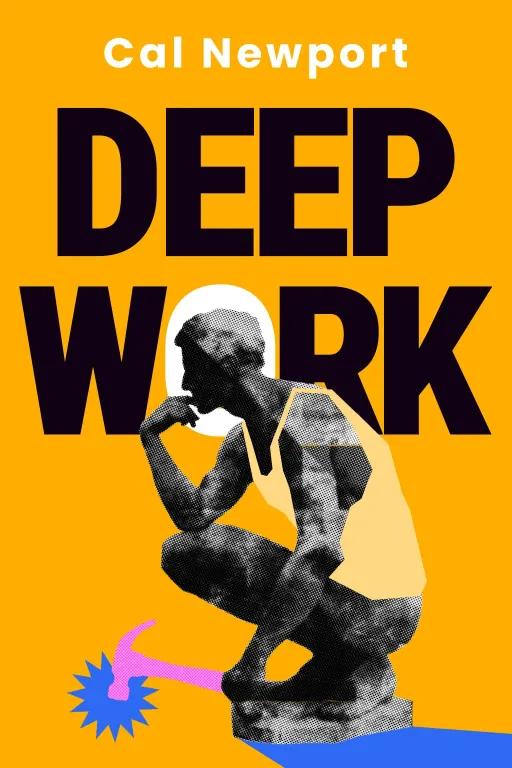
Nova: Exactly, Atlas! And that's precisely the provocative core of what we're dissecting today, drawing heavily from the insights of Cal Newport's seminal work, 'Deep Work,' and Daniel J. Levitin's brilliant exploration of cognitive management in 'The Organized Mind.' What's fascinating about Newport is his own background as a computer science professor who published several successful books using social media – a living embodiment of his own principles.
Atlas: That's incredible. He practices what he preaches. But how does that connect to this "innovation illusion" you're talking about? Because, honestly, most of us believe more communication equals better ideas, right?
The 'Innovation Illusion' and the Case for Deep Work
SECTION
Nova: We do, and that's the illusion. In our always-on world, we've come to mistake constant communication, rapid-fire responses, and an endless stream of digital notifications for actual productivity and innovation. But Newport argues that true breakthroughs, the kind that genuinely move the needle, don't come from these superficial activities. They come from what he calls 'deep work.'
Atlas: Okay, 'deep work.' What exactly does that mean? Because for a lot of people, their work deep, but it's constantly interrupted.
Nova: That's the key distinction. Deep work is the ability to focus without distraction on a cognitively demanding task. It's the kind of work that pushes your cognitive capabilities to their limit, creating new value, improving your skill, and is difficult to replicate. It's not just about being busy; it's about being intensely, singularly focused.
Atlas: So, it's not just about shutting your office door, it's about shutting down else in your brain too?
Nova: Precisely. Think about Bill Gates' famous 'Think Weeks.' He would retreat to a remote cabin, completely cut off from the outside world – no emails, no phone calls, no meetings. Just him, a stack of books and papers, and his thoughts.
Atlas: You're kidding. Bill Gates, the founder of Microsoft, just... disappeared into a cabin?
Nova: Absolutely. And during those weeks, he would engage in intense, uninterrupted deep work, leading to major strategic shifts for Microsoft, like the company's embrace of the internet. He understood that to solve truly complex problems or envision future directions, he needed to intentionally remove all distractions and dedicate himself to sustained, high-level cognitive effort.
Atlas: But wait, looking at this from a strategic leadership perspective, aren't we supposed to be fostering collaboration, cross-functional teams, and agile communication? How do you balance that with this idea of isolation? It sounds almost anti-teamwork.
Nova: That's a great point, and it's a common misconception. Deep work isn't anti-collaboration; it's about recognizing that there's a time and place for different types of work. Collaboration is vital, but the insights and solutions you bring to those collaborative sessions are significantly enhanced if they're born from periods of deep, individual thought, not just off-the-cuff brainstorming. When you show up to a meeting with fully formed, well-researched ideas, that's far more impactful than just throwing around half-baked thoughts.
Atlas: I guess that makes sense. It's about elevating the quality of your individual contribution so that your collaborative efforts are more fruitful. It's not about being a lone wolf, but a highly effective, focused wolf when it counts.
Architecting Your Environment for Sustained Focus
SECTION
Nova: Exactly! And speaking of creating those focused pockets, that brings us beautifully to Daniel J. Levitin's work in 'The Organized Mind,' which is all about understanding how our brains actually function under pressure and how we can design our world to support that focus.
Atlas: Okay, so it's not just willpower then? Because I feel like I'm constantly fighting my own brain to stay focused.
Nova: You're not alone! Levitin explains that our brains are phenomenal at pattern recognition and creative synthesis, but they are absolutely terrible at constant task-switching. Every time you switch tasks—even just checking an email or a notification—your brain experiences what researchers call "attention residue."
Atlas: Attention residue? That sounds like something you'd find at the bottom of a coffee cup.
Nova: It's a perfect analogy! It means a portion of your attention remains stuck on the previous task, even when you've moved on to a new one. It's like leaving a little bit of your cognitive processing power behind. So, if you're constantly bombarded with notifications or jumping between projects, you're never giving your full cognitive capacity to single task. Organizations, often unintentionally, foster this with constant notifications, open-plan offices, and the expectation of immediate responses.
Atlas: Wow. So my brain isn't a supercomputer for multitasking; it's more like a single-core processor that keeps getting interrupted. That's a huge shift in perspective. So, what's a tiny, actionable step for a team leader or an individual achiever to start building this 'attention-friendly' environment? My inbox is a warzone, Nova.
Nova: That's a relatable image! The tiny step, and it's backed by both Newport and Levitin, is to schedule a 'deep work block.' It could be just 90 minutes. During that time, turn off all notifications – literally, put your phone in another room or on airplane mode. Close all unnecessary tabs.
Atlas: Just 90 minutes? That feels doable. But what about the fear of missing out? Or the expectation from my team that I'm always available?
Nova: That's where the 'architecting' comes in. You communicate these blocks to your team. You set expectations. It's not about being unavailable; it's about being strategically unavailable for focused bursts, so you can deliver higher quality output when you available. Imagine if everyone on your team had even just one 90-minute block of truly uninterrupted, focused time. The collective impact on innovation would be immense. It's not about demanding deep work without support; it's about creating a culture that values and protects those cognitive resources.
Synthesis & Takeaways
SECTION
Nova: Ultimately, both Newport and Levitin are telling us that deep work isn't just a productivity hack; it's a fundamental shift in how we approach intellectual contribution. It's about being deliberate. It's about making conscious choices to protect our most valuable cognitive resource – our attention – from the constant onslaught of superficial demands.
Atlas: So, ultimately, this isn't just about getting more done, it's about doing work, the kind that actually moves the needle and creates meaningful impact. It makes me wonder, how many brilliant ideas have been lost to the tyranny of the urgent?
Nova: Too many, I'm sure. But the good news is we can reclaim that. So, here's our tiny step for you this week: Schedule a 90-minute 'deep work' block for yourself, free from meetings and notifications. Just try it. Observe the quality of your output. See what magic happens when you give your brain the space it truly needs to innovate.
Atlas: I'm in. I'm going to commit to that. And we'd love to hear how that goes for you. Share your insights and challenges with us. What's one distraction you're committing to banishing for your deep work session?
Nova: This is Aibrary. Congratulations on your growth!