The 'Productivity Paradox': Why More Effort Doesn't Always Mean More Results.
Golden Hook & Introduction
SECTION
Nova: What if I told you that working harder, longer, and faster isn't just ineffective, but actively sabotaging your ability to achieve anything truly meaningful?
Atlas: Whoa. That's a bold claim, especially in a world that constantly glorifies the grind and the hustle. I imagine a lot of our listeners, who are driving big projects and leading teams, probably feel like working harder is the only way forward.
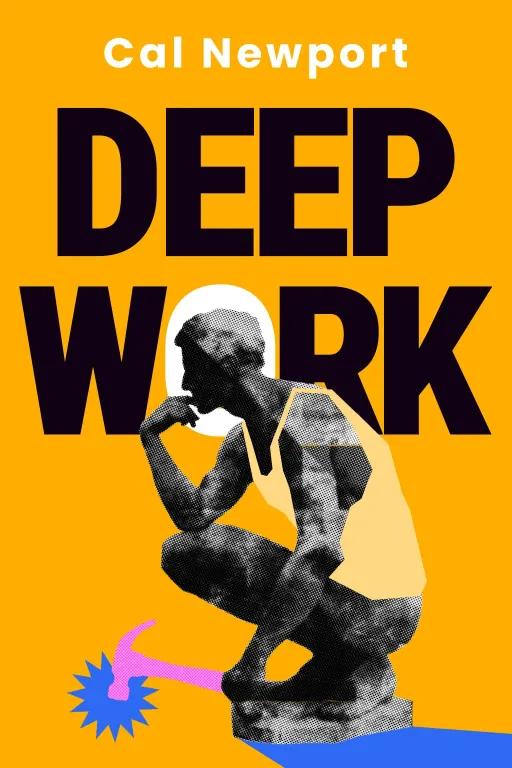
Nova: It’s the prevailing myth, isn't it? But today, we're cracking open the pages of by Cal Newport to challenge that very notion. And what's fascinating about Newport is he’s not some self-help guru spinning theories. He's a computer science professor at Georgetown, publishing peer-reviewed papers on complex algorithms, writing bestselling books, and raising a family. He practices what he preaches, proving deep work isn't just theoretical fluff, it's a lived reality for high achievers.
Atlas: That's a pretty compelling credential for someone telling us how to focus in a hyper-distracted world. It immediately gives his argument weight. So he’s not just talking the talk, he’s walking it while solving complex mathematical problems. I’m already intrigued. What exactly is this 'deep work' he champions?
The Superpower of Deep Work: Cultivating Undivided Focus
SECTION
Nova: Well, Newport defines deep work as the ability to focus without distraction on a cognitively demanding task. It’s about pushing your cognitive capabilities to their limit, creating new value, and improving your skill. The opposite, he calls 'shallow work' – the emails, the meetings, the instant messages, the social media notifications. These are tasks that don't require much cognitive effort and are often performed while distracted.
Atlas: Oh man, that sounds like my entire Tuesday. I can definitely relate to the feeling of being busy all day, answering a hundred emails, jumping from call to call, and then looking back to realize I haven't actually moved the needle on anything truly important. But for someone leading a high-stakes team, isn't shallow work unavoidable? How do you carve out that kind of intense focus when you're constantly pulled in a hundred directions, when collaboration is key?
Nova: That's the million-dollar question, and Newport isn't saying eliminate shallow work entirely. He's saying we need to drastically it and deep work. He brings up figures like Carl Jung, who literally built a stone tower in the woods, his "Bollingen Tower," where he could retreat for weeks at a time to think, write, and create without interruption. No internet, no phone, just pure, unadulterated thought. Or consider Bill Gates, famous for his "think weeks," where he'd isolate himself with books and papers to grapple with big ideas.
Atlas: Wow. A stone tower for thinking. That sounds like a dream, or maybe a nightmare for some. But it really illustrates the extreme dedication to creating an environment free from distraction. It’s not just about wanting to focus; it's about building a fortress around that focus. How do we even begin to start, especially if our current fortress is currently made of paper-thin walls and constant pings? I imagine a lot of our listeners in demanding roles are thinking, "That's great for Jung and Gates, but what about me?"
Nova: That's where Newport offers practical methods. It's about scheduling deep work blocks, ritualizing your approach – deciding where, when, and how you’ll do deep work – and even embracing boredom. He argues that if your brain is constantly stimulated by every little notification, it loses its capacity to bored, and thus, its capacity for deep focus. It's about training your attention like a muscle.
Atlas: So, it's not just about time management, it's about attention management. It's a mental discipline as much as it is a scheduling hack. I can see how that would be a superpower for anyone trying to make a significant impact.
The Power of One Thing: Ruthless Prioritization for Extraordinary Results
SECTION
Nova: And that idea of creating a fortress around your focus naturally leads us to the next powerful concept: identifying exactly deserves that fortress. This is where Gary Keller's comes in. Keller, along with Jay Papasan, argues that extraordinary results are directly proportional to how narrowly you can focus your efforts. It’s about finding the single most important task.
Atlas: Okay, so Newport tells us to focus, and Keller tells us to focus on. But 'one thing'? That sounds almost too simple for the complex challenges leaders face. Aren't we supposed to be juggling a dozen priorities, managing multiple projects, and keeping all the plates spinning? The idea of just thing seems almost negligent for a strategic architect.
Nova: It’s counter-intuitive, isn’t it? Keller introduces what he calls the "Focusing Question": "What's the ONE Thing I can do such that by doing it everything else will be easier or unnecessary?" It’s about finding that lead domino. Think about a startup, for example. Instead of trying to build ten features perfectly, they identify the core feature that will solve their customers' biggest pain point. They pour all their deep work, all their focus, into making that thing exceptional.
Atlas: That makes sense. Like a software company that perfects its core search algorithm before worrying about social features. But how does that translate to a more established company or a leader who has inherited a complex portfolio of projects? How do you convince an entire organization to rally around thing when everyone has their own 'most important' project? That feels incredibly difficult to implement.
Nova: It requires immense clarity and often, a willingness to say no to good ideas to say yes to the best idea. Keller uses the analogy of a straight line versus a scattered shot. If you want to build a truly impactful legacy, you don't scatter your energy across a hundred average efforts. You direct it like a laser beam at the thing that will create the most leverage. This singular focus provides unparalleled clarity, simplifies decision-making, and powerfully aligns teams. It’s the difference between being busy and being productive.
Atlas: So it's about strategic clarity the discipline to execute that clarity. It's not just about doing more; it's about doing the right one thing, exceptionally well. That resonates with the idea of building legacies and driving sustainable growth, not just chasing fleeting metrics.
Synthesis & Takeaways
SECTION
Nova: Exactly. When you combine Newport's to achieve deep work with Keller's to focus on with your one thing, you get an unbeatable formula for impact. It's about choosing your 'one thing' and then applying deep, undistracted focus to it. It’s about deliberate focus, not just busy-ness, as the key to unlocking your highest potential and making a significant impact.
Atlas: That’s a powerful synthesis. It's about asking the right questions to identify that crucial task and then having the mental discipline to protect the time and space to execute it. For anyone who feels overwhelmed by the sheer volume of demands, this offers a clear pathway out of the productivity paradox.
Nova: Absolutely. And that brings us to your tiny step for tomorrow. For everyone listening, carve out just 90 minutes. That's it. 90 minutes for deep, uninterrupted work on your single most important task. Turn off all notifications. Just 90 minutes of pure, focused effort.
Atlas: 90 minutes. That's a powerful commitment to make to yourself and your most important work. It's about building that legacy, one focused block at a time, trusting your inner wisdom and letting those insights emerge.
Nova: Exactly. It's about trusting your inner wisdom, carving out that time for reflection, and letting those insights emerge.
Nova: This is Aibrary. Congratulations on your growth!