The Polymath's Paradox: How to Focus Without Losing Your Edge
Golden Hook & Introduction
SECTION
Nova: What if the secret to achieving more, to truly mastering your diverse passions, isn't about adding another skill, another project, or another late night? What if it's about radically subtracting?
Atlas: Subtracting? Oh, man, that sounds almost heretical for someone who thrives on diverse pursuits. It feels like giving up on potential, doesn't it? Like you're supposed to narrow your world.
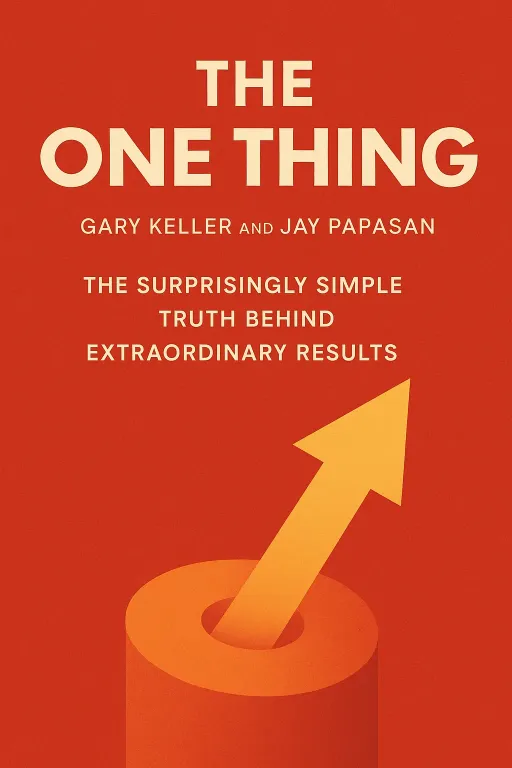
Nova: I know, right? It's the ultimate paradox for the aspiring polymath. We're conditioned to believe that more inputs equal more outputs, more breadth equals more brilliance. But often, it just leads to scattered efforts and slower progress. Today, we're diving into how to solve that "Polymath's Paradox" by exploring two incredibly powerful frameworks: "The One Thing" by Gary Keller and Jay Papasan, and "Essentialism" by Greg McKeown.
Atlas: Okay, so these aren't about just doing less to be lazy, but doing less to be effective, more impactful? I’m curious, because for so many of our listeners, the challenge isn't finding things to do, it's choosing.
Nova: Exactly. Gary Keller, a highly successful real estate entrepreneur, co-wrote "The One Thing" from decades of practical, real-world business experience. It's lauded for its straightforward, actionable advice, offering a powerful counter-narrative to the idea that multitasking leads to success. Then you have Greg McKeown, who, as a leadership consultant, has worked with giants like Apple and Google, and his book "Essentialism" gained significant traction for its elegant yet powerful philosophy of the disciplined pursuit of less, but better. Both are about strategic elimination, not just time management.
Atlas: That makes sense. It’s not about scarcity of opportunity, it's about scarcity of focus in a world overflowing with possibility.
The One Thing: Finding Your Highest Leverage Point
SECTION
Nova: Precisely. And that brings us to our first core idea: "The One Thing." Keller and Papasan argue that success comes from identifying your "one thing"—that single most important action that makes everything else easier or unnecessary. Think of it like finding the ultimate domino. You tip that one, and everything else just falls into place.
Atlas: But how do you even find one thing when you have a dozen "most important" things on your plate? For someone juggling multiple ambitious projects – say, coding a passion project, learning a new language, and writing a novel – this feels like an impossible choice. Everything feels important.
Nova: That's the beauty and the challenge of it. It forces you to ask a very specific question: "What's the ONE Thing I can do such that by doing it everything else will be easier or unnecessary?" It's a focusing question. Let me tell you about Elara. Elara was a classic aspiring polymath – brilliant, driven, but perpetually overwhelmed. She was dabbling in advanced coding, writing a sci-fi short story, and trying to build a portfolio of her stunning landscape photography. Each pursuit was "good," but none were gaining real momentum. Her energy was diffused, like sunlight through a prism, beautiful but not powerful enough to ignite anything.
Atlas: Oh, I know that feeling. It's like having a dozen browser tabs open, and none of them ever fully load. You're constantly switching contexts.
Nova: Exactly. Elara felt that constant context switching. She was making incremental progress across all three, but never felt she was truly any. Then she discovered "The One Thing." She asked herself: "What's the ONE Thing I can do, across all these interests, that would make everything else easier or unnecessary?" And her answer wasn't another coding course or a photography workshop.
Atlas: What was it? I'm on the edge of my seat!
Nova: It was building a truly exceptional, interactive, personal portfolio website. Not just a static page, but a dynamic platform that her coding prowess, provided a space for her written work, and was, by its very nature, a photography portfolio. It became her "One Thing."
Atlas: So, it wasn't about one to focus on, but finding the that served her areas? That's a clever hack.
Nova: Absolutely. By committing to building that one website, she was forced to hone her coding skills, because it had to be beautiful and functional. She had to select and curate her best written pieces, which refined her editorial eye. And she had to optimize and present her photography, which made her look at her images in a new light. The website wasn't just another project; it was the ultimate domino. Once that was done, suddenly, her other pursuits had a central hub, a professional showcase. She started getting inquiries for coding projects, her photography gained traction, and her writing felt more legitimate because it had a home.
Atlas: Wow. That's actually really inspiring. So, it's about identifying the that amplifies everything else, rather than just adding another item to the to-do list. It's about strategic amplification.
Nova: Yes, strategic amplification. It’s about understanding that not all actions are created equal. Some actions have disproportionately higher returns. The One Thing pushes you to find that singular action that, when done, creates a ripple effect, making everything else not just easier, but often unnecessary. Elara didn't give up on her diverse passions; she found the central node that connected and propelled them all.
Essentialism: The Discipline of Less But Better
SECTION
Nova: And that commitment to identifying the true "domino" leads us perfectly into the realm of Essentialism, which takes that concept of ruthless prioritization and elevates it into a complete philosophy of life.
Atlas: Okay, so "The One Thing" helps me find to focus on. But "Essentialism" sounds like it helps me decide entirely. For someone who loves learning new things and exploring various fields, that's a tough sell. How do you decide what's "non-essential" without feeling like you're losing part of your identity or future potential?
Nova: That's the core tension, isn't it? McKeown emphasizes doing 'less but better.' This isn't about time management in the traditional sense, but about discerning what is absolutely essential and eliminating everything else. It's about making choices that align with your highest contribution, your deepest values. Think of it like a master sculptor. They don't clay; they constantly it, chiseling away everything that isn't essential to reveal the masterpiece within.
Atlas: That's a great analogy. It’s like curating a capsule wardrobe instead of just accumulating clothes. But what about the fear of missing out? Or the genuine desire to explore all these different avenues? It's not just about saying 'no' to bad things; sometimes it's saying 'no' to good things that simply aren't the essential. That's where the real pain lies for a polymath.
Nova: It absolutely is. And that's where the of essentialism comes in. It requires courage to say no, even to good opportunities, because you understand that saying yes to too many good things means saying no to your absolute best. Consider Leo, a driven achiever, always taking on new leadership roles, joining committees, starting side hustles. He was constantly busy, productive even, but perpetually stretched thin, feeling like he was always just scratching the surface. He had a mile-wide, inch-deep experience.
Atlas: Oh, I've been there. You feel like you're doing so much, but at the end of the day, you can't point to one thing that truly moved the needle in a significant way. It's exhausting.
Nova: Exactly. Now, compare him to Maya. Maya, also incredibly ambitious and with diverse interests, applied essentialism. She was offered a fantastic opportunity to lead a new committee, a "good" thing. But she also had a deeply personal, interdisciplinary research project she felt called to complete, a "great" thing. After careful discernment, she politely declined the committee role, strategically divested from two other "good" but not "great" pro-bono projects, and poured her concentrated energy into her research.
Atlas: And what happened? Did she feel like she missed out?
Nova: Initially, there was a little hesitation, a pang of FOMO. But by focusing her energy, she made a profound breakthrough in her research, publishing a paper that synthesized insights from three different fields. She achieved a depth of excellence and made an impact she wouldn't have achieved otherwise. She didn't shrink her world; she refined it, making space for deeper engagement in the things that truly mattered to her growth and impact. Her diverse interests fed each other, but only because she gave them the focused space to truly grow.
Atlas: So, it's not about shrinking your world, but about refining it. It's about choosing where to invest your finite energy so you can truly excel, rather than just spread yourself thin. It allows for deeper dives and richer connections between fields, which is what a true polymath craves, isn't it? That mastery.
Nova: Precisely. It’s about designing your life, not just reacting to it. For the aspiring polymath, essentialism isn't about giving up on your diverse interests; it's about making deliberate choices that allow you to bring a higher level of mastery and impact to the ones that genuinely align with your core purpose and potential. It allows you to trust your inherent capability to connect disparate fields, because you've given them the space to breathe and feed each other.
Synthesis & Takeaways
SECTION
Nova: Ultimately, "The One Thing" helps you pinpoint that highest leverage point, that critical domino, and "Essentialism" gives you the discipline and the framework to protect that focus. It allows the aspiring polymath to build true mastery across domains, not just dabble.
Atlas: It sounds like a strategic framework for saying "yes" to your biggest potential, by saying "no" to everything else, even the good stuff. It's about intentionality, not limitation. It's about trusting that by going deep in a few chosen areas, you'll actually create more meaningful connections between them.
Nova: Absolutely. It's about moving from a mindset of "how can I fit it all in?" to "what is the most important thing I can be doing right now?" So, our tiny step for you this week, our listeners, is to identify one project that, if completed this week, would make the biggest positive impact on your primary goal. Just one.
Atlas: And then, ruthlessly protect the time and energy to get that one thing done. Trust that your diverse interests will feed each other, once you've given them the space to truly grow in their essential form. This is about building a life of profound impact and continuous growth, not just endless activity.
Nova: And that, my friends, is how you focus without losing your edge. This is Aibrary. Congratulations on your growth!