The Overwhelm Trap: Why More Isn't Always Better for Deep Work.
Golden Hook & Introduction
SECTION
Nova: Atlas, quick game. In five words or less, tell me your current relationship status with your inbox. Go!
Atlas: Oh man, uh… “It’s complicated, bordering on toxic.” Definitely toxic.
Nova: "Complicated, bordering on toxic!" I love that, and I think a lot of our listeners, especially those who are constantly trying to level up, probably feel that in their bones. Because today, we're diving into what we're calling "The Overwhelm Trap." It's this pervasive feeling that we're constantly busy, but often, not actually doing our best, most impactful work.
Atlas: I can definitely relate. It feels like every time I try to focus on something big, something else screams for my attention. So, are we talking about just managing emails better, or is this something deeper?
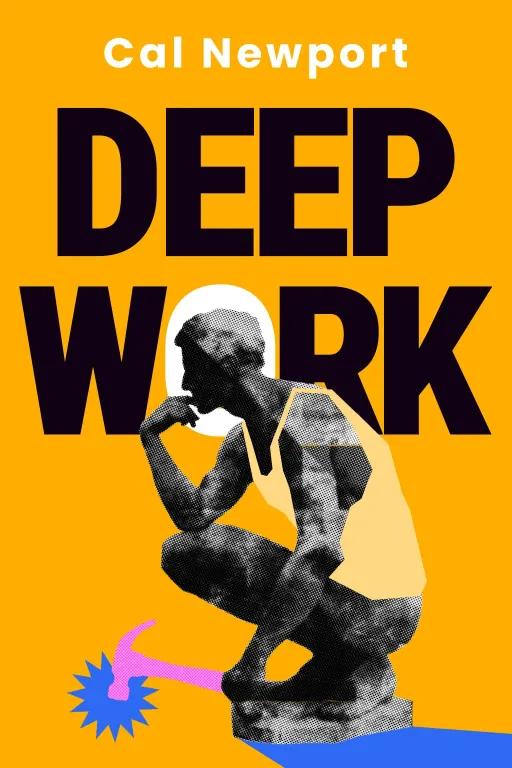
Nova: Much deeper, Atlas. We're pulling insights from two titans in the productivity space: Cal Newport, a computer science professor at Georgetown, who brings this incredibly rigorous, almost engineering-like precision to understanding how we work. And then there's Gary Keller, whose work with Jay Papasan really simplifies the seemingly complex world of priorities. Newport, particularly, approaches focus not as a soft skill, but as a hard, cultivatable asset. He essentially reverse-engineers peak performance.
Atlas: Okay, a computer science professor reverse-engineering focus. That sounds like my kind of problem-solving. But how does this idea of an 'overwhelm trap' actually manifest? Because for a lot of us, the constant demands feel non-negotiable.
The Novelty Trap & Shattered Focus
SECTION
Nova: That's precisely where it starts, Atlas. The core issue is our brain's ancient wiring. Our brains crave novelty. Think about it: back when we were hunter-gatherers, spotting a new rustle in the bushes, a new berry, or a new threat was crucial for survival. It's a dopamine-driven reward system.
Atlas: So, our brains are literally wired against sustained focus? That sounds like a rigged game! How does that play out in, say, a modern office or a demanding engineering project?
Nova: Exactly. In the modern world, that ancient craving for novelty is exploited by every app, every notification, every new email. It's like a thousand tiny rustles in a thousand digital bushes, all day long. This leads to what Newport calls "shallow work."
Atlas: Shallow work. So, not the deep, complex problem-solving. More like… responding to pings?
Nova: Precisely. Shallow work is low-value, easily replicated tasks. Responding to emails, attending unproductive meetings, scrolling through social media, quick chats that break your flow. You feel busy, you're interacting, but you're not actually significant value. The real problem isn't just the time spent on shallow work, but the constant context-switching it enforces.
Atlas: Oh, I know that feeling all too well. You're deep into a complex algorithm, trying to debug a tricky piece of code, and then – an email about a team lunch. You glance at it, respond, and by the time you get back to your code, that intricate mental model you built is... gone. Shattered.
Nova: It is absolutely shattered. Every time you switch tasks, your brain pays a "switching cost." It takes time and mental energy to re-engage with the original task. Do that fifty times a day, and you've spent hours not just on the shallow tasks themselves, but on the from those tasks. You're expending cognitive resources without moving the needle on your most important work, and that's the essence of the overwhelm trap. You're busy, but unproductive, and exhausted.
Atlas: That's such a clear explanation. So, it's not just about the notification itself, but the cognitive residue it leaves behind. But wait, looking at this from a high-stakes tech environment, isn't some level of 'shallow work' like essential communication or quick problem-solving necessary? How do you distinguish between essential interaction and pure distraction?
Nova: That's a critical distinction, Atlas. And it brings us to the solution-oriented side of the equation. It's not about eliminating all shallow work – that's often impossible. It's about and your deep work. It's about building a fortress.
Fortress Building & The One Thing
SECTION
Nova: So, understanding our brain's vulnerability is step one. Step two, and this is where the real power lies, is actively building what I call a "fortress" around your most important tasks. This is where Cal Newport's "Deep Work" and Gary Keller's "The One Thing" brilliantly converge.
Atlas: "Building a fortress." I like that imagery. It sounds proactive, like an engineer designing a robust system. But for someone who feels like they’re already drowning in tasks, where do you even begin to build this fortress? Like, practically, what's the first brick?
Nova: The first brick, Atlas, is identifying your "one thing." This comes straight from Gary Keller's work. He argues that extraordinary results are directly proportional to how narrow you can make your focus. It's about asking: "What's the ONE thing I can do, such that by doing it, everything else will be easier or unnecessary?"
Atlas: How do you what your 'one thing' is? For a lot of us, especially those driven by self-mastery, everything feels important. And what about all the other 'important' things that still need to get done? It feels like you're just ignoring problems, which could backfire.
Nova: That's a common fear, but it's a misconception. The 'one thing' isn't about ignoring other tasks; it's about sequence and leverage. It's the domino effect. Think of it like this: if you have a line of dominoes, pushing the first, biggest one, will knock over all the others. In your work, there's usually one task that, if completed, unlocks or significantly simplifies many other tasks. For an engineer, it might be designing the core architecture of a system, knowing that once that's solid, the rest of the coding flows much more smoothly.
Atlas: Okay, so it’s about identifying the bottleneck, the highest-leverage activity. That makes sense. But even if I find my 'one thing,' how do I actually it without getting pulled into that novelty trap we just talked about? How do I protect it?
Nova: That's where Newport's "Deep Work" strategies come in. Once you know your 'one thing,' you intentionally schedule dedicated blocks of time for it. This isn't just "finding time"; it's time. It's literally putting "Deep Work" on your calendar, like an important meeting. And during that time, you build your fortress: turn off all notifications, close irrelevant tabs, tell colleagues you're unavailable.
Atlas: So, it's about radical protection of that time. Like putting up a "Do Not Disturb" sign on your brain. I imagine a lot of our listeners, especially those in fast-paced environments, might feel like that's impossible. "My boss expects instant replies!" "My team needs me!"
Nova: That's the challenge, and it requires courage. But the alternative is constant overwhelm and mediocre output. The key is to start small. You don't have to block out an entire day initially. Even 90 minutes, consistently protected, can yield exponential results. It's not about working harder, it's about working. The return on investment for focused, undistracted work is incredibly high. You accomplish more in those 90 minutes than you might in an entire afternoon of shallow work.
Synthesis & Takeaways
SECTION
Nova: So, what we've really explored today is this powerful synergy: understanding our brain's inherent drive for novelty, and then intentionally building fortresses of focus around our highest-leverage tasks. It's about being strategic with our attention, not just our time.
Atlas: That's actually really inspiring. Because it shifts the blame from "I'm not disciplined enough" to "I haven't designed my environment and my approach effectively." It’s a mindset shift from fighting your brain to optimizing it. So for someone listening right now, feeling that overwhelm, what's immediate, tiny step they can take tomorrow to start building their own fortress?
Nova: Here’s your tiny step, your first brick, for tomorrow: block out 90 minutes. It doesn't have to be perfect. Turn off notifications – absolutely everything. And focus on one single task, your 'one thing,' for that entire duration. Don't check email, don't browse the web, just that one task.
Atlas: Ninety minutes of pure, unadulterated focus. That sounds like a superpower in today's world. And honestly, for anyone driven by self-mastery, that's exactly the kind of intentional refinement that leads to peak performance. It’s not just about getting more done, it’s about getting the things done, deeply.
Nova: Absolutely. It's about reclaiming your attention and, ultimately, your impact.
Atlas: Fantastic. That's a challenge I'm willing to take.
Nova: This is Aibrary. Congratulations on your growth!