The Hidden Cost of Busyness: Why Deeper Work Wins.
Golden Hook & Introduction
SECTION
Nova: If this episode found you, you probably spent more time to be productive this week than actually productive. Or maybe you're just constantly "busy" but feel like you're running in place, always putting out fires, never building anything truly meaningful.
Atlas: Oh man, Nova, that hits a little too close to home! Honestly, my to-do list feels like a hydra—I check off one thing, and three more pop up. It's like I'm in a constant state of productive anxiety.
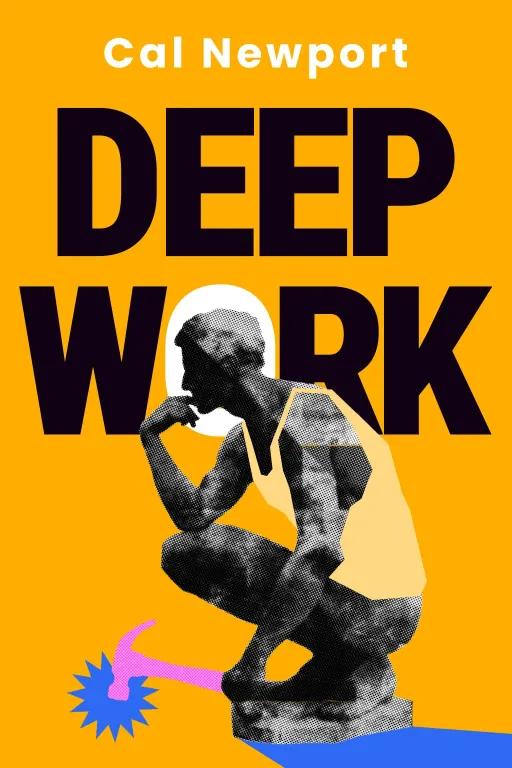
Nova: Exactly! And that feeling, Atlas, that pervasive sense of busyness, is the hidden cost we're talking about today. We're diving deep into the world of focused productivity, drawing heavily from two pivotal books: by Cal Newport and by Gary Keller and Jay Papasan. What's fascinating about Cal Newport, the author of, is that he's a computer science professor who doesn't even have social media accounts. He lives what he preaches, which gives his arguments a rare kind of weight and credibility.
Atlas: Whoa, a computer science professor without social media? In this day and age? That sounds almost… impossible for someone trying to stay relevant, especially if you're, say, in a field like marketing, where networking and digital presence are everything. How does someone like that even function, let alone advocate for it?
Nova: That's precisely the point, Atlas. It's about intentionality, about understanding the profound difference between just being active and actually creating value. And that leads us right into our first core idea.
The Illusion of Busyness vs. Real Productivity
SECTION
Nova: Many of us, myself included at times, conflate constant activity with valuable output. We call it "hustle culture," the glorification of being perpetually busy. But Cal Newport, among others, argues that much of what we do day-to-day is actually "shallow work."
Atlas: Shallow work? What exactly do you mean by that? Is it just, like, busywork?
Nova: It's more insidious than just busywork. Shallow work is non-cognitively demanding, logistical-style tasks, often performed while distracted. Think checking email, scheduling meetings, managing social media, responding to instant messages. These tasks are necessary, yes, but they rarely push your cognitive abilities. They're easy to replicate, and they don't create significant new value.
Atlas: Okay, so it’s like the difference between sharpening your axe versus actually chopping down a tree. You need to sharpen it, but if that's all you do, the tree never falls.
Nova: That's a perfect analogy! Now, contrast that with "deep work": professional activities performed in a state of distraction-free concentration that push your cognitive capabilities to their limit. These efforts create new value, improve your skill, and are hard to replicate. Imagine a marketing professional trying to develop a groundbreaking new campaign strategy, or learn a complex new data analytics software. If they're constantly interrupted by notifications, emails, and urgent Slack messages, they're not doing deep work. They're just context-switching, burning mental energy without making real progress.
Atlas: Oh, I know that feeling. It's like you're trying to hold a conversation in a crowded party. You hear bits and pieces, but you never really anything deeply. What are the actual hidden costs of this constant distraction, especially for someone trying to upskill and stay competitive in a fast-paced environment?
Nova: The costs are enormous. First, there's the cognitive residue. When you switch from one task to another, your attention doesn't immediately follow. A remnant of your attention remains stuck thinking about the original task. So, if you're constantly jumping between emails, a project, and a new skill tutorial, you're never truly giving your full attention to any of them. It's like trying to fill a bucket with a sieve.
Atlas: So basically, your brain is always playing catch-up, even when you've moved on? That sounds exhausting.
Nova: It absolutely is. And it prevents you from entering a state of "flow," where you're so immersed in a task that time seems to disappear. That's where true learning, innovation, and high-quality output happen. If you're always in reactive mode, you're sacrificing the opportunity to build valuable, rare skills. For a marketing grad looking to gain a competitive edge, this means the difference between superficially understanding new trends and actually mastering a complex, high-demand skill that sets them apart. You’re not just losing time; you’re losing the to think deeply.
Atlas: That makes me wonder, how much of this constant distraction is self-imposed, and how much is just the nature of modern work? Because sometimes it feels like you to be responsive, you to be on top of everything, or you'll fall behind.
Nova: That's a critical point. Some of it is certainly systemic, but a significant portion is habit. We've conditioned ourselves to seek novelty, to feel validated by constant interaction. But the irony is that by doing so, we're making ourselves less valuable in the long run. The ability to perform deep work is becoming increasingly rare, which makes it incredibly valuable. In a world of shallow work, those who can truly focus will inevitably win.
Mastering Deep Work for Competitive Advantage
SECTION
Nova: So, if busyness is the enemy, then deep work is the weapon. And this is where Gary Keller and Jay Papasan's book,, really amplifies Newport's ideas, offering a powerful framework for strategic focus.
Atlas: Okay, so we've established that deep work is important. But how do you actually it? What does it look like to "master" it, especially when your calendar is already packed with meetings, urgent client requests, and the need to constantly learn new tools? For someone trying to break into a new skill set, how do they protect that time without seeming unresponsive or falling behind?
Nova: That's the million-dollar question, and it requires intentionality and strategy. Newport offers several "rules" for deep work, but one of the most powerful is to simply deep work. Don't wait for inspiration or a free moment; block out 90 minutes, maybe even two hours, in your calendar. Treat it like a non-negotiable meeting with the most important person: yourself and your most important work.
Atlas: Block out 90 minutes? That sounds almost revolutionary for a lot of people! It's like saying, "I'm going to turn off my phone for an hour and a half during the workday." People might think the world will end.
Nova: And that's where Keller's comes in. It's about identifying your "one thing": the single most important task, the one thing that, by doing it, will make everything else easier or unnecessary. For a marketing grad looking to upskill, that might be mastering Python for data analysis, or becoming truly proficient in advanced SEO techniques, rather than just dabbling in a dozen different online courses.
Atlas: So, instead of trying to be decent at five things, you aim to be exceptional at one high-value thing, and you dedicate focused time to it. That makes sense from a competitive standpoint. But how do you protect that time? What if your boss calls? What if a client emails with an urgent request?
Nova: You create rituals. You communicate your boundaries. For example, you might have a "deep work" mode where notifications are off, your email client is closed, and you've told your team you'll be unavailable for that block of time unless it's a genuine emergency. It's about training yourself, and training those around you, that this focused time is sacred. You might start with just 30 minutes, then build up to 90.
Atlas: That’s a great way to put it. It’s a skill you develop, both for yourself and with your environment. I imagine this would be a massive competitive advantage. If everyone else is doing shallow work and reacting, the person who can consistently produce deep, high-value output is going to stand out.
Nova: Absolutely. Think about it: real breakthroughs, real innovation, real mastery—they don't happen in fragmented 10-minute bursts between email checks. They happen when you immerse yourself fully, pushing your mental boundaries. In a world that is increasingly distracted, the ability to focus intensely is a superpower. It's not just about productivity; it's about building a unique, invaluable skill set that sets you apart in any competitive field. It's about being the person who actually the value, not just manages the noise.
Synthesis & Takeaways
SECTION
Nova: So, what we've really been talking about today is this profound realization: true progress, true competitive advantage, doesn't come from being perpetually busy. It emerges from the deliberate, often uncomfortable, act of focused, uninterrupted effort. It's about understanding that your ability to concentrate deeply is not just a personal preference; it's an economic asset, a rare skill that the modern world is desperately short on.
Atlas: That's actually really inspiring, Nova. It flips the script on what we're told about "hustle." It's not about doing more; it's about doing the right things with intense focus. For anyone trying to upskill or make a real impact, this isn't just a productivity hack; it's a fundamental shift in how you approach your craft. It’s about building a career foundation that truly matters.
Nova: Precisely. And the best part is, you can start small. So, here's your tiny step for tomorrow: Block out 90 minutes for a single, important task. Turn off all notifications. Close all unnecessary tabs. Focus only on that one thing. You might be surprised at what you can achieve.
Atlas: I'm going to try that first thing tomorrow morning. I'm already thinking about what my "one thing" will be.
Nova: Excellent! That's the spirit. And remember, the ability to do deep work, to identify and execute your one thing, is a muscle. The more you use it, the stronger it gets. It's how you move from merely being busy to truly being effective and impactful.
Atlas: That’s a powerful thought to leave our listeners with. What a game-changer!
Nova: Indeed. This is Aibrary. Congratulations on your growth!