The Deep Work Trap: Why You Need Focused Productivity, Not Just More Hours
Golden Hook & Introduction
SECTION
Nova: What if I told you that putting in hours isn’t just inefficient, it’s actively making you effective? That the very act of striving for 'busy' is costing you your most valuable asset?
Atlas: Oh, I know that feeling. It's like a badge of honor in some circles, right? The 24/7 grind. But what valuable asset are we talking about here? My sanity? My coffee budget?
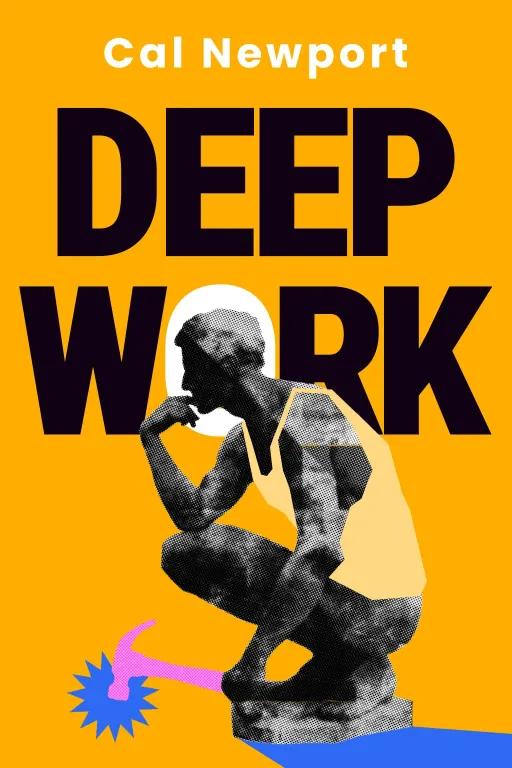
Nova: Maybe all of the above, Atlas, but more profoundly, your. Today, we're diving into that often-overlooked truth, pulling insights from two foundational books: Cal Newport’s critically acclaimed "Deep Work: Rules for Focused Success in a Distracted World" and "The One Thing: The Surprisingly Simple Truth Behind Extraordinary Results" by Gary Keller and Jay Papasan.
Atlas: Ah, Cal Newport. He’s the computer science professor who basically told us all to chill out with the constant notifications, isn't he? I always appreciate how he brings that academic rigor to what often feels like fluffy self-help advice.
Nova: Exactly. His background gives his insights a unique, research-backed weight. And Keller and Papasan? Their wisdom comes from Keller's journey building one of the largest real estate companies in the world, grounding "The One Thing" in hard-won business success. So, this isn't just theory; it's battle-tested.
Atlas: That's a powerful combination. For anyone trying to build something significant, theory needs to meet reality. So, it’s not about working harder, but... smarter?
The Superpower of Deep Work: Reclaiming Focus in a Distracted World
SECTION
Nova: Precisely. And the first big idea, from Newport, is the concept of "deep work." He defines it as the ability to focus without distraction on a cognitively demanding task. It's a skill that allows you to quickly master complicated information and produce better results in less time. He essentially argues it’s the superpower of the 21st century.
Atlas: Superpower, huh? That sounds enticing. But wait, for someone building a vision, surrounded by constant demands—emails, meetings, team check-ins, market shifts—how do you even begin to carve out that kind of focus? It feels almost impossible to escape the noise.
Nova: I hear you. That's the insidious trap of "shallow work"—non-cognitively demanding, logistical-style tasks, often performed while distracted. Think constant email checking, quick Slack responses, social media updates. They productive because they keep us busy, but they rarely move the needle on high-value projects. Newport argues that the constant context-switching these tasks demand actually damages our brain's ability to engage in deep, sustained focus. It's like trying to run a marathon by constantly stopping to tie your shoe.
Atlas: So you're saying the quick Slack responses, which feel like keeping things moving, are actually draining our capacity for real innovation or strategic thinking? That’s kind of rough.
Nova: It absolutely is. Consider the cost of context-switching: studies suggest it can take up to 25 minutes to regain deep focus after an interruption. If you're constantly bouncing between tasks, you're not just losing those minutes, you're losing the mental energy required to even a deep work state. It’s a battle for mental energy that many of us are losing without even realizing it. Newport himself, as an academic, literally schedules his deep work blocks. He treats them like non-negotiable meetings with himself, often in isolation, to write papers or develop complex theories.
Atlas: That makes me wonder, what are some of the practical steps he suggests for reclaiming this superpower, especially for those of us who can't just disappear into a cabin in the woods for a week?
Nova: He outlines several strategies. One is to schedule deep work blocks, literally putting them on your calendar and defending them fiercely. Another is to create rituals: having a specific time, place, and routine that signals to your brain it’s time to go deep. It could be brewing a specific kind of tea, listening to a certain type of music, or going to a quiet co-working space. And perhaps most counter-intuitive, he advocates for embracing boredom. When you're standing in line or waiting for a meeting, resist the urge to pull out your phone. Let your mind wander. This strengthens your brain’s ability to resist distraction when it matters most. It’s about protecting your mental energy, which is crucial for a visionary founder.
The Clarity of the 'One Thing': Strategically Amplifying Impact
SECTION
Nova: And speaking of protecting mental energy for what truly matters, that leads us perfectly into our second big idea from Keller and Papasan's "The One Thing." This book argues that extraordinary results are directly determined by how narrow you can make your focus. It’s about identifying your ‘one thing’ – the single most important task or goal that, by doing it, makes everything else easier or unnecessary.
Atlas: For a visionary architect, honestly, everything feels like 'the one thing' at some point. Product development, hiring, fundraising, marketing, customer experience... How do you find one thing when you're cultivating a whole ecosystem and trying to move multiple foundational pieces forward at once?
Nova: That’s where the power of their "focusing question" comes in. It’s not just a general question; it's highly specific: "What's the ONE Thing I can do, such that by doing it, everything else will be easier or unnecessary?" This question forces you to think sequentially, to identify the 'lead domino' in whatever area you're focusing on. Take a startup aiming for product-market fit. Their 'one thing' might be user retention for their core feature, because if they nail that, everything else—marketing, investment—becomes easier. If they don't, nothing else matters.
Atlas: So this isn't just about my daily to-do list, it's about my entire business strategy, right? Finding the 'one thing' for product-market fit, or for developing empathetic leadership, or even for my own personal growth?
Nova: Absolutely. It applies at every level. For your personal life, it could be "What's the one thing I can do today to improve my health?" and the answer might be "drink more water." By doing that, everything else—energy levels, skin, sleep—becomes easier. For a team leader, it could be "What's the one thing I can do to empower my team this quarter?" It forces radical clarity and ruthless elimination of the non-essential. It’s about understanding that not all tasks are created equal; some have a disproportionately higher impact.
Atlas: That makes a lot of sense. It’s almost like a strategic filter for all the noise. For someone who thrives on building a thriving environment, this concept of focusing on the 'lead domino' to create a holistic impact really resonates.
Nova: It’s empowering because it shifts you from feeling overwhelmed by endless tasks to feeling strategic about the few that truly matter. It’s about leveraging your energy, your deep work capacity, in the most impactful direction possible. It’s how you achieve extraordinary results, not just accumulate busy hours.
Synthesis & Takeaways
SECTION
Nova: Ultimately, Atlas, these aren't just productivity hacks. They're about intentionality. Deep work gives you the capacity to produce at your highest level, and "The One Thing" gives you the precise direction for where to apply that capacity. It’s a powerful combination for anyone who wants to make a real impact.
Atlas: It really is. It feels like it’s about protecting that inner compass, as our visionary profile suggests, and channeling that focused energy not just for personal gain, but for truly meaningful impact and cultivating that thriving environment founders strive for. It shows that embracing vulnerability as a strength also means admitting you can’t do and choosing what truly moves the needle.
Nova: Exactly. It's about achieving more by doing less, but doing that "less" with profound focus and intention. So, for our listeners, here’s a tiny step: block out your first 'deep work' hour tomorrow morning. Turn off all notifications. Focus on a single, high-impact task that, if done, will make everything else a little easier. Protect that energy.
Atlas: And watch the dominoes fall. I love that. It’s a powerful way to start.
Nova: This is Aibrary. Congratulations on your growth!