Stop Overwhelm, Start Focused Flow: Your Guide to Deep Work.
Golden Hook & Introduction
SECTION
Nova: Atlas, what’s the one thing you know about achieving extraordinary results?
Atlas: Oh man, easy. It’s usually the thing I’m actively avoiding. Or the thing I forget to do because I’m doing ten other less important things.
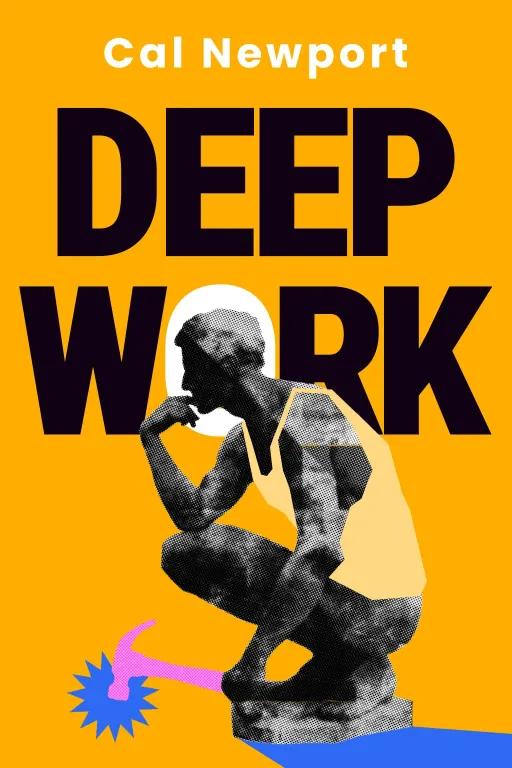
Nova: Precisely! And that's why we’re diving into a powerful combination today: by Cal Newport and by Gary Keller with Jay Papasan. Newport, a computer science professor, wrote as a direct challenge to the constant distractions he saw eroding our ability to think deeply. And Keller, a real estate mogul, distilled his immense business success into this profoundly simple, yet powerful, concept of extreme prioritization.
Atlas: So, we have an academic and a business titan, both arriving at similar conclusions about focus. That’s a fascinating convergence. It makes me wonder, if they both agree, why is it still so hard for so many of us to actually do?
Nova: That’s the million-dollar question, isn't it? It’s hard because our world is actively designed to pull us away from deep concentration.
The Inescapable Reality of Distraction & The Necessity of Deep Work
SECTION
Nova: Newport defines "deep work" as professional activities performed in a state of distraction-free concentration that push your cognitive capabilities to their limit. These efforts create new value, improve your skill, and are hard to replicate. Think of it like a blacksmith's forge, where intense, isolated heat shapes raw metal into something strong and useful.
Atlas: Okay, so a blacksmith's forge. That’s a great image. But what does that look like for someone who isn't forging metal, but maybe, designing a building or studying complex engineering problems? For an aspiring architect, for example, what’s the opposite of deep work?
Nova: That’s where 'shallow work' comes in. It’s non-cognitively demanding, logistical-style tasks, often performed while distracted. Replying to emails, endless meetings, social media management—these are the digital equivalent of sifting through sand. They feel productive, but they rarely create lasting value. Imagine that architect, trying to sketch out a complex structural detail while their phone buzzes, emails pop up, and colleagues drop by for "quick" chats.
Atlas: Oh, I know that feeling. It’s like trying to fill a bucket with a hole in it. You're constantly pouring in effort, but nothing ever quite fills up because it’s always leaking out.
Nova: Exactly! And the cold, hard fact is that those constant interruptions don't just briefly pull your attention away; they fragment it. Each time you switch tasks, a residue of your attention remains with the previous task. It’s called "attention residue." You think you’re back on track, but part of your brain is still processing that email or that notification.
Atlas: So you're saying that even a quick glance at a notification isn't just a few seconds lost, it's actually a mini-brain drain that impacts my focus for much longer? That sounds rough, but it makes sense. I can definitely relate.
Nova: It’s precisely why true mastery, whether in architecture, coding, or writing, requires uninterrupted focus. You’re systematically building a skill, not just performing tasks. Newport argues that in our increasingly distracted world, the ability to do deep work is becoming rarer and, therefore, more valuable. It’s a skill you can build, but it takes intentional effort.
Atlas: So, it's not just about willpower, it's about creating an environment and a routine that that kind of attention. I’m curious, what are some of the biggest obstacles people face when trying to implement this? Because for a lot of our listeners who are juggling multiple projects and deadlines, the idea of "distraction-free concentration" might feel like a fantasy.
Nova: That’s a great question, and it brings us to the core challenge: designing systems that protect your attention. People often struggle with the sheer of distraction. We’ve become conditioned to constant stimulation. The urge to check your phone, to open a new tab, it’s a deeply ingrained behavioral loop. We’re essentially rewiring our brains for superficiality.
Atlas: Wow, rewiring our brains for superficiality. That’s a powerful, almost unsettling, idea. So, if deep work is the —the way we engage with a task—then what about the? How do we choose what deserves that intense, uninterrupted focus?
Strategic Focus: The Power of 'The One Thing'
SECTION
Nova: That’s a perfect pivot, Atlas, because that’s where comes in. While Newport gives us the environment for focus, Keller and Papasan give us the target. Their philosophy is elegantly simple: identify the single most important task that, by doing it, makes everything else easier or unnecessary.
Atlas: Okay, so you’re saying instead of having a to-do list a mile long, I should have a to-do list with just one item on it? That sounds almost too simple. And frankly, a little terrifying for anyone with a demanding job.
Nova: It terrifying for many, because our natural inclination is to multitask, to juggle. We think we’re being efficient, but research consistently shows multitasking is a myth. You’re not doing multiple things at once; you’re rapidly context-switching, and each switch incurs that attention residue we just talked about. forces you to ask: "What's the ONE thing I can do, such that by doing it, everything else will be easier or unnecessary?"
Atlas: In other words, it’s about finding the domino that, when it falls, knocks over a whole row of other dominos. That’s a great analogy. But how do you even that one domino, especially when everything feels urgent and important? For someone who’s constantly optimizing their strategy and seeking mastery, how do they pinpoint that singular focus amidst a sea of priorities?
Nova: That’s the art of it. It requires ruthless prioritization and a clear understanding of your larger goal. Let’s say our aspiring architect has three major projects on their plate, all with looming deadlines. Their instinct might be to work a little on each, trying to keep all balls in the air. But approach would have them ask: "What is the ONE thing I can do that will have the biggest impact on my most important project, making progress on the others easier later?"
Atlas: So, it’s not about ignoring the other projects completely, but about recognizing that focused effort on the most impactful task will ultimately lead to better, faster results across the board. It sounds like it actually accelerates progress, rather than slowing it down, which is counterintuitive.
Nova: Precisely. Imagine our architect dedicates a 90-minute, distraction-free deep work block to just solving the critical structural challenge of Project A. By the end of that block, they’ve made significant progress, perhaps even found a solution that streamlines aspects of Project B and C. That’s the power of the domino effect. It's about achieving extraordinary results by not diffusing your effort.
Atlas: I can see how that would be incredibly powerful. It’s like, instead of spreading yourself thin and achieving mediocrity across many things, you go deep on one thing and achieve excellence, which then elevates everything else. It really challenges the conventional wisdom that 'busyness' equals productivity.
Nova: Absolutely. And that’s the beauty of combining these two ideas. gives you the mental space and concentration power, while gives you the precise target for that power. Together, they form a formidable strategy for anyone truly committed to excellence and mastery. It’s not just about working harder; it’s about working smarter and more intentionally.
Synthesis & Takeaways
SECTION
Nova: So, bringing it all together, Atlas, what we’re really talking about is reclaiming our most valuable resource—our attention—and then strategically directing it. Distraction is the enemy of mastery, and deep work is the systematic cultivation of intense focus.
Atlas: And is the compass that points that intense focus in the most impactful direction. The combination is potent. It’s about creating a systematic routine, not just hoping for occasional bursts of focus. That’s where the real growth happens for anyone seeking to improve and apply their knowledge effectively.
Nova: Exactly. It's about building this skill systematically. And for anyone listening who wants to take a tiny step towards this, here’s a challenge: tomorrow, block out 90 minutes for one task only. Turn off all notifications. Close all unnecessary tabs. Just dedicate yourself to that one thing.
Atlas: I love that. It’s actionable, practical, and directly addresses the problem of fractured attention. It’s about acknowledging your efforts and capability, and giving yourself the grace to focus without guilt. So, if you try that 90-minute challenge, share what you accomplished with the Aibrary community! We’d love to hear how that focused flow felt.
Nova: Because you are capable, and you are doing enough. You just need to direct that incredible capability.
Atlas: This is Aibrary. Congratulations on your growth!