Stop Overthinking, Start Doing: The Guide to Deep Work
Golden Hook & Introduction
SECTION
Nova: Atlas, five words. Describe the feeling of trying to get real work done when your phone is buzzing every five minutes.
Atlas: Oh, that's easy. 'Productivity's ghost, a digital nightmare.'
Nova: 'Productivity's ghost.' That's a perfect visual for the constant battle for our attention. Today, we're diving into a book that tackles this head-on: "Stop Overthinking, Start Doing: The Guide to Deep Work."
Atlas: I can see how that would be a battle for anyone in a high-demand role. The title alone resonates with the mental clutter we all deal with.
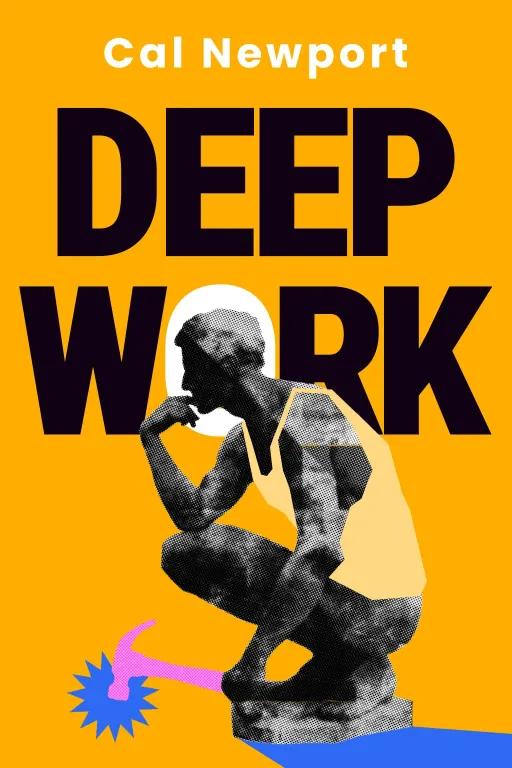
Nova: Absolutely. And it's built on principles championed by people like Cal Newport, a computer science professor who famously operates without social media. He's not just theorizing; he's living proof that deep focus is possible, even in our hyper-connected world. It's not an academic idea; it's a battle cry for anyone feeling overwhelmed by constant demands.
Atlas: That makes me wonder, how does someone in his field, which is often at the forefront of digital distraction, manage to not just survive, but thrive without it?
Nova: That's the power of what he calls "deep work." And today, we're going to explore two crucial aspects of it. First, why true focus is becoming a rare and powerful superpower, then we'll discuss tactical insights on how to cultivate that superpower by eliminating distractions and zeroing in on what truly matters.
The Scarcity and Value of Deep Work
SECTION
Nova: So, let's start with this core idea: "deep work." Cal Newport defines it as focused, distraction-free concentration that pushes your cognitive capabilities to their limit. It's the kind of work that allows you to quickly master complicated information and produce at an elite level. On the flip side, there's "shallow work" – the administrative tasks, the quick emails, the meetings that fill our days but rarely move the needle.
Atlas: That sounds like a luxury for most people, especially those balancing complex tasks with constant communication. For our listeners who are in demanding, detail-oriented roles like software development, the ability to master complex information quickly is everything. But it feels like a constant battle to even carve out time for that kind of focus.
Nova: It absolutely is a battle. And that's why it's becoming so valuable. Think about Bill Gates. He famously had "Think Weeks." Twice a year, he would disappear to a secluded cabin for two weeks, completely isolated from distractions. No emails, no phone calls, just reading, thinking, and strategizing.
Atlas: Wow. Two weeks? That sounds less like a work strategy and more like a sabbatical.
Nova: It was extreme, yes, but the principle is profound. During these periods of intense deep work, he would emerge with breakthroughs that shaped Microsoft's future. The cause was complete isolation and focus. The process was unadulterated thought and learning. The outcome? Strategic leaps that changed the industry. It's a vivid illustration of how deep work allows you to master complex information and produce at an elite level.
Atlas: So, we all need to go off to a cabin in the woods? Is that really the only way to tap into this superpower? That sounds a bit out there for the average person.
Nova: Not at all. Gates's example highlights the of the principle, but the principle itself is universal: creating dedicated, uninterrupted blocks of focus. Deep work is rare because our world is designed for interruption. Because it’s rare, it’s also incredibly valuable. The ability to concentrate is a competitive advantage, allowing for rapid skill mastery and elite-level output.
Atlas: I get the 'valuable' part. The ability to master complex information quickly is everything in today's fast-evolving landscape. But how do you even to build that habit when your inbox is a war zone and your team chat is constantly pinging?
Strategic Focus: Eliminating Distraction and Embracing the 'One Thing'
SECTION
Nova: That's exactly where Gary Keller and Jay Papasan's "The One Thing" comes in. It's not just about deep work is, but to make space for it by identifying and relentlessly focusing on your most important task.
Atlas: Ah, the 'one thing.' So, less is more? In a world that constantly tells us to multitask and juggle everything? That sounds a bit counterintuitive.
Nova: It is, but it's incredibly powerful. The core principle is finding the "domino" – that single task that, if completed, makes everything else easier or unnecessary. Imagine you're working on a software project. Instead of trying to optimize ten minor bugs simultaneously, you identify the one critical architectural improvement that will prevent countless bugs down the line. That's your one thing.
Atlas: That makes sense. Focusing on the biggest leverage point. But how do you eliminate the noise? Notifications are like digital vampires, sucking away your attention. What's a practical, tiny step someone can take tomorrow?
Nova: The tiny step is deceptively simple: block out 90 minutes tomorrow for a single, focused task. Turn off all notifications – literally, put your phone in another room, close unnecessary tabs. Commit to that one thing. It's about creating a "deep work block" and protecting it fiercely. It needs a clear start and end ritual, almost like a mini-retreat within your day.
Atlas: Ninety minutes? For many, even 15 minutes without checking Slack feels like an eternity. I imagine a lot of our listeners are thinking, 'I can barely find 90 minutes to eat lunch!' What kind of mindset shift is required to even that?
Nova: It requires a shift from reactivity to intentionality. Nova’s Take is that consistent, deep focus is the bedrock of significant achievement. It's not about being perfect from day one, but about building a mental muscle. Each 90-minute block is a rep. You're training your brain to resist distraction and engage fully. It’s about building complex systems and mastering new skills without constant interruption.
Atlas: So, it's not about being a productivity guru overnight, but about consistent, small efforts to protect your mental energy. I can see how that would compound over time.
Synthesis & Takeaways
SECTION
Nova: Exactly. Newport defines the "what" and "why" of deep work—its rarity, its value. Keller and Papasan provide a powerful "how" for prioritizing, for finding that one thing and making space for it. It's about intentionality over reactivity.
Atlas: So, it's not just about doing more, it's about doing what truly moves the needle, and protecting that time fiercely. It's about being a craftsman of your own attention, rather than just a responder to external stimuli.
Nova: Precisely. The ability to perform deep work is becoming rarer, but also more valuable. It's the superpower for mastering complex information and producing at an elite level. It’s how you reclaim your cognitive edge.
Atlas: That gives me chills. So, for our listeners, what's the one thing they should take away from this conversation? What's their 'domino' for tomorrow?
Nova: Your challenge for tomorrow: Find a 90-minute block. Turn off every notification. Pick one task that truly matters, and commit to it, undistracted. See what happens.
Atlas: I imagine a lot of our listeners are thinking, 'I can barely find 90 minutes to eat lunch!' But the point is, you the time, because that's where the real magic happens. That's actually really inspiring. It's an investment.
Nova: It absolutely is. An investment in your mental energy, and your intellectual output. And it pays dividends far beyond those 90 minutes.
Atlas: Fantastic. A true guide to reclaiming your mental energy. What a powerful concept.
Nova: Indeed. This is Aibrary. Congratulations on your growth!