Stop Chasing Noise, Start Building Signal: The Guide to Focused Innovation
Golden Hook & Introduction
SECTION
Nova: What if I told you that being constantly 'on' and connected isn't just making you tired, it's actively sabotaging your ability to create anything truly original or impactful?
Atlas: Oh, Nova, that sounds like a personal attack... and also, deeply true for about 99% of our audience right now, myself included. The endless pings, the notifications, the 'just checking one more thing' loop. It's insidious.
Nova: Insidious is the perfect word. Because it's the cold, hard fact at the heart of the book we're dissecting today: "Stop Chasing Noise, Start Building Signal: The Guide to Focused Innovation." This isn't just some abstract theory; it's a guide to reclaiming your mental real estate.
Atlas: Right. And this book, as I understand it, isn't just one person's opinion. It draws heavily from two titans of productivity and focus.
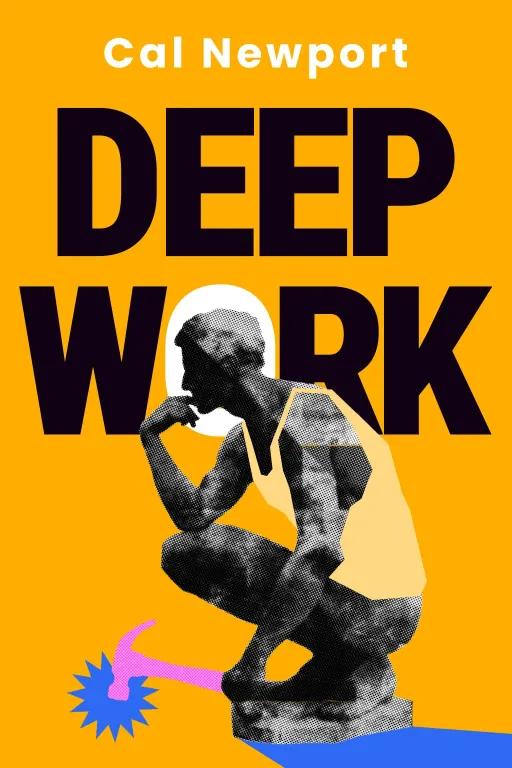
Nova: Exactly. We're talking about the distilled wisdom of Cal Newport, a computer science professor at Georgetown who famously doesn't use social media – which, in today's world, is almost a superpower in itself. And then there's real estate mogul, Gary Keller, who built an empire on a shockingly simple principle.
Atlas: A computer science professor social media? That's like a baker who doesn't eat bread. It immediately lends a certain weight to his arguments about distraction, doesn't it? He's walking the talk.
Nova: He absolutely is. And that unique perspective is what anchors the first big idea from "Stop Chasing Noise, Start Building Signal": the concept of Deep Work. In a world designed for distraction, true innovation often gets buried under a mountain of digital noise. This book posits that to build something truly meaningful and impactful, you need to reclaim your focus. And that starts with understanding what deep work actually is.
Deep Dive into Core Topic 1: The Superpower of Deep Work
SECTION
Atlas: So, Nova, what exactly is this 'deep work' that Newport champions? Because for many of us, 'work' just feels like a constant stream of shallow, reactive tasks.
Nova: That's precisely the problem deep work aims to solve. Newport defines it as the ability to focus without distraction on a cognitively demanding task. It’s about pushing your cognitive capabilities to their limit, creating new value, improving your skill, and it’s hard to replicate. Think of it as intellectual heavy lifting.
Atlas: Oh, I like that. Intellectual heavy lifting. So, it's not just about sitting at your desk; it's about a specific of focused effort. Can you give us an example? Because it sounds almost mythological in our current always-on culture.
Nova: It can feel that way, but it's very real. Consider someone like J. K. Rowling. While not a scientist, her creative process embodies deep work. She famously checked into hotels to write parts of the Harry Potter series, isolating herself from the demands of her family and public life. She wasn't just; she was immersing herself in a complex, multi-layered narrative, building an entire world. That kind of intense, uninterrupted creation is deep work. She created something of immense value by deliberately eliminating distractions.
Atlas: Wow. So it’s about creating a mental and physical fortress around the task. But wait, for our listeners who are managing high-pressure teams, or are in roles where constant communication is expected, how does this theory apply? It feels impossible to implement when your inbox is a battlefield and your Slack is a siren.
Nova: That’s a crucial point, Atlas. It’s not about abandoning all communication or becoming a hermit. Newport acknowledges that not everyone can be a full-time deep worker. The key is. He argues that even small, dedicated blocks of deep work can yield immense results. It’s about being intentional. Instead of letting shallow work, like email and meetings, dictate your day, you schedule your deep work first. You protect those blocks fiercely.
Atlas: So basically you’re saying, instead of reacting to every notification, you proactively carve out time for the really important stuff. That sounds rough, but also liberating. But how do you even begin to to focus without distraction when our brains have been rewired for constant stimulation?
Nova: That’s where the "cultivating the skill" comes in. It’s like a muscle. You start with small, protected blocks. Maybe 60 minutes. You turn off everything. Your phone is in another room. Your email is closed. You work on one single, cognitively demanding task. Over time, you build that capacity. The insights from "Stop Chasing Noise" fundamentally solve the problem of scattered attention by providing actionable strategies to prioritize and execute on high-leverage activities.
Deep Dive into Core Topic 2: The Clarity of The One Thing
SECTION
Atlas: I can see how protecting that focus is vital. But deep work isn't just about you work, it's about you choose to work on profoundly. And that brings us to the second pillar of "Stop Chasing Noise, Start Building Signal": the surprising clarity that comes from identifying 'The One Thing.'
Nova: Exactly! Because what's the point of deep work if you're deep working on the wrong thing? This is where Gary Keller's philosophy shines. He emphasizes that extraordinary results are directly proportional to how narrow you can make your focus. He asks: "What's the ONE Thing you can do such that by doing it everything else will be easier or unnecessary?"
Atlas: That makes me wonder, how do you even begin to answer that question? Especially for our curious learners who are passionate about exploring new knowledge areas. It feels almost counterintuitive to say, 'ignore everything else and just do one thing.' Doesn't that stifle exploration?
Nova: It's a common misconception that 'The One Thing' means you only ever do one thing in your entire life. It’s much more dynamic than that. It’s about identifying the most important priority, in this moment, for this specific goal. Think of it like a domino effect. You identify the lead domino, the biggest, most impactful one, and you push it. Once that falls, it knocks down a whole series of smaller dominos, making everything else easier or even unnecessary.
Atlas: That’s a great analogy. The lead domino. Can you give an example of this in action? How does a business, or even an individual, figure out their 'one thing' and then actually stick to it?
Nova: Absolutely. Consider a classic startup story. Many new companies try to be everything to everyone – they build a dozen features, target multiple markets, spread their resources thin. But often, the ones that break through are those that relentlessly focus on solving for with. Think of early Facebook: their "one thing" wasn't global domination; it was connecting college students. They mastered that, and then expanded. That hyper-focus allowed them to allocate all their deep work, all their energy, to making that one thing exceptional.
Atlas: Right, like... build the best social network for college students, and then everything else will follow. So, for a curious learner, it wouldn't mean abandoning all other subjects, but maybe for a specific project, identifying the single most impactful learning goal or skill to master first?
Nova: Precisely. If your goal is to understand a new field, your 'one thing' might be to master the foundational concept that unlocks everything else. Or if you're trying to launch a side project, your 'one thing' might be to get that first minimum viable product into the hands of a few users to get feedback. It's about ruthless prioritization, driven by a clear, singular question.
Atlas: That makes sense. It’s about intentionality, not limitation. It's about saying no to good things, to say yes to the best thing.
Synthesis & Takeaways
SECTION
Nova: And that's where the magic happens when you combine these two powerful ideas. Deep work provides the – the undistracted focus to execute. 'The One Thing' provides the – the singular, most impactful objective to apply that focus to. Together, they create an incredibly potent formula for innovation and meaningful impact.
Atlas: So, it's not just about working hard, it's about working hard on the thing, with the kind of focus. The real innovation isn't just about coming up with new ideas; it's about having the uninterrupted mental space and strategic clarity to bring those ideas, the truly important ones, to fruition.
Nova: Exactly. It's about moving from being busy to being productive, from chasing every shiny object to building something truly significant. It’s about making a deliberate choice to cultivate your attention.
Atlas: I love that. And it simplifies the overwhelming feeling of having too much to do. So, if our listeners want to take just one tiny step from this guide, what would it be?
Nova: The book gives us a perfect tiny step: Block out 90 minutes tomorrow for a single, focused task. Turn off all notifications and work uninterrupted. And before you start, ask yourself: What's the ONE Thing I can do in these 90 minutes that will make everything else easier or unnecessary?
Atlas: That's actually really inspiring. Just 90 minutes. Not a whole life overhaul. It's a powerful way to start building signal, instead of just chasing noise.
Nova: Absolutely. Take that first step. Protect that time. And see what kind of signal you can start building.
Atlas: This is Aibrary. Congratulations on your growth!