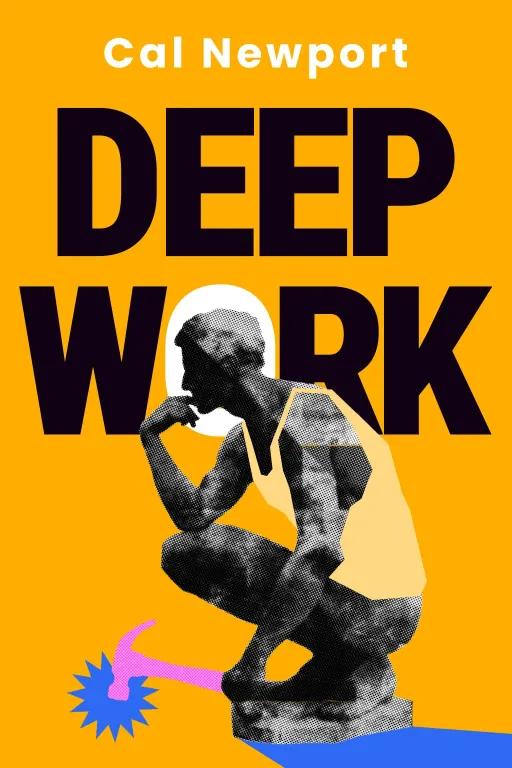
Deep Work: Achieving Focused Success in a Distracted World
Golden Hook & Introduction
SECTION
Nova: What if the very tools designed to make you more productive, the ones promising to connect you, actually make you less effective, less creative, and ultimately, less genuinely successful?
Atlas: Oh man, that's a gut punch, Nova. Because I think we all secretly suspect that. We chase after these new apps and notification systems, hoping they'll save us, but often, they just feel like they’re draining us.
Nova: Exactly! It’s a paradox we live with every single day. And today, we're diving into that precise, pervasive problem, exploring the transformative power of "Deep Work" by Cal Newport. This isn't just a book; it's a phenomenon that didn't just sell millions of copies; it sparked a global movement for focused living. Newport, a computer science professor, champions this idea of deep work, not just as a theory, but as something he actively practices, which I think gives his arguments incredible weight in our tech-saturated world.
Atlas: Right, so it's not just another time management guide, then? It's deeper than that. For anyone who feels their efforts are constantly diluted by the digital clamor, this sounds like a lifeline. But what even deep work beyond just, you know, "focusing hard"?
The Existential Threat of Distraction: Why Deep Work is Non-Negotiable
SECTION
Nova: That's the perfect question, Atlas. Deep work, as Newport defines it, is focused, uninterrupted concentration on a cognitively demanding task. It’s when you push your cognitive capabilities to their limit, leading to new value, improved skill, or a deeper understanding. The opposite is "shallow work"—tasks that don't require much brainpower and are often performed while distracted. Think email, social media, routine meetings.
Atlas: So, it's about getting into that flow state we hear so much about? But how many of us actually get there?
Nova: Precisely. And the cost of doing deep work is immense. Think of your brain like a muscle. If you constantly switch between tasks, you're doing mental bicep curls with tiny weights, constantly interrupting the growth. Your deep work muscle atrophies. Consider a programmer I read about, let's call him Alex. Alex was stuck on a particularly thorny coding problem for a major tech company. He’d tried every trick in the book, but the constant notifications, team meetings, and urgent emails kept pulling him away. He was working long hours, but getting nowhere.
Atlas: I know that feeling. It's like trying to fill a bathtub with the plug out.
Nova: Exactly! So, Alex, in a moment of desperation, decided to go off-grid. He booked a small, rustic cabin in the woods for two weeks, no internet, no phone signal, just his laptop and the problem. The first few days were brutal—his mind rebelled, craving the constant stimulation. But he stuck with it. He’d wake up, go for a walk, then dedicate hours to nothing but that code. He meticulously mapped out the logic, experimented with different architectures, and allowed his mind to fully immerse itself without interruption.
Atlas: And what happened? He cracked it, didn't he?
Nova: He did. By the end of the two weeks, he emerged not just with a solution, but with a completely novel approach that saved the company months of development time. His output wasn't just; it was. The cause was intentional isolation, the process was sustained, deep concentration, and the outcome was a breakthrough innovation. That's the power of deep work.
Atlas: Wow. That's actually really inspiring. But for our listeners who are building robust systems, managing teams, and navigating a perpetually connected environment, "retreating to a cabin" sounds like a beautiful fantasy. How do we achieve that level of isolation when there are constant demands and notifications inherent in a leadership role?
Nova: That's a crucial point. Newport isn't suggesting we all become hermits. He offers various strategies. One is "fixed-schedule productivity," where you schedule your deep work blocks first and let everything else fit around it. Another is "journalistic deep work," where you switch into deep work mode whenever you find a free hour or two, like a journalist on assignment. The key is protecting that time, not necessarily total isolation. And it’s about understanding "attention residue." Every time you switch tasks, a fragment of your attention stays with the previous task, making it harder to fully engage with the new one. This constant switching makes us feel busy, but it dilutes our cognitive power.
Atlas: So, it's not just about finding the time, but making sure that time is truly and focused. That makes total sense. It really hammers home the cost of doing deep work, which I think is what many of us overlook. We just see the immediate email, not the long-term erosion of our capacity for meaningful output.
The Power of Ruthless Prioritization: Your One Thing and the Art of Elimination
SECTION
Nova: Absolutely. And once we understand the of focus, we need to talk about the —what exactly should we be focusing on? This brings us beautifully to our second core idea, which often acts as a perfect complement to deep work: the power of ruthless prioritization, epitomized by the book "The One Thing" by Gary Keller and Jay Papasan.
Atlas: Oh, I've heard whispers about this one. It sounds almost too simple.
Nova: It is, and that's its genius. The core premise is that extraordinary results are directly proportional to how narrow you can make your focus. It's about finding the single most important task that, by doing it, everything else becomes easier or unnecessary. The book became a massive bestseller because it cut through the noise of complex productivity systems, offering a clear, almost brutally simple framework for achieving clarity in an overwhelming world. It resonated deeply with people who felt swamped and were looking for a way to achieve real, lasting impact.
Atlas: So, it’s about that domino effect? Knocking over the biggest domino first?
Nova: Exactly! Imagine a successful entrepreneur, let's call her Sarah. She ran a rapidly growing tech startup, wearing a dozen hats. Every day felt like a whirlwind of urgent demands—investor calls, product development, HR issues, marketing strategies. She was constantly busy, but felt like she was just treading water, not making foundational progress. She picked up "The One Thing" and realized her biggest problem wasn't a lack of effort, but a lack of effort.
Atlas: I can totally relate to that. When everything is important, nothing is important.
Nova: Right. So, Sarah started asking herself the "focusing question" every morning: "What's the ONE Thing I can do today, such that by doing it everything else will be easier or unnecessary?" For a while, it was terrifying to ignore other things, but she forced herself to identify that one critical task—maybe it was refining a core algorithm, or securing a key partnership. She dedicated her deep work blocks to that one thing.
Atlas: And the results? Did it actually work in a real-world, high-stakes environment?
Nova: It absolutely did. By consistently identifying and executing her "one thing," she found that other tasks become easier, or simply fell away as irrelevant. Her team became more aligned because they understood her priority. She wasn't just managing the chaos; she was strategically dismantling it. The discipline of focusing on that single, most impactful task each day, even when other tasks clamored for attention, led to exponential results and sustainable growth for her company.
Atlas: That’s a powerful story. But for someone like our "Cultivator" listener, who is dedicated to building robust systems and vibrant communities, where everything feels interconnected, how do you pick without neglecting other crucial areas? It sounds almost too simplistic for complex, multi-faceted growth.
Nova: That's a brilliant challenge, Atlas. The trick is that the "one thing" isn't static. It changes. It's not "my one thing for life is to build a successful company." It's "my one thing is to finalize the architectural blueprint for Project X," or "my one thing is to have that critical conversation with a key team member." It's about strategic leverage at each moment. And it demands the courage to say "no." To protect that "one thing," you have to be willing to push back on distractions, even if they seem important in the moment. It's about understanding that by doing the most important thing, you're actually serving all those other areas more effectively in the long run.
Atlas: That makes me wonder, it sounds like it requires almost a different mindset, too. A trust that by narrowing your focus, you actually expand your impact. It’s a very counterintuitive idea for most of us who are conditioned to juggle.
Synthesis & Takeaways
SECTION
Nova: It is a mindset shift, absolutely. And that's where these two ideas beautifully converge. Deep work provides the mental environment and the time, and "The One Thing" provides the laser-sharp target. It's about combining intense, protected focus with strategic clarity. It's how you move from merely busy to truly impactful, from just reacting to strategically cultivating lasting value.
Atlas: So, it's not just about getting more done, but getting the things done, with an almost surgical precision of focus. It's about building a legacy, not just a never-ending to-do list. For anyone seeking concrete solutions and sustainable growth, this is foundational. What's one tiny step someone could take this week to start building this muscle?
Nova: The tiniest step, and it's transformative, is to block out just 90 minutes this week for uninterrupted, focused work on your most important project. That's it. Turn off all notifications. Close all unnecessary tabs. Put your phone in another room. Treat it like a sacred appointment. Ninety minutes is long enough to make real progress but not so long that it feels impossible to protect.
Atlas: I love that. It’s not about an overnight transformation, but about building that deep work muscle, one protected block at a time. And as our user profile says, sometimes you have to trust your intuition as much as your data. This feels intuitively right.
Nova: It does. It's about reclaiming your attention, and in doing so, reclaiming your capacity for truly exceptional work.
Nova: This is Aibrary. Congratulations on your growth!