Beyond Hustle: The Calm Approach to Sustainable Entrepreneurship.
Golden Hook & Introduction
SECTION
Nova: If you're an entrepreneur, you've probably internalized the mantra: 'hustle hard, grind it out, more is better.' It’s practically etched into the startup founder's DNA. But what if that relentless pursuit of 'more' is actually sabotaging your chances of real, sustainable success?
Atlas: Whoa, Nova, that's a pretty provocative opening! You’re challenging the very foundation of modern entrepreneurship for a lot of people. It’s like telling a fish to stop swimming so fast.
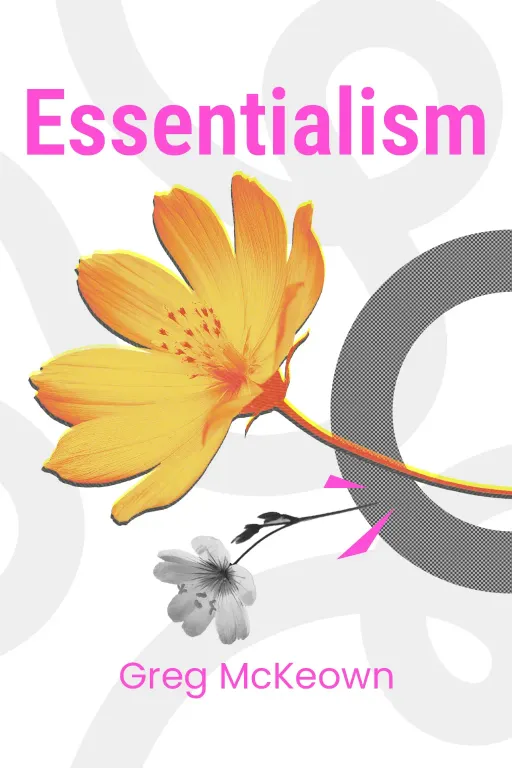
Nova: Exactly, Atlas! We're conditioned to believe that busyness equals productivity, and that constant expansion is the only path to growth. But this mindset often leads to a different kind of growth—the kind that spells burnout, overwhelm, and ultimately, less impact. Today, we're diving into a calmer, more strategic approach, drawing insights from two phenomenal books: by Greg McKeown and by Gary Keller and Jay Papasan.
Atlas: Oh, I've heard whispers about McKeown. Wasn't he a consultant who realized his own success was leading him down a path of scattered priorities, prompting him to write to help people reclaim focus?
Nova: Precisely! McKeown, after years witnessing and experiencing the paradox of success leading to overwhelm, became a passionate advocate for deliberate choice in a world of endless demands. And these insights fundamentally solve the problem of overwhelm by offering a path to clarity, discipline, and greater effectiveness through intentional choice.
Atlas: That makes a lot of sense, especially for early-stage founders trying to juggle product development, team building, and market fit all at once. What does this calmer approach actually look like?
The Tyranny of 'More' and the Power of Essentialism
SECTION
Nova: Well, let's start with what we call the "Cold Fact" – the idea that 'more is better' often leads to burnout and less impact. Think of it like a chef trying to cook a five-course meal, but instead of focusing on perfecting each dish, they start adding more ingredients, more techniques, more dishes to the menu, all at once. The result isn't a grand feast; it's chaos, diluted flavors, and an exhausted chef.
Atlas: Oh, I know that feeling! It’s like a founder trying to add every single feature request to their product, or chasing every potential partnership, thinking each one will be the silver bullet. But then you end up with a Frankenstein product and a team stretched thin.
Nova: Exactly! That’s where the power of essentialism comes in. McKeown argues that only by identifying what is truly essential can we make our highest contribution. It's not about doing more things; it's about doing the things. It's the disciplined pursuit of less, but better.
Atlas: But wait, how do you even begin to discern what's "essential" when everything feels urgent and important, especially when you're trying to prove a concept or grow a user base? For someone building a product, every feature, every user seems vital.
Nova: That's the core challenge, and it requires a shift in mindset. It’s about exploring, eliminating, and executing. Imagine a startup founder who, in their early days, said 'yes' to every potential client, every custom feature, every networking event. They were constantly busy, their calendar packed, but their product was becoming a collection of disparate requests rather than a cohesive vision. Their team was burnt out trying to support a sprawling, unfocused offering.
Atlas: Yeah, that’s a common trap. You want to please everyone, capture every opportunity. It feels counter-intuitive to turn things down when you're just starting out.
Nova: It does. But when this founder embraced essentialism, they took a hard look at their core value proposition. They identified their ideal customer and the one problem they were uniquely positioned to solve. They then ruthlessly eliminated or delayed features that didn't align with that core, even if they were 'good' ideas. They said 'no' to partnerships that didn't directly amplify their essential mission.
Atlas: And what happened? Did they just shrink their business?
Nova: Quite the opposite. By saying 'no' to good things, they were able to say 'yes' wholeheartedly to the things. Their product became sharper, their marketing clearer, and their team could focus their energy on excelling at what truly mattered. This led to a more loyal user base, stronger growth, and a much more sustainable operational rhythm. It’s about making deliberate, courageous choices.
The 'One Thing' Principle: Laser Focus for Sustainable Growth
SECTION
Nova: And that brings us perfectly to by Gary Keller and Jay Papasan, which provides a tactical blueprint for this essentialist mindset. If essentialism is the philosophy, "The One Thing" is the practical hammer.
Atlas: I'm curious. What exactly is "The One Thing" in their framework? Is it just about picking your top priority?
Nova: It goes deeper than that. Keller and Papasan propose a "focusing question": "What's the ONE Thing I can do such that by doing it everything else will be easier or unnecessary?" It's not just about prioritizing; it's about identifying the lead domino. You knock down that one big domino, and it sets off a chain reaction, making all the subsequent, smaller dominos fall seemingly effortlessly.
Atlas: That’s a great analogy! So, for an early-stage founder focused on product growth, what might their 'one thing' look like? Is it always user acquisition, or could it be something else entirely?
Nova: It’s rarely just "more users." Let's take a founder with a new social app. Initially, they might think their 'one thing' is getting a million downloads. But if their app has a terrible onboarding experience, those users will just churn. So their "one thing" might actually be to "identify and fix the three biggest friction points in the first-time user experience." By doing that, they ensure that every new user who comes in is far more likely to stick around, making all their future marketing efforts infinitely more effective.
Atlas: That’s a powerful distinction. It’s not about the most obvious task, but the task that creates leverage for everything else. So, if you fix the retention, then user acquisition becomes easier because you're not pouring water into a leaky bucket.
Nova: Exactly. It's about finding that strategic leverage point. By focusing intensely on that one critical thing, they unlock disproportionate results. It’s about working smarter, not just harder. This approach cultivates clarity, discipline, and greater effectiveness.
Atlas: I can see how that would cut through a lot of the noise and overwhelm. And it ties directly into the "Tiny Step" you mentioned earlier. What's one tiny step someone could take this week to start applying this?
Nova: A perfect question, Atlas. Our "Tiny Step" for this week is simple: identify one non-essential task you can eliminate or delegate this week to free up time for your most important work. Maybe it’s an unnecessary meeting, a report no one reads, or a task you’ve been doing out of habit. Just one.
Atlas: That sounds actionable. It's not about overhauling your entire life overnight, but finding one small win.
Synthesis & Takeaways
SECTION
Nova: Ultimately, what McKeown, Keller, and Papasan teach us, and what Nova’s Take really emphasizes, is that true growth isn't about constant, frantic hustle. It's about calm, focused intention. It’s about making deliberate choices to create sustainable success and impact, rather than just reacting to every demand.
Atlas: It’s incredibly counter-intuitive, isn't it? To achieve more, you must consciously choose to do less. It's a radical reframing of what productivity and success look like for a founder. How does this mindset impact not just the business, but the founder's well-being and the team's health?
Nova: By embracing this focus, founders cultivate clarity, discipline, and greater effectiveness, which directly translates to preventing burnout. When the leader is clear on priorities, the team aligns, resources are optimized, and the entire organization moves with purpose, rather than just motion. It builds a foundation for true, lasting impact, not just chasing fleeting metrics. It’s about designing a life and a business where you can thrive, not just survive.
Atlas: That makes perfect sense. It’s about building a sustainable engine, not just burning fuel as fast as you can. It’s about achieving mastery through focus.
Nova: Absolutely. So, for our listeners, we challenge you: What’s your one non-essential task you can shed this week? And what’s the one essential thing that, if you focused on it, would make everything else easier?
Atlas: Take that tiny step towards a calmer, more impactful entrepreneurial journey.
Nova: This is Aibrary. Congratulations on your growth!