The Leadership Dyad: Unlocking Agency and Empathy in The Mind Club
Golden Hook & Introduction
SECTION
Shakespeare: Imagine you're a leader. A crucial deadline looms, a veritable tempest on the horizon. Do you rally the troops, demanding sacrifice for the sake of the goal, becoming a paragon of pure? Or do you shield them from the storm, tending to their morale, their fears, their? This is no mere management choice. It is the central drama of the human mind.
Hermione: And it's a drama we all live, whether we're leading a team, an innovation project, or just ourselves. It's that constant pull between being a 'doer' and a 'feeler'.
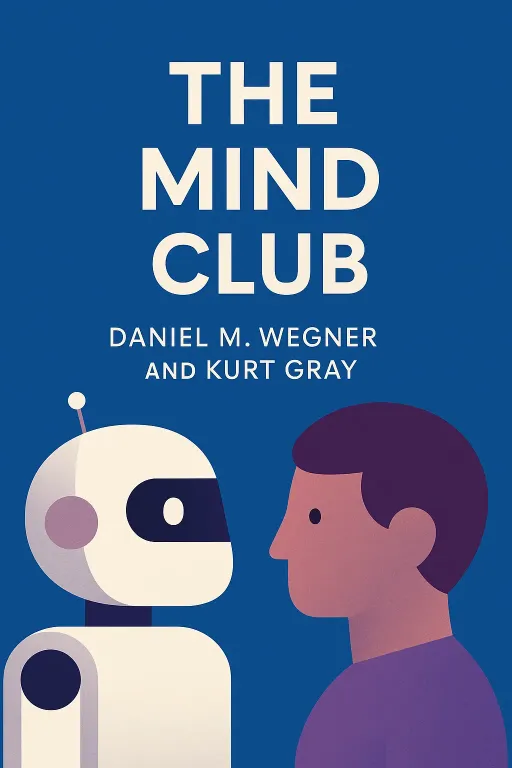
Shakespeare: Precisely. And today, we're diving into a book that gives us a map to this very territory: by Daniel Wegner and Kurt Gray. It argues that our entire moral universe, our sense of right and wrong, is built on this one fundamental split. Today we'll dive deep into this from two perspectives. First, we'll unpack the two fundamental dimensions of any mind—agency and experience—and see how they create the essential tension in leadership.
Hermione: Then, we'll expand our view to explore the fascinating and often paradoxical 'minds' of groups and machines, and what that means for innovation, creativity, and even self-care in our hyper-connected world.
Deep Dive into Core Topic 1: The Two Faces of Mind: Agency and Experience
SECTION
Shakespeare: So, Hermione, let's begin with the book's most powerful revelation. It posits that when we look at another being, we're not just seeing 'more' or 'less' mind. We're subconsciously judging them on two distinct scales: Agency and Experience.
Hermione: Can you break those two down for us?
Shakespeare: Of course. Think of Agency as the mind of a doer. It is the capacity for thought, for planning, for self-control and action. It's the part of the mind that executes a grand strategy or resists a fleeting temptation. Then, there is Experience. This is the mind of a feeler. It is the capacity for sensation—for pain, pleasure, fear, hunger, and joy. It's the raw, subjective quality of being.
Hermione: So, doing versus feeling.
Shakespeare: Exactly. And our moral world is built upon this divide. The book offers a wonderfully stark thought experiment to make this plain. Picture this scene: a cliff's edge. On one side, a baby, gurgling, full of potential joy and pain. On the other, a highly advanced robot, capable of complex calculations and actions. A sudden gust of wind threatens to send them both over. You can only save one. Who do you choose?
Hermione: The baby, of course. No question.
Shakespeare: And why? The robot may be more complex, more 'intelligent' in a computational sense. But the baby possesses a universe of Experience. We save it because we perceive its immense capacity to feel, to suffer. It is a being to be protected.
Hermione: Okay, that makes sense.
Shakespeare: But now, let us flip the stage. Imagine that same baby and that same robot are on a table next to a loaded gun. One of them accidentally knocks the gun off the table, and it goes off, injuring someone. Who do you hold responsible? Who do you blame?
Hermione: You'd blame the robot. Or, more accurately, its owner or programmer. You can't blame a baby; it doesn't know what it's doing.
Shakespeare: And there it is! You blame the robot because you perceive it as having high Agency—the capacity for action and control, even if flawed. The baby has no agency, so it cannot be held responsible. This reveals the core moral equation: we grant rights to those with Experience, and we assign responsibility to those with Agency.
Hermione: That's such a clear illustration. It's the difference between a moral —someone we must protect—and a moral —someone we hold responsible. In leadership, you're constantly navigating that. Your team members are patients in the sense that you're responsible for their well-being, their psychological safety, their experience at work.
Shakespeare: A profound point! You must see their capacity for experience.
Hermione: Exactly. But as a leader, you are judged almost entirely on your agency—your ability to plan, execute, and take responsibility for outcomes. If you're seen as all experience and no agency, you're perceived as perhaps kind, but ultimately ineffective. It's a balancing act.
Shakespeare: A tightrope walk upon the very definition of a mind.
Hermione: It really is. It reminds me of how public figures are perceived. Take Taylor Swift. Her brand is a masterclass in this. Her lyrics and persona project immense —vulnerability, heartbreak, joy. That's what creates the deep, empathetic connection with her fans. They see her as a moral patient, someone who feels deeply.
Shakespeare: The poet, whose heart is laid bare for all to see.
Hermione: Right. But her business acumen, her strategic re-recording of her albums to reclaim ownership, her meticulous control over her career—that's pure, undeniable. She's also a powerful moral agent. She's both the patient and the agent in the public story, and that's incredibly powerful because it makes her feel like a 'complete' mind to us. We can relate to her feelings and admire her actions.
Shakespeare: A brilliant connection! She commands both the heart and the head. The book argues this very balance is what we perceive as a 'full' human mind, worthy of both our empathy and our respect.
Deep Dive into Core Topic 2: Minds Beyond the Individual: Leading Groups and Machines
SECTION
Shakespeare: And that notion of a 'full mind' becomes even more curious when we look beyond single humans. What happens when the entity we're judging is not one person, but a group? Or not even a person at all, but a machine? This leads us to our second act: the minds of groups and machines.
Hermione: This feels very relevant to innovation and creativity, where you're always dealing with teams and technology.
Shakespeare: Indeed. And groups present a startling paradox. They can be sources of both breathtaking intelligence and terrifying mindlessness. Let me paint you a picture from 1907. The great scientist Sir Francis Galton is at a country fair. A prize is offered for guessing the weight of a slaughtered ox. Nearly 800 people, from farmers to clerks, write their guesses on tickets.
Hermione: A classic 'wisdom of the crowds' setup.
Shakespeare: Precisely. Galton, a man of numbers, collected the tickets, expecting to find folly. But what he found was astonishing. The ox weighed 1,198 pounds. The average of all 787 guesses? 1,207 pounds. The group's mind was off by less than one percent. A stroke of collective genius born from individual error.
Hermione: So the group mind can be brilliant.
Shakespeare: It can. But now, a darker scene. January 27th, 1986. A meeting of NASA engineers and managers. The question: is it safe to launch the space shuttle Challenger in the forecast's freezing temperatures? Individually, many engineers harbored grave doubts. They knew the rubber O-rings in the rocket boosters could fail in the cold. But in the group? Silence reigned. Each person looked around, saw no strong dissent, and mistook the group's silence for confidence.
Hermione: Groupthink.
Shakespeare: The deadliest form. They launched. Seventy-three seconds later, the Challenger was gone. The group, made of brilliant individuals, had become dumber and more reckless than any single one of its members.
Hermione: That's the tightrope every leader of an innovative team walks. How do you create the conditions for the 'wise crowd' effect and avoid the pitfall of 'groupthink'? The book seems to suggest it's about preserving individual agency within the group, ensuring people don't feel deindividuated or lost in the crowd.
Shakespeare: Precisely! Deindividuation, where the self is lost to the mob. And this is amplified when we bring machines into the mix. The book talks about the famous Turing Test—can a machine fool us into thinking it has a mind?
Hermione: Which is no longer a thought experiment, is it? We interact with AI like ChatGPT daily. I've seen people in creative fields get frustrated and say 'the AI is being stubborn today' or 'it just doesn't get me.' We're attributing agency—and a lack of understanding—to it, just like the robot in the first example.
Shakespeare: We perceive a mind, and then we judge it.
Hermione: Exactly. And from an innovation standpoint, the leader's job is to frame the AI correctly. Not as a flawed agent to get angry at, but as a powerful tool with specific capabilities. It's about managing the team's perception of the machine's 'mind'. If you let them see it as a stubborn, unfeeling agent, they'll get bogged down in frustration. If you frame it as a tool, they'll leverage its strengths for creativity.
Shakespeare: So the leader's role is to be the chief 'mind perceiver' for the team, defining the relationship with the technology.
Hermione: I think so. And that's a form of self-care too, which is something I'm really focused on. If you're in an online group, for example, recognizing the dynamics of deindividuation and anonymity can help you protect your own mindset. You can see a mob forming and consciously decide not to get swept up in it, preserving your own sense of agency and experience. You recognize the 'group mind' for what it is and choose not to join.
Shakespeare: A shield of awareness against the madness of crowds. A truly powerful application of these ideas.
Synthesis & Takeaways
SECTION
Shakespeare: So, we find ourselves at the end of our brief journey. From the lone leader to the teeming crowd, from the gurgling babe to the thinking machine, this perception of mind, this delicate dance of Agency and Experience, is the invisible script directing our moral lives.
Hermione: It really is a fundamental shift in perspective. It's not just an abstract philosophical idea. It’s a practical framework for understanding why we trust certain leaders, how we can build more creative teams, and even how we can be more mindful in our own lives.
Shakespeare: Well said. So, as we part, what final thought, what call to action, would you leave our listeners with, Hermione?
Hermione: I think it's a powerful lens for self-reflection. So, for everyone listening, the next time you're leading a meeting, collaborating on a project, or even just arguing with a chatbot, take a second. Ask yourself: What kind of mind am I seeing here? Am I focused only on what it can, its agency? Or am I also making space for what it might, its experience? Getting that balance right might be the most creative and innovative act of all.
Shakespeare: A perfect closing thought. To see the mind in others, and in doing so, to better know our own.