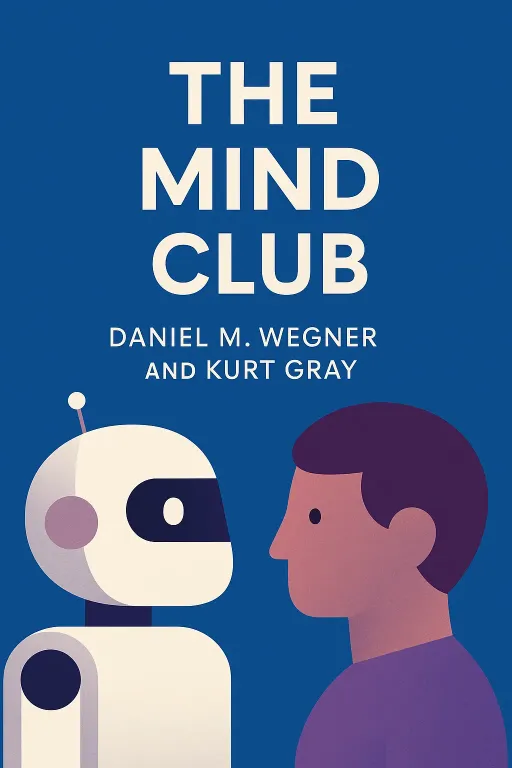
Decoding Connection: Inside the Mind Club of Empathy and Relationships
Golden Hook & Introduction
SECTION
Dr. Celeste Vega: In the 1980s, London police arrested a man named Dennis Nilsen. He was a serial killer who had murdered fifteen young men in his apartment. But as the police were taking him away, his primary concern wasn't his life sentence. It was for his dog, Bleep. He was terrified about what would happen to his dog.
yiopp: That's… deeply unsettling. To care so much for an animal and so little for human beings.
Dr. Celeste Vega: Exactly. How can a person show such profound indifference to human life, yet such deep care for an animal? This disturbing paradox gets to the heart of a huge question: how do we decide who, or what, has a mind worthy of our care? It’s the central mystery of the book 'The Mind Club' by Daniel Wegner and Kurt Gray, and it’s what we’re exploring today with our guest, yiopp. Welcome!
yiopp: Thanks for having me, Celeste. That opening story is already spinning in my head. It feels central to so many questions about empathy and connection.
Dr. Celeste Vega: It really is. And the book gives us a fascinating toolkit to unpack it. So today, we're going to tackle this from two angles. First, we'll explore the fundamental building blocks of how we see minds—the twin pillars of Experience and Agency. Then, we'll discuss the dramatic consequences of this perception, looking at how it leads us to 'typecast' people as either heroes or victims, often with profound effects on our empathy.
yiopp: I'm ready. It feels like understanding this could be a key to understanding our relationships, not just with others, but with ourselves.
Deep Dive into Core Topic 1: The Two-Dimensional Mind: Experience vs. Agency
SECTION
Dr. Celeste Vega: Perfect. So let's start with that first piece of the puzzle. The authors of 'The Mind Club' argue that we don't just see minds on a simple scale of 'more' or 'less.' Instead, our brains perceive mind along two totally different dimensions. The first is.
yiopp: Okay, what falls under Experience?
Dr. Celeste Vega: Think of it as the capacity to feel. It’s about hunger, fear, pain, pleasure, rage, desire, consciousness. It's the lights being on inside. It’s the part of a mind that can suffer.
yiopp: So, a vulnerable feeler.
Dr. Celeste Vega: Precisely. The second dimension is. This is the capacity to. It’s about self-control, planning, memory, thought, and communication. It’s the ability to act on the world, to have intentions and carry them out.
yiopp: A thinking doer.
Dr. Celeste Vega: Exactly. A vulnerable feeler and a thinking doer. And the book has this brilliant thought experiment to show how we use these two dimensions to make moral judgments. Are you ready for it?
yiopp: Let's do it.
Dr. Celeste Vega: Okay. Imagine you're on a cliff. A baby and a hyper-advanced, friendly robot are about to fall off. You can only save one. Who do you save?
yiopp: The baby. No question. It's not even a choice.
Dr. Celeste Vega: Right. Almost everyone says the baby. Now, second scenario. A loaded gun is left on a table. It accidentally goes off, and someone is hurt. Who do you hold morally responsible: a baby who crawled up and somehow pulled the trigger, or the hyper-advanced robot that knocked it over?
yiopp: The robot, for sure. You can't blame a baby. A baby has no concept of what it's doing. The robot, you'd assume, has programming, some level of intention or at least complex decision-making.
Dr. Celeste Vega: You just perfectly demonstrated the core thesis! We save the baby because we perceive it as having immense —the capacity to feel, to have a life. But we blame the robot because we perceive it as having high —the capacity for intention and action. The authors argue this is our hidden moral grammar: we grant moral —the right to be protected from harm—to beings we see as 'experiencers.' And we assign moral —blame or praise—to beings we see as 'agents.'
yiopp: Wow. Okay, that's… that's a framework that explains so much. It's like a formula for our intuition. It immediately makes me think about love relationships. When a relationship is healthy and connected, you see both dimensions in your partner, right? You see their agency—their goals, their thoughts—and you feel their experience—their joys, their fears.
Dr. Celeste Vega: Yes, absolutely.
yiopp: But in a conflict, it's so easy to reduce them to just one of those. I might see my partner only as an 'agent'—'You didn't do the thing you said you'd do!'—and I'm completely forgetting the 'experiencer' who might be feeling hurt, or overwhelmed, or scared. In that moment, I'm basically stripping them of their vulnerability in my own mind.
Dr. Celeste Vega: You've hit on something huge there. You're denying their 'Experience' mind. And the authors would say that empathy is fundamentally, almost definitionally, about connecting with that 'experience' dimension. When you cut that off, you cut off empathy. You're no longer relating to a feeler; you're just dealing with a malfunctioning doer.
yiopp: A malfunctioning doer. That's a chillingly accurate way to describe how we can sometimes treat people we claim to love. It's like we're temporarily kicking them out of the 'mind club' of beings who feel.
Deep Dive into Core Topic 2: Moral Typecasting and Dehumanization
SECTION
Dr. Celeste Vega: And that idea of reducing someone to just one dimension is the perfect bridge to our second topic: what the authors call 'moral typecasting.' They argue that our minds have a hard time seeing someone as both a full-blown agent a full-blown experiencer at the same time. We tend to lock them into one of two roles: a moral agent, the doer, or a moral patient, the feeler.
yiopp: So you're either the one punching or the one getting punched, but it's hard for us to imagine being both.
Dr. Celeste Vega: Exactly. A CEO who punches a little girl is a villain—a powerful agent acting on a vulnerable patient. A little girl who punches a CEO is… kind of funny. The moral equation doesn't compute. And this typecasting is the root of dehumanization. The book argues that when we want to harm someone, we engage in 'mechanizing'—we deny their capacity for Experience. We see them as a cold, unfeeling machine.
yiopp: Like in that Dennis Nilsen story. He must have 'mechanized' his victims. He saw them as objects for his fantasies, not as people who could feel terror and pain.
Dr. Celeste Vega: Precisely. It's a psychological prerequisite for that kind of cruelty. Think about wartime propaganda. The enemy is so often portrayed as a relentless, killing robot, or a faceless horde. It's a deliberate stripping away of their 'Experience' mind. It makes it psychologically easier to harm them because, in our perception, we've denied their capacity to suffer.
yiopp: That is so powerful. And it makes me think… it's not just about how we see our enemies. We do it to ourselves.
Dr. Celeste Vega: How do you mean?
yiopp: I'm thinking about self-care and burnout. That whole 'hustle culture' mindset, the pressure to be constantly productive… isn't that a form of self-mechanization? We treat ourselves like productivity machines, denying our own 'experience'—our exhaustion, our sadness, our need for rest—all in the name of 'agency' and just getting things done.
Dr. Celeste Vega: That is a brilliant connection. You're turning the lens inward.
yiopp: Yeah, and in that light, self-care isn't just about bubble baths. It's a radical act of re-humanization. It's about looking at yourself and saying, 'I am not just an agent. I am an experiencer. I have a right to feel, to be tired, to be vulnerable.' It's about consciously granting yourself full membership back into the mind club.
Dr. Celeste Vega: I love that framing. It's about granting yourself the same moral status—the right to be protected from harm, even harm you inflict on yourself—that you'd grant to any other vulnerable 'patient.' You're re-activating your perception of your own 'Experience' mind.
yiopp: And it makes sense why it's so hard. We're fighting against this deep-seated tendency to typecast. We want to be the hero of our own story, the 'agent.' It's hard to accept that we're also the 'patient' who needs care.
Synthesis & Takeaways
SECTION
Dr. Celeste Vega: So, when we pull it all together, we have this incredible, almost hidden grammar of the mind. This fundamental split between Experience and Agency dictates who we care for, who we blame, and how we connect.
yiopp: And just being aware of that grammar is a superpower. It helps us see when we're flattening people—or ourselves—into one-dimensional cartoons. It's the difference between seeing a person as a problem to be solved versus a being to be understood.
Dr. Celeste Vega: Beautifully put. It's about moving from judgment to curiosity. So, if we were to leave our listeners with one actionable takeaway from 'The Mind Club,' I think it would be this: a simple question to ask yourself.
yiopp: I'm listening.
Dr. Celeste Vega: The next time you feel a disconnect in a relationship—with a partner, a friend, a colleague, or even yourself—just pause and ask: 'In this moment, am I seeing them primarily as a doer or as a feeler? An agent or an experiencer?'
yiopp: That's it. You don't even have to have the answer right away.
Dr. Celeste Vega: Not at all. The authors would suggest that just asking the question can be enough to disrupt the typecasting. It forces you to look for the dimension you've been ignoring. If you're angry because they 'did' something wrong, it forces you to wonder how they 'feel.' That simple shift can be the key that reopens the door to empathy.
yiopp: It's about consciously choosing to see the whole person, the whole mind. Not just the part that's convenient for our anger or our narrative. And that choice, I think, is the real foundation of empathy.
Dr. Celeste Vega: I couldn't agree more. It’s how we truly welcome others—and ourselves—into the mind club. yiopp, thank you so much for this conversation.
yiopp: Thank you, Celeste. This has given me so much to think about.