The Network Effect is a Trap: Why You Need Antifragility for Innovation.
Golden Hook & Introduction
SECTION
Nova: Atlas, quick game. 'Antifragility for Innovation' in five words. Go.
Atlas: Oh, I love this! Painful, necessary, powerful, game-changing, growth.
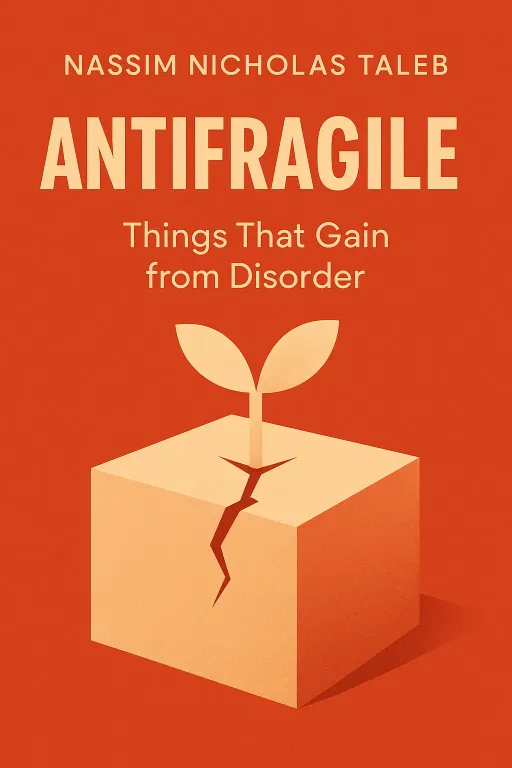
Nova: Ooh, I like that. 'Painful necessary' hits different. And it perfectly sets the stage for what we're diving into today: a concept that challenges everything we think we know about strength and stability. We're talking about Nassim Nicholas Taleb's groundbreaking work,. Now, Taleb isn't your typical academic; he's a former options trader, a statistician, and a philosopher, which gives him this incredibly unique lens on risk, uncertainty, and how systems genuinely thrive.
Atlas: That’s a fascinating background, and it makes so much sense given the book's core idea. And when you talk about 'gaining from disorder,' my mind immediately jumps to Eric Ries and. Ries’s whole philosophy of validated learning, of 'build-measure-learn' cycles, and knowing when to pivot or persevere… it feels like the practical application of what Taleb is theorizing. It’s about taking those abstract ideas of benefiting from chaos and turning them into actionable strategies for innovators.
Nova: Absolutely. It’s like Ries gave us the 'how-to' manual for building antifragile businesses, even if he didn't explicitly use that term. Today, we're cutting through the noise to show you why simply being robust isn't enough, and how to actually engineer your way to something far more powerful.
The Blind Spot: Beyond Robustness to Antifragility
SECTION
Nova: So, let's unpack this. We often hear about robustness, right? We want our systems, our businesses, our even our physical bodies, to be robust—to withstand shocks. Or resilience, which means you get knocked down, but you bounce back. But Taleb introduces a third, far more potent category: antifragility. It’s not just about resisting or recovering. It’s about from disorder, volatility, even mistakes. Think of it like a package: robust means it arrives intact. Resilient means it gets a bit squashed but still delivers the goods. Antifragile? That package arrives stronger because of the journey.
Atlas: Okay, but wait, isn't being robust good enough? I mean, for a lot of our listeners who are strategists or architects, the goal is often to build something solid, something that just. Most people just want things to not fall apart, right? Why aim for something more complex if stability is the primary goal?
Nova: That's the blind spot, Atlas. The trap of only aiming for robustness. Take the Roman road system, for instance. Incredibly robust for its time. It withstood centuries of wear and tear, armies marching over it, trade routes… But it couldn't adapt. When new transportation technologies emerged, or when the empire itself shifted, those roads, for all their strength, became obsolete. They resisted shock but couldn't. A robust system can become a dead end precisely because it's so rigid.
Atlas: That makes sense. So, a robust system can be a dead end. What’s the for actually gaining from disorder? How does something get stronger by being exposed to stress? For someone with a conceptual mind, like many of our listeners, understanding the 'why' is key.
Nova: The mechanism often lies in asymmetry and optionality. Taleb argues that antifragile systems have more to gain from upside volatility than they have to lose from downside volatility. They have built-in redundancy, or they learn from small failures. Think about a muscle: when you lift weights, you're intentionally introducing micro-tears, small stressors. Those aren't catastrophic; they signal the muscle to repair itself, but stronger. That's gaining from disorder on a biological level. And this is exactly where Eric Ries comes in with the Lean Startup. His validated learning cycles are essentially controlled stressors. You release an MVP, a Minimum Viable Product, knowing it’s imperfect. The feedback you get, the 'disorder' from the market, doesn't kill the startup. It provides crucial data to pivot and improve, making the product, and the business, stronger.
Atlas: So, instead of building a brick wall and hoping it never gets hit, we’re building something that learns how to build better walls by testing different bricks in the wind. That’s a powerful reframing for anyone trying to make a lasting impact.
Intentional Stressors: Engineering Growth from Volatility
SECTION
Nova: Exactly. And if we want to gain, we can't just passively wait for shocks to happen, right? We have to proactively seek them out. How do we do that intentionally in our plans, in our innovation?
Atlas: This is where the rubber meets the road for anyone trying to build something lasting. How do you for beneficial chaos? Because for a strategist or an architect, deliberately introducing problems sounds counterintuitive to developing a solid plan.
Nova: It’s about introducing what we call "controlled stressors." It’s not about inviting catastrophe. It’s about creating environments where small, manageable failures or challenges can occur. Think of a software company that runs 'chaos engineering' experiments, intentionally taking down a small part of their system to see how the rest responds. They're not trying to break everything; they're looking for the weakest links in a controlled environment to strengthen them. Or, going back to the MVP, a startup deliberately releasing a product they know is imperfect. The 'imperfection' is the intentional stressor. The market feedback provides the disorder, and the startup gains from it by learning and iterating.
Atlas: But how small is 'small' enough? And how do you know you're not just breaking things for the sake of it? For someone developing a solid plan, this sounds like deliberately introducing risk where you're trying to minimize it. It flies in the face of conventional risk management.
Nova: The key lies in the asymmetry of the stressor: the downside of the challenge is small and contained, but the upside of the learning and strengthening is significant. It’s like the athlete we mentioned: progressive overload in training. Small, controlled muscle damage leads to stronger muscles. That's a controlled stressor with asymmetric upside. Jumping off a cliff, on the other hand, is an uncontrolled, catastrophic stressor with no beneficial asymmetry. For our listeners who are problem-solvers and innovators, it's about asking: where can I create a low-cost, low-risk experiment that could reveal a high-value insight about my system's weaknesses?
Atlas: That’s a great analogy. So, it's like an architect testing small structural models in a wind tunnel to find design flaws, rather than just building the skyscraper and hoping it stands up to a hurricane. It’s about building those feedback loops into the very foundation of your work.
Nova: Precisely. It’s about building in those feedback loops, those 'wind tunnels' for your ideas, for your business blueprint, to let the system tell you where it's weak so you can strengthen it the real storm hits. It transforms potential threats into opportunities for accelerated growth.
Synthesis & Takeaways
SECTION
Atlas: Okay, so the big takeaway here is that waiting for failure isn't enough. We need to our own beneficial failures. But for someone with a conceptual mind, who’s always building robust foundations, how do they start doing this? It sounds a bit counterintuitive to deliberately seek out problems when your goal is to build something lasting.
Nova: It's about shifting from a defensive posture to an offensive one. Instead of just protecting against failure, we design for growth failure. For our listeners, especially those building ambitious plans, the challenge is simple yet profound: identify one small, safe area in your current plan where you can intentionally introduce a stressor this week. A minor 'break' to reveal a hidden strength. Maybe it's testing a new feature with a tiny user group, or running a small, controlled experiment with a slightly different process. The goal isn't to fail, but to from the inevitable friction.
Atlas: A minor break for a major breakthrough. I love that. So, it’s not just about trusting your vision; it’s about rigorously testing your vision to make it not just unbreakable, but truly antifragile. That’s how you ensure your legacy isn't just solid, but ever-evolving.
Nova: Exactly. It's about building solutions that don't just survive the unpredictable nature of real-world problems, but actually get stronger because of them. This is Aibrary. Congratulations on your growth!