The 'Jobs-to-be-Done' Lens: Uncovering True Market Needs for Lasting Retention.
Golden Hook & Introduction
SECTION
Nova: Atlas, quick game: I say a common product, you tell me the "job" you're hiring it for, not just what it is. Ready?
Atlas: Oh, I like this. Hit me.
Nova: Alright, a drill.
Atlas: Oh, easy. I'm hiring a drill to make a hole. Not to a drill, but to a hole.
Nova: Exactly! Okay, how about a social media app?
Atlas: Hmm. Not to scroll mindlessly, though that happens. I'm hiring it to connect with friends, share an experience, maybe even to escape boredom for a few minutes. It's a connection or a distraction job.
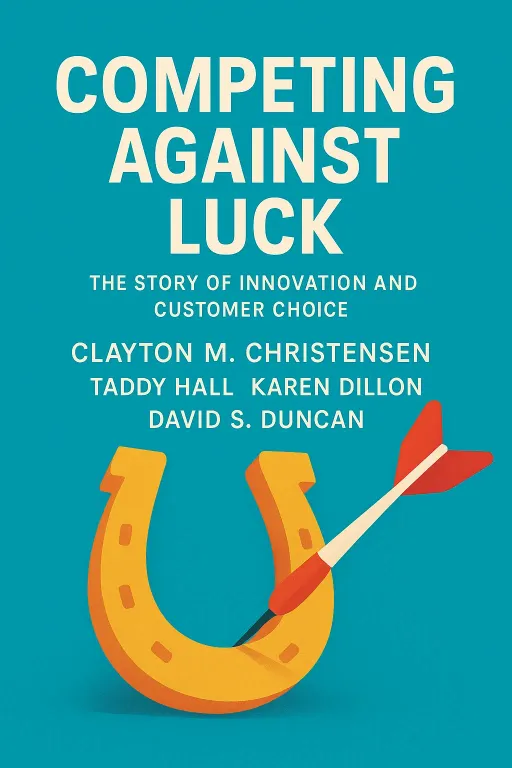
Nova: Fascinating. And today, we're diving into the genius behind that kind of thinking, largely thanks to Clayton M. Christensen's groundbreaking work, especially in his book "Competing Against Luck," and the complementary insights from Eric Ries's "The Lean Startup." Christensen, a Harvard Business School professor, wasn't just an academic; he was a brilliant disruptor who fundamentally reshaped our understanding of innovation before his passing, leaving a legacy that's widely acclaimed for its practical business wisdom. He and Ries show us how to uncover true market needs.
Atlas: That makes sense. But wait, this idea of "jobs" can sound like another piece of business jargon. How do we make sure we're not just swapping out "features" for "jobs" and still missing the point? For someone trying to cast a vision for a new product, how do they even begin to uncover these hidden 'jobs' and avoid just adding another buzzword to their pitch?
The 'Jobs-to-be-Done' Framework: Beyond Features to Fundamental Needs
SECTION
Nova: That’s the core question, isn't it? The beauty of Christensen's Jobs-to-be-Done theory is its radical simplicity: customers don't buy products; they "hire" them to get specific "jobs" done in their lives. It's not about the product itself, but the progress a customer is trying to make. And the classic illustration of this is what's famously known as "The Milkshake Problem."
Atlas: The Milkshake Problem? You've got my attention.
Nova: So, a major fast-food chain wanted to sell more milkshakes. Naturally, their instinct was to improve the milkshake itself. They made them thicker, cheaper, added more flavors, ran promotions. But sales… they just didn't budge. They were looking at the product through the wrong lens.
Atlas: I imagine a lot of our listeners, especially founders or product managers, have faced similar frustrations. You pour resources into improving features, and the market just… shrugs.
Nova: Precisely. So, Christensen's team came in. Instead of asking customers what features they wanted, they observed them. They stood in the restaurant, watching people buy milkshakes. And what they found was revolutionary. A huge percentage of milkshakes were being bought early in the morning by commuters, alone.
Atlas: Early morning? That's not the typical milkshake demographic, is it?
Nova: Exactly! They interviewed these commuters. And what they discovered was the "job" these people were hiring the milkshake to do. It wasn't about the taste as much as it was about the commute. They needed something that would keep them full, that was easy to eat with one hand while driving, that wouldn't make a mess, and that would last the entire boring drive to work. A bagel was too crumbly, a banana was gone too fast, a candy bar wasn't filling enough. The milkshake, thick and substantial, was perfect. It took a long time to drink, keeping boredom at bay, and didn't spill.
Atlas: Wow. So, it wasn't a breakfast food; it was a "make my commute tolerable and keep me full for a bit" solution. That’s a fundamentally different job than, say, a parent buying a milkshake for their kid as an afternoon treat, where the job might be "make my child happy without too much guilt."
Nova: You've got it! The same product, hired for completely different jobs. Once the chain understood this, they stopped focusing on traditional milkshake improvements. They made it even thicker to last longer, added small fruit chunks to make it more interesting, and optimized the ordering process for speed. Sales skyrocketed. It wasn't about the of the milkshake, but the of the customer's life.
Atlas: That’s incredible. It completely flips the script. For someone trying to inspire a growing team, this concept might feel impossible to implement without a huge research budget. How do you even begin to uncover these hidden 'jobs' without hiring a team of anthropologists?
Validated Learning & Rapid Experimentation: Building What Customers Truly Want
SECTION
Nova: That naturally leads us to the second key idea we need to talk about, which often acts as a critical partner to Jobs-to-be-Done: Eric Ries's "The Lean Startup" and its emphasis on validated learning. Once you identify a potential job, the Lean Startup provides the methodology to build the solution efficiently, without wasting precious resources or burning out your team.
Atlas: Okay, so it’s about testing those job hypotheses? Because identifying the job is one thing, but building something that actually does it well is another beast entirely.
Nova: Precisely. Ries advocates for a continuous feedback loop: Build, Measure, Learn. You start with a Minimal Viable Product – an MVP – which is the smallest thing you can build to test your core hypothesis about the job and your solution. Then you measure how users interact with it, and most importantly, you from those interactions to decide whether to pivot, persevere, or even stop.
Atlas: So it's not just about getting numbers, it's about getting the numbers that tell you if you're actually solving the job. I imagine that's a huge shift for many strategists who are used to big launches and then hoping for the best.
Nova: Absolutely. Think about the trap of "vanity metrics." We see this all the time with new apps or platforms. A startup might proudly announce they've achieved millions of downloads. Everyone celebrates. But if you dig deeper, you find that users download it, open it once, and never return. The "job" isn't actually getting done, or the solution isn't suitable.
Atlas: So, those millions of downloads are just noise, not a signal of true value. It's like the fast-food chain celebrating how many milkshakes they, not how many solved a customer's commute problem.
Nova: Exactly! In a Lean Startup approach, instead of a full-scale launch based on a vanity metric like downloads, they'd release that MVP to a small, targeted group. They'd measure – how often people use it, for how long, what features they interact with. Crucially, they'd interview those users to understand they stay or leave, what pain points remain, what unexpected jobs the product might be doing. They'd iterate rapidly based on, not just activity.
Atlas: That’s huge for a strategist. But when you're trying to build a 'dream team,' especially in a fast-paced environment, how do you foster this culture of rapid experimentation without burning people out or making them feel like their efforts are constantly being rewritten? Conscious delegation is one thing, but constant change can be demoralizing.
Nova: That’s a critical point, and it’s where leadership comes in. Validated learning isn't about throwing out work; it's about work. You define the riskiest assumptions about the "job" and the "solution," and you design the smallest experiment to test them. It's about clarity of purpose for each sprint, even if that purpose is to invalidate an idea quickly. You empower teams to own those small experiments, to learn, and to bring that learning back. It actually reduces burnout in the long run because you're not building massive features that nobody wants. You're building with purpose and continuous feedback, which fosters a sense of impact and progress.
Synthesis & Takeaways
SECTION
Nova: The magic happens when Jobs-to-be-Done informs to build – that deep, empathetic understanding of what customers truly need – and Lean Startup informs to build it effectively and efficiently. It’s about combining profound empathy with agile execution.
Atlas: So, for our listeners who are vision-casting or even fundraising, this isn't just product development jargon. It's about articulating a much deeper value proposition. Instead of saying "we have X features," you're saying "we help people accomplish Y crucial job, and we have a validated, iterative process to ensure we do it well." That's a powerful narrative for investors and for inspiring a team. It's about trusting that inner compass, as our growth recommendations suggest, but validating its direction with real customer needs. It offers clarity, defines vision, and provides strategic foresight.
Nova: Absolutely. It moves you from guessing to knowing, from building features to solving fundamental problems. It’s the ultimate retention strategy because you're consistently meeting a deep-seated need.
Atlas: So, what 'job' is your product truly hired to do, and how might that understanding change your next design sprint, or even your next investor pitch? That's the question I'm leaving with today.
Nova: A brilliant question to ponder. Thank you for joining us today, Atlas, and thank you all for listening.
Atlas: Always a pleasure, Nova. We hope our discussion sparks some profound insights for your own journey.
Nova: This is Aibrary. Congratulations on your growth!