The 'Good Idea' Trap: Why You Need Structured Creativity to Innovate.
Golden Hook & Introduction
SECTION
Nova: Most people believe creativity is this mystical, elusive lightning bolt that strikes only a chosen few. You either have it, or you don't. And if you don't, well, your brilliant ideas are doomed to remain just that: brilliant, but forever trapped inside your head.
Atlas: Oh, I know that feeling. So, you're saying all those "good ideas" I've had that never went anywhere, it wasn't because they weren't good enough, but because I was just waiting for the muse to show up again? That's a bit of a relief, but also a challenge.
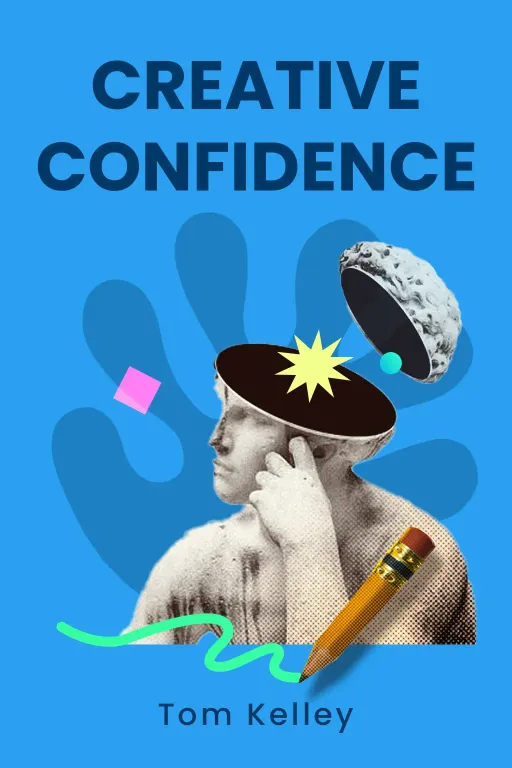
Nova: Exactly! Today, we're diving headfirst into "The 'Good Idea' Trap," exploring why innovation isn't just about having those initial sparks, but about systematically fanning them into a roaring fire. Our insights today are heavily inspired by two foundational books: "Creative Confidence" by Tom and David Kelley, and "The Lean Startup" by Eric Ries. What's fascinating about the Kelleys is their background with IDEO, the legendary design firm, where they literally built an empire on the idea that creativity is a learnable process for anyone.
Atlas: That's a game-changer. So, these books aren't just about abstract theories; they're about giving us a roadmap to turn those sparks into something real. I'm curious how they connect to give us that path.
Creativity as a Learnable Skill: Unlocking 'Creative Confidence'
SECTION
Nova: They connect beautifully. Let's start with "Creative Confidence." The core message from Tom and David Kelley is a profound one: creativity isn't a rare talent bestowed upon a lucky few, but a skill. It's a muscle you develop through practice, much like any other. They champion design thinking as the ultimate training regimen for this muscle.
Atlas: Wait, so it's not about being born a Picasso or a Steve Jobs? It's something I can actually? That sounds almost too good to be true, especially for our listeners who might feel they're stuck in a rut or that their industry isn't "creative."
Nova: Absolutely. Think about it like this: if you wanted to become a better chef, you wouldn't just sit around waiting for culinary inspiration to strike, right? You'd learn techniques, experiment with ingredients, follow recipes, and practice. Design thinking is the recipe and the techniques for creativity. The Kelleys, through IDEO, have demonstrated this countless times. One classic example is how they helped design a new patient experience for a hospital. Instead of just asking patients what they wanted, they used empathy, observing patients and staff, even having designers spend a night in a hospital bed themselves for firsthand experience.
Atlas: That's a great way to put it. I can see how that would be different from just a standard brainstorming session. So, it's not just about throwing ideas at a whiteboard. It’s about deeply understanding the problem first.
Nova: Precisely. From that deep understanding, they moved to ideation, generating hundreds of potential solutions, no matter how wild. Then, crucially, they moved to rapid prototyping. They'd build quick, rough versions of ideas—even just cardboard mock-ups or role-playing scenarios—to test them with real users, getting feedback early and often. This iterative process, this willingness to build, test, and learn, is what unlocks creative confidence. It takes the pressure off "getting it right" the first time and puts the focus on "learning fast."
Atlas: That sounds rough, but also incredibly liberating. I imagine a lot of our listeners struggle with that fear of judgment, that fear of putting out an "imperfect" idea. So, it’s like giving yourself permission to fail, but to fail forward?
Nova: Exactly! It's about reframing failure as feedback. The Kelleys argue that the biggest barrier to creativity isn't a lack of ideas, but the fear of execution, the fear of looking foolish. Design thinking provides a structured way to overcome that fear by making experimentation part of the process, almost a game. You're not failing; you're just learning what doesn't work so you can find what does.
Systematic Innovation: Validated Learning and Rapid Experimentation
SECTION
Atlas: So, we've got the confidence and the tools to be creative, to generate those innovative ideas. But what happens next? Even with all that creative energy, I've seen countless brilliant concepts just… fizzle out. That's where "The Lean Startup" comes in, right?
Nova: You've hit on the critical next step. Eric Ries's "The Lean Startup" is the perfect complement to "Creative Confidence." While the Kelleys give us the courage to create, Ries provides the rigorous framework to ensure those creations actually land and provide value. The core idea is "validated learning" through continuous build-measure-learn cycles.
Atlas: Okay, but isn't that just common sense? Why do we need a whole book for "test your ideas"? It sounds a bit out there, to be honest. And how does this apply to someone who isn't launching a tech startup? What about someone trying to innovate in their existing job or personal life?
Nova: That's a great question, and it's where the nuance lies. It seems like common sense, but the "validated learning" part is often overlooked. Most people build something they customers want, rather than something customers want. Ries highlights countless examples of startups that spent years and millions building elaborate products based on assumptions, only to fail spectacularly. The "lean" approach is about rigorously testing those assumptions with the smallest possible experiment.
Atlas: Can you give an example? Like how would that work in real life?
Nova: Think about the classic Dropbox story. Before they built a single line of complex code, founder Drew Houston created a simple video demonstrating how Dropbox would work. He posted it online, and within hours, sign-ups for a product that didn't even exist yet exploded. That video was their Minimum Viable Product, their MVP. It wasn't a fully functional product; it was the simplest possible experiment to validate the core assumption: "Do people want a seamless file synchronization service?" The answer was a resounding yes, and it saved them years of development on something that might not have resonated.
Atlas: Wow, that's incredibly smart. So, it's not just about building; it's about building the to answer your most crucial questions. That makes me wonder how someone could apply that in their own life, say, if they're trying to launch a new internal process at work or even change a personal habit.
Nova: Exactly! You're getting to the heart of it. If you're trying to introduce a new process at work, don't roll out a company-wide mandate. Start with one team, or even a small subset of that team. Measure their feedback, their efficiency. Is it actually solving the problem you thought it would? For a personal habit, like wanting to read more, don't commit to reading a book a week. Start with 15 minutes a day, measure your consistency, and adapt if it's not working. That's validated learning in action – constant small experiments, constant learning, constant adaptation.
Synthesis & Takeaways
SECTION
Atlas: This is powerful. It sounds like "Creative Confidence" gives us the permission and the initial toolkit to imagine boldly, to generate those ideas without fear. And "The Lean Startup" then gives us the rigorous framework, the disciplined process, to make sure that imagination isn't wasted, but systematically built into something real and valuable. It really gets us out of that 'good idea trap,' doesn't it?
Nova: It absolutely does. These books, together, underscore a profound truth: innovation isn't a magical spontaneous event; it's a disciplined craft. It’s about merging the courage to create with the rigor to validate. The real trap isn't lacking good ideas, it's lacking the structure to see them through, to learn from every attempt, and to continuously refine until you've created something truly impactful. It’s about embracing uncertainty through systematic exploration, ensuring your creative energy finds a powerful, directed path to concrete solutions instead of fading away.
Atlas: That's actually really inspiring. For our listeners who are brimming with unformed ideas, who are ready to trust their inner guide and really dedicate time to creative exploration, what's a "tiny step" they can take right now?
Nova: Here's your tiny step, and it's incredibly practical: Pick just one unformed idea you have – it could be for a new project, a personal goal, or even a solution to a daily frustration. Now, outline the first three steps you'd take to test its core assumption. Don't worry about perfection; just focus on the smallest possible experiment to learn something new.
Atlas: I love that. Start small, learn fast, and keep moving forward. That's a powerful way to end it.
Nova: This is Aibrary. Congratulations on your growth!