Stop Guessing, Start Leading: The Guide to UK Product Vision.
Golden Hook & Introduction
SECTION
Nova: Atlas, quick fire: What's the first thing that comes to mind when I say "product vision"?
Atlas: Oh, a beautifully crafted PowerPoint deck that lives in a shared drive, quietly gathering digital dust, only to be resurrected for quarterly reviews.
Nova: Precisely! And that's exactly what we're here to fix today, because the cold fact is, many brilliant product managers struggle to articulate a truly compelling vision.
Atlas: I know that feeling. It's not a lack of ideas, is it? It's more about how those ideas coalesce, or rather, coalesce into something tangible and actionable.
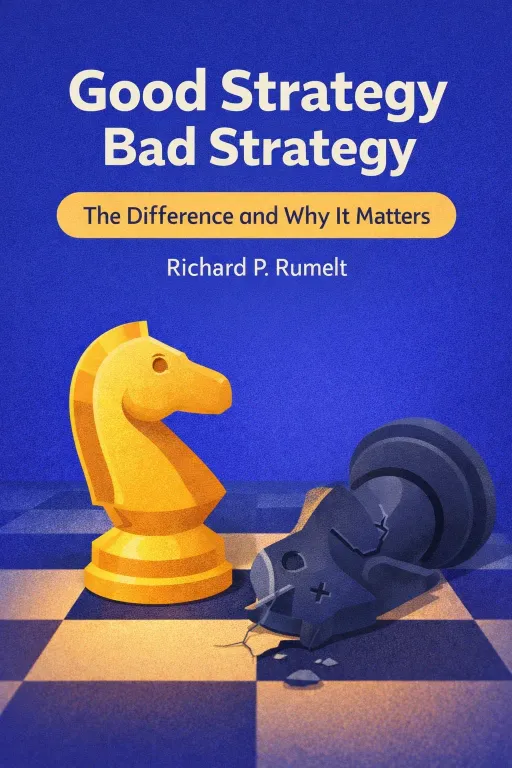
Nova: Exactly. It's a failure to define and communicate a coherent strategy that cuts through complexity and rallies a team. Today, we're diving into how to stop guessing and start leading your product vision, drawing inspiration from two foundational texts. The first is "Good Strategy/Bad Strategy" by Richard Rumelt.
Atlas: Ah, a classic. I've heard that one mentioned in countless boardrooms.
Nova: Rumelt's background is fascinating. He wasn't just an academic; he spent years consulting for major corporations, witnessing firsthand how often grand ambitions were mistaken for actual strategy. He essentially wrote this book out of frustration, seeing brilliant minds fail to articulate a coherent path forward.
Atlas: Which, I imagine, resonates with a lot of our listeners in high-stakes product roles, especially here in the UK market, where clarity and a clear path are everything. It’s hard to rally a team around a vague ambition.
The Kernel of Good Strategy: Diagnosing the Problem
SECTION
Nova: You've hit the nail on the head. Many companies mistake goals or ambition for strategy, leading to unfocused efforts. Rumelt argues that a good strategy has a "kernel." It’s composed of three essential parts: a diagnosis, a guiding policy, and coherent actions.
Atlas: Okay, so a "kernel." That makes me wonder, what distinguishes a good diagnosis from just identifying a problem?
Nova: That’s a crucial distinction. A good diagnosis isn't just saying "our sales are down." It's about unearthing the. It’s like a doctor not just noting a fever, but meticulously investigating the fever is there – is it a bacterial infection? A viral one? The diagnosis identifies the true nature of the challenge, the underlying causes, not just the symptoms.
Atlas: So you’re saying, for a Principal PM looking at, say, declining user engagement, it’s not enough to say "we need more engagement." They need to dig deeper into engagement is low. Is it a UI issue? A feature gap?
Nova: Precisely. The diagnosis reveals the pivotal aspect of the situation, the leverage point. Once you have that, the guiding policy outlines the overall approach for dealing with that diagnosis. It’s not a detailed plan, but a high-level strategic direction.
Atlas: That makes sense. It’s like, once the doctor diagnoses the infection, the guiding policy is "we need to eliminate the bacteria," rather than "prescribe antibiotic X, Y, Z."
Nova: Exactly! And then, coherent actions are the coordinated steps designed to carry out that guiding policy. They are consistent with the guiding policy and the diagnosis. They amplify each other, creating a powerful, focused attack on the critical challenge identified.
Atlas: But wait, isn’t having a big, ambitious goal enough to inspire a team? I mean, shouldn't a product vision be about a bold future state?
Nova: It's natural to think that. However, ambition alone isn't strategy. A grand goal without a clear diagnosis and a guiding policy can lead to a lot of wasted effort. Imagine a company whose goal is "to be the market leader in AI," but they haven't diagnosed why they're currently lagging, nor do they have a clear policy for how they'll achieve leadership. They’ll just throw resources at anything AI-related, hoping something sticks.
Atlas: That sounds rough, but I’ve seen it happen. So, for our listeners who are tasked with defining product vision, how do they actually this diagnosis? What's the first step in uncovering the real challenge, especially in a competitive market like the UK?
Nova: It starts with deep, critical analysis. Look at your market, your competitors, your customers, and your own capabilities. Instead of immediately jumping to solutions, spend time asking "why?" multiple times. Use frameworks like a SWOT analysis, Porter's Five Forces, or even just detailed customer journey mapping to truly understand the landscape and identify the one or two most critical challenges.
Atlas: It sounds like it's about asking uncomfortable questions, which can be tough in some corporate cultures where people prefer to focus on positive outcomes.
Nova: Absolutely. But courageous diagnosis is the bedrock of real leadership. It requires honesty and a willingness to confront difficult truths. Without it, your guiding policy will be built on sand, and your actions will be unfocused.
Validated Learning: Building an Adaptive Product Vision
SECTION
Nova: Once you have that solid kernel of strategy, diagnosing the problem and outlining your guiding policy, the next challenge is ensuring it doesn't become a static monument. This is where Eric Ries and "The Lean Startup" step in.
Atlas: Ah, "The Lean Startup." Another book that's practically gospel in the tech world.
Nova: Indeed. Ries emphasizes validated learning and continuous iteration. His framework helps you build a product vision that adapts to market feedback, avoiding the trap of rigid, unproven plans. It's all about the build-measure-learn loop.
Atlas: So you're saying, even with a strong strategy, you still need to be ready to pivot? But if you're constantly iterating and learning, doesn't that make the "vision" feel unstable? How do you maintain a long-term view while being so agile?
Nova: That’s a common misconception. The vision, the ultimate destination, provides the north star. Validated learning refines the to that star, not the destination itself. Think of it like a journey across the ocean: your vision is the destination port, but the build-measure-learn loop is your navigation system, constantly checking the winds, currents, and your actual progress, allowing you to adjust your sails and rudder to stay on course.
Atlas: That's a great analogy. It makes me wonder, in a fast-moving market like the UK, where customer expectations can shift quickly, how does this prevent resource waste on unproven ideas?
Nova: It's incredibly powerful for that. Instead of spending months or years building a perfect product based on assumptions, you identify your riskiest assumptions, build a Minimum Viable Product – an MVP – to test those assumptions with real customers, measure the results, and then learn from that data. This early, small-scale feedback helps you de-risk initiatives and build confidence, or pivot quickly if your assumptions are wrong.
Atlas: So basically you’re saying, don't build the whole car if you just need to test if people want to drive. Build a skateboard first.
Nova: Exactly! It’s about learning what customers want by observing their actual behavior, not just what they say they want. This continuous feedback loop ensures that your product vision evolves based on empirical evidence, making it much more robust and market-aligned.
Atlas: What's the "tiny step" here for someone who feels their current product roadmap is too rigid? How can they introduce this mindset without a complete overhaul?
Nova: Start small. Pick one feature or even a small part of an existing feature. Identify the single riskiest assumption underlying it. Then, design the smallest possible experiment – your MVP – to test that assumption. It could be a simple landing page, a mock-up, or even an email survey. Measure the results, learn, and then decide whether to persevere, pivot, or stop. It's a cultural shift towards learning, one tiny experiment at a time.
Atlas: That sounds like a manageable way to introduce this thinking without causing chaos. It gets people thinking about hypotheses instead of just requirements.
Synthesis & Takeaways
SECTION
Nova: So, we've gone from diagnosing fundamental strategic problems using Rumelt's kernel to building visions that learn and adapt through Ries's validated learning. It's about combining clarity of purpose with agility in execution.
Atlas: That "tiny step" from the book content – articulating your current product goal's kernel: the diagnosis, guiding policy, and first coherent action – suddenly feels incredibly powerful. It's not just an exercise; it's a strategic reset button.
Nova: Exactly. It's about transforming "guessing" into "leading" with intention. Imagine the confidence a team gains when they truly understand the "why" and see their efforts directly linked to validated insights, especially in the nuanced UK product landscape.
Atlas: It's a mindset shift, really. From hoping your vision is right, to building a vision that right through deliberate learning. That's a superpower for any leader trying to make a real impact.
Nova: Absolutely. For our listeners who are looking to elevate their strategic vision, try that tiny step this week. Take one product goal, diagnose its core challenge, define your guiding policy, and outline the first coherent action. It's a powerful way to start. This is Aibrary. Congratulations on your growth!