Stop Chasing Trends, Start Engineering Markets: The Guide to Revolutionary Products.
Golden Hook & Introduction
SECTION
Nova: What if the biggest mistake you're making with your revolutionary product isn't a lack of vision, but a fundamental misunderstanding of how markets actually adopt innovation?
Atlas: Oh, I know that feeling. It's like you've got this brilliant idea, you can see the future, but then the market just... doesn't get it. For impact-makers and strategists, that's a soul-crushing moment.
Nova: Exactly! It’s that invisible wall between your groundbreaking vision and the real-world success you crave. Many brilliant ideas, truly world-changing concepts, fade into obscurity not because they weren't good enough, but because their creators didn't understand this critical juncture where vision meets reality.
Atlas: So, you're saying it's not enough to just build a better mousetrap, even if it's a laser-guided, self-cleaning mousetrap? There's a whole strategic layer we're missing?
Nova: Absolutely. And that strategic layer is precisely what we're dissecting today. We’re talking about how to stop merely chasing trends and instead, new markets for your revolutionary products. Our guide for this journey is an insightful approach synthesized from two seminal works, captured in the essence of 'Stop Chasing Trends, Start Engineering Markets: The Guide to Revolutionary Products.' It's a framework that blends strategic market understanding with tactical, iterative innovation, ensuring your product doesn't just launch, but truly takes root and scales.
Engineering Revolutionary Markets - Part 1: Crossing the Chasm
SECTION
Atlas: Okay, so if we can't just expect our revolutionary idea to take off, where do we even begin? What's the first strategic hurdle a visionary needs to clear?
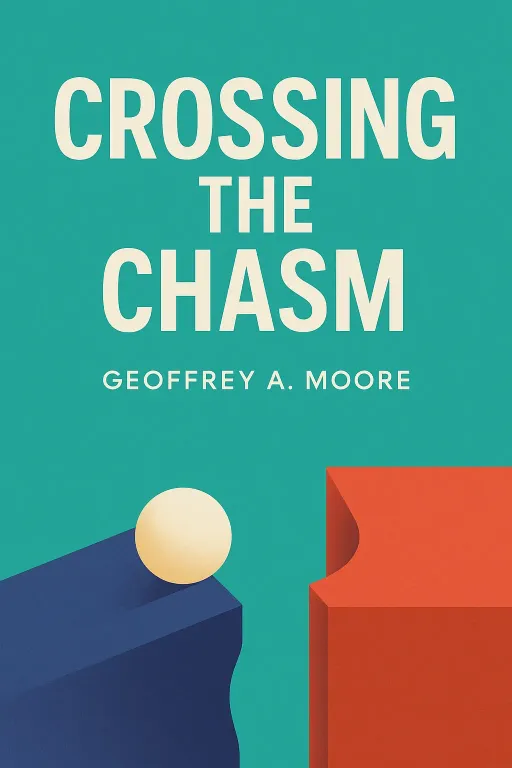
Nova: The first hurdle, and it’s a big one, is what Geoffrey Moore famously called 'Crossing the Chasm.' Moore, a brilliant strategist who helped shape Silicon Valley's understanding of tech adoption, observed that there's a treacherous gap between 'early adopters' – those tech enthusiasts and visionaries who love new things – and the 'early majority,' who are far more pragmatic and risk-aaverse.
Atlas: Wait, so is a great product not enough to bridge that gap? I always thought if you built something truly superior, people would eventually come.
Nova: That’s the common misconception, and it’s why so many innovative products stall. Think about the early days of personal computers. Enthusiasts, hobbyists, and some businesses were thrilled by them. But for the average person, a PC was complex, expensive, and didn’t immediately solve an obvious, urgent problem in their daily lives. The early adopters loved the, the early majority needed.
Atlas: So you're saying the mindset of the people buying your product fundamentally changes as you try to scale? It's not just more people, it's a different of people?
Nova: Precisely. The early majority doesn't want to be pioneers; they want solutions that are reliable, proven, and integrated. Moore argues that to cross this chasm, you can't try to appeal to everyone at once. You need a highly focused strategy: target a specific, small niche market within the early majority and win them over completely. Create a 'beachhead.'
Atlas: How do you even identify that perfect niche? For a visionary trying to change the world, isn't that limiting? It feels like we're being told to think small when our dreams are huge.
Nova: It's not about thinking small forever, Atlas, it's about strategizing smart. Imagine electric vehicles in their early stages. Instead of trying to sell to every family or commuter right away, some companies initially targeted specific segments like environmentally-conscious urban dwellers or tech-savvy early adopters who could afford a premium. They focused on proving the technology, building infrastructure, and demonstrating real-world value for. Once they dominated that niche, they had the credibility, resources, and customer stories to expand. It's about concentrated force, not diluted effort.
Atlas: That makes sense. So, instead of a broad, hopeful launch, it's about a surgical strike on a very specific problem for a very specific group, proving your value there, and then using that success as a springboard. That's a true strategist's move.
Engineering Revolutionary Markets - Part 2: The Lean Startup & Iteration
SECTION
Atlas: Okay, so we've identified our niche, our beachhead. But how do we build something that truly wins them over, without burning through all our resources trying to guess what they want? For the visionary, there's always that tension between holding true to the grand vision and adapting to what customers they want.
Nova: That's where Eric Ries's 'The Lean Startup' comes in, and it's the perfect complement to Moore's strategy. Ries emphasizes validated learning through rapid experimentation and iteration. Instead of grand, secretive launches based on assumptions, you build, measure, and learn. It’s about creating a Minimum Viable Product, an MVP, that delivers core value to your chosen niche, gets it into their hands quickly, and then relentlessly gathers feedback to refine it.
Atlas: So you're saying, for products that revolutionize, we shouldn't aim for perfection on day one? That feels counterintuitive for someone who wants to build something lasting.
Nova: It’s not about imperfection, it's about perfection. Think of it like a chef creating a revolutionary new dish. They don't spend years in secret, then unveil it to the world hoping it's a hit. They might create a small-batch version, invite a few trusted diners from their target audience, get their honest feedback, tweak the recipe, and iterate until it's perfect for specific palate. The 'lean' approach reduces risk dramatically because you're building what customers want, not what you they want.
Atlas: That’s a great analogy. So, it's like a continuous feedback loop: you build a little, test it, learn from it, and then build the next improved version. But doesn't 'lean' feel small for a truly revolutionary product? Visionaries want to make a big splash!
Nova: It’s about making a splash, Atlas, one that creates ripples rather than just a fleeting spray. Look at Instagram. It started as a check-in app called Burbn, but the founders noticed users were mostly interested in its photo-sharing features. They leaned into that, stripped away everything else, and created a simple, focused photo-sharing app. That was their MVP. By listening to user behavior, they iterated their way to a global phenomenon. It wasn't a 'small' vision, but its execution was incredibly lean and iterative, allowing them to pivot and grow based on real user needs.
Atlas: Wow, that’s actually really inspiring. So, the lean approach isn't about your vision, it's about your path to achieving that vision by continuously validating it with your target market. How do these two concepts, 'Crossing the Chasm' and 'The Lean Startup,' really work together?
Synthesis & Takeaways
SECTION
Nova: When we combine Moore's strategic market understanding with Ries's tactical approach to building, we get a powerful blueprint for engineering revolutionary products. 'Crossing the Chasm' gives you the strategic map: it tells you to focus your initial, concentrated efforts – that specific niche beachhead within the pragmatic early majority.
Atlas: And 'The Lean Startup' provides the iterative compass for that map, right? It tells you to navigate that niche effectively – by constantly building, measuring, and learning from those specific customers.
Nova: Exactly. Revolutionary products aren't born fully formed and then to find a market. They are through a deliberate, iterative dance between strategic niche targeting and continuous customer feedback. It's about understanding the sociological dynamics of adoption and then building your product in lockstep with those dynamics.
Atlas: So, for the visionary who wants to make a real mark, who's driven by significant financial success and creating lasting value, it's not about having idea, it's about having to make that idea resonate, starting small and learning fast, then scaling strategically. It's about being a market engineer, not just a product inventor.
Nova: Precisely. And the tiny step you can take today, for any visionary product you're contemplating or already building, is this: identify one specific, small niche market for your revolutionary product and outline a clear strategy to win them over completely. Don't just dream big; engineer your path to that dream.
Atlas: That gives me chills. It's such a hopeful way to look at it, transforming what often feels like a gamble into a strategic, repeatable process.
Nova: Indeed. It's about empowering your vision with an actionable strategy.
Atlas: Incredible.
Nova: This is Aibrary. Congratulations on your growth!