Growth Hacking Reimagined: Beyond the Funnel
Golden Hook & Introduction
SECTION
Nova: Atlas, what's the first thing that springs to mind when you hear the phrase, "growth hacking"? Be honest.
Atlas: Oh, you know, it's like a secret society of tech wizards in hoodies, chugging energy drinks at 3 AM, trying to find some obscure loophole to make their app go viral overnight. A bit like digital alchemy, maybe?
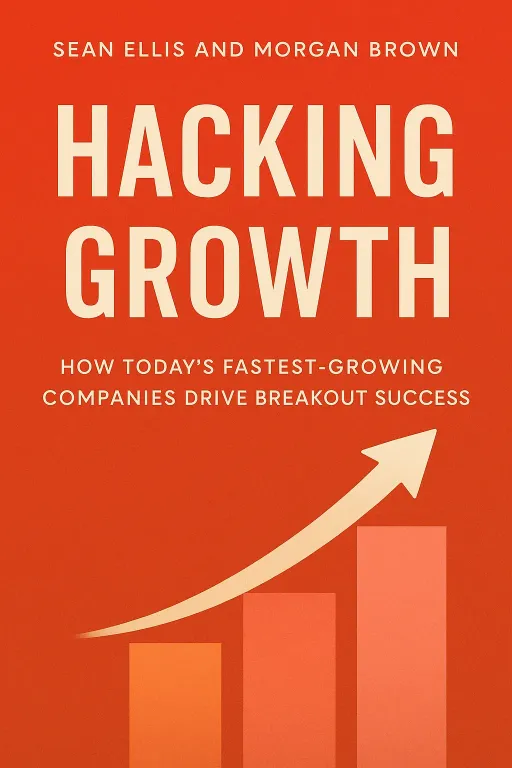
Nova: Exactly! That's the popular, almost mythical image. And it's precisely what we're going to dismantle today. Because while the term "growth hacking" might conjure images of shadowy shortcuts, the reality, as laid out in seminal works like "Hacking Growth" by Sean Ellis and Morgan Brown, and "The Lean Startup" by Eric Ries, is far more systematic, rigorous, and frankly, revolutionary.
Atlas: Hold on. So, it’s not about finding that one magical button that changes everything? Because I think a lot of our listeners, especially those building something new or trying to scale, might secretly hope for that magic button.
Nova: Well, it’s about discovering magic button, but through a process of scientific discovery, not sorcery. Sean Ellis, who actually coined the term 'growth hacker,' along with Morgan Brown, breaks it down into a systematic approach to rapid experimentation across the entire customer journey. And what Eric Ries offers in "The Lean Startup" is the strategic mindset for that: validated learning through the Build-Measure-Learn feedback loop.
Atlas: Okay, so it’s less about a single silver bullet and more about a continuous, data-driven rifle range. You’re saying these two books, one tactical and one strategic, actually complete each other? That’s a fascinating synergy.
The Experimentation Mindset: Blending Growth Hacking with Lean Principles
SECTION
Nova: Absolutely. Think of it this way: "Hacking Growth" gives you the blueprint for the lab, the equipment, and the safety protocols for experimentation. "The Lean Startup" gives you the scientific method itself, the underlying philosophy. It's not about throwing spaghetti at the wall and seeing what sticks. It's about forming a precise hypothesis, designing a minimal experiment to test it, measuring the results, and then learning from those results to inform your next, smarter action.
Atlas: I can see that. For someone who’s a forward-thinker and loves to build, that idea of a systematic, scientific approach to growth is incredibly appealing. It’s about building a predictable engine, not just hoping for a lucky break. But how does this translate into a team? Does every startup need a 'growth team' full of these mythical hackers?
Nova: Not mythical! Real, cross-functional teams. Ellis and Brown emphasize building growth teams that are agile, autonomous, and singularly focused on a specific, measurable growth metric. They're not just marketers, or engineers, or product managers; they're all of those, working together, cycling through that Build-Measure-Learn loop at lightning speed.
Atlas: So, it's like a mini-startup within a startup, all focused on one specific lever, but using a scientific framework to pull that lever? That makes me wonder, what’s a really vivid example of an early insight gained from this kind of rapid experimentation? Something that might not have seemed obvious at first glance?
Nova: Great question. Imagine an early social media platform. Their main goal is user retention – keeping people coming back. They hypothesize that sending push notifications about friend activity will increase engagement. They build a basic notification system, send it to a small segment of users, and track their return rate versus a control group.
Atlas: Sounds straightforward enough.
Nova: But here’s the twist: the notifications increase returns, but they also see a spike in users uninstalling the app, or worse, reporting the notifications as spam. Their initial hypothesis was partially correct, but the is far more profound: users want to be notified, but they value control and relevance above all else. The initial experiment didn't "fail" in the traditional sense; it provided crucial data about user and that a simple A/B test on notification frequency alone might have missed.
Atlas: Wow. So the real learning wasn't just "notifications work," but "notifications work they're perceived as valuable and non-intrusive." That’s a fundamentally different insight. It’s about understanding the psychology behind the metric, not just moving the needle. That’s what a strategic learner needs.
From Hypothesis to Impact: Designing and Executing Your Own Growth Experiments
SECTION
Nova: Exactly. And once you have that mindset and understand that growth is a learning process, the next step is actually it. How do you go from a vague idea – "I need more users" – to a rapid, measurable experiment that yields those kinds of insights?
Atlas: Alright, so for someone who’s really driven by impact and wants to build something meaningful, where do they even begin? What’s the very first step in designing an experiment that isn't just a shot in the dark?
Nova: The first step is to identify you want to improve this quarter. Just one. Don't try to boil the ocean. This comes directly from the "Hacking Growth" playbook. It could be user acquisition, activation, retention, revenue, or referral. Pick one, and make it your North Star. Then, you formulate a clear, testable hypothesis. It's like a scientist saying, "If we do X, then Y will happen, and we'll see it in Z metric."
Atlas: So, it’s not "I think this feature is cool, let's ship it." It’s "I believe adding this specific feature will increase user activation by 15%, and we'll measure that by tracking the completion rate of our onboarding flow." That’s much more precise.
Nova: Precisely! Then comes the "Build" phase of the Build-Measure-Learn loop: design the smallest, fastest experiment possible to test that hypothesis. It doesn't have to be perfect; it just needs to be sufficient to get data. Then "Measure" the results objectively. Did your metric move? How much? And finally, "Learn." Analyze why it moved or didn't move. What new insights did you gain?
Atlas: Can you give us a really concrete, simple example of this full loop? Like, for someone trying to improve engagement with their online course, how would this 'Build-Measure-Learn' cycle actually play out?
Nova: Let's say your key metric is "course completion rate." You hypothesize that providing a short, weekly video summary will increase completion by 10%. So, your "Build" is creating a single, five-minute video summary for week one, and sending it to half of your new students, while the other half gets nothing.
Atlas: Okay, so a minimal viable experiment.
Nova: Exactly. Then you "Measure" the completion rates for both groups after that first week. If the experiment group shows a significantly higher completion rate, you've got validated learning. If not, you've still learned something valuable without investing in a whole series of videos. You might learn that students prefer text summaries, or that the videos need to be interactive, or that the problem isn't the content delivery but the course structure itself.
Atlas: That sounds much more manageable than trying to overhaul an entire course based on a hunch. But what about failure? People are often afraid of experiments that 'don't work.' How do these books reframe that fear for the resilient builder who just wants to see progress?
Nova: That’s the beauty of it: in this framework, there's no "failure," only "learning." Every experiment, whether it validates your hypothesis or not, yields data. That data reduces uncertainty and informs your next, smarter hypothesis. It’s about systematically reducing risk, not eliminating it. You're not failing; you're iterating towards success.
Synthesis & Takeaways
SECTION
Nova: So, what we've really been talking about today is how blending the tactical blueprint of "Hacking Growth" with the strategic mindset of "The Lean Startup" isn't about finding shortcuts. It's about building a robust, scientific engine for continuous improvement and innovation. It's about making deliberate, data-backed decisions that drive sustainable impact.
Atlas: That resonates so much with the idea of trusting your instincts, but then relentlessly testing them with data, to actually speak your vision into being. For our listeners who are forward-thinkers and builders, who really want to make a difference, what’s one single, practical thing they can do to start applying this?
Nova: Here’s your challenge: Identify one key metric you want to improve this quarter. Just one. Then, design the smallest, fastest experiment you can think of to move that metric. What's your hypothesis, and how will you measure its success? Start small, learn fast.
Atlas: Start small, learn fast. I love that. It really is about making a real difference, one experiment at a time, moving beyond that vague hope for growth into a concrete, measurable reality.
Nova: Exactly. It's about transforming uncertainty into your greatest superpower.
Nova: This is Aibrary. Congratulations on your growth!