Building Products that Last: Lessons from Enduring Innovation.
Golden Hook & Introduction
SECTION
Nova: Atlas, quick challenge for you. When I say "building products that last," what's the first thing that comes to your mind? Give me your wittiest, most brutally honest take.
Atlas: Oh, man. "Building products that last"? I immediately picture a dusty old instruction manual that nobody ever reads, for a product that was probably over-engineered and under-loved. It sounds like a lot of hard work for something that might just end up in a museum.
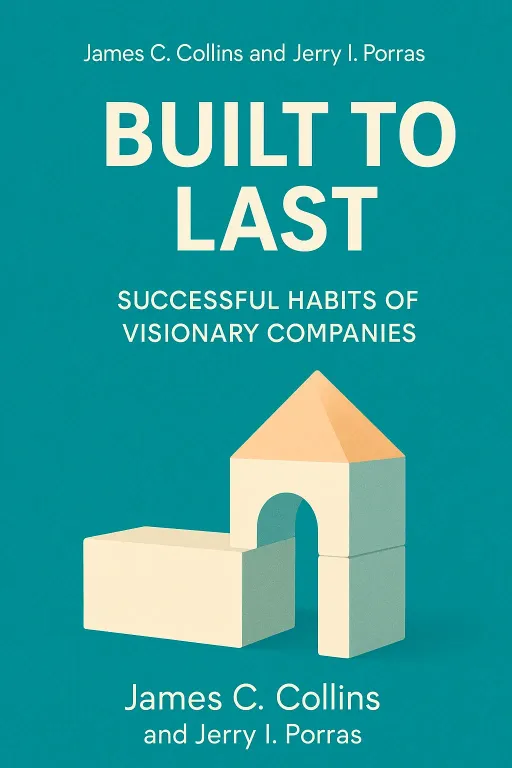
Nova: You're not wrong about the hard work part! But what if we told you it doesn't have to be a dusty relic, but a vibrant, evolving legacy? Today, we're diving into "Building Products that Last: Lessons from Enduring Innovation." And to guide us, we're drawing insights from two absolute titans in the world of business and innovation: "Built to Last" by Jim Collins and Jerry I. Porras, and "The Lean Startup" by Eric Ries.
Atlas: Oh, I like that. Two very different books, but both incredibly relevant to anyone, like many of our listeners, who’s trying to bring a big idea to life. Especially if that idea is something as tangible and complex as, say, an innovative tractor.
Nova: Exactly. Jim Collins and Jerry Porras, both professors at Stanford, embarked on this incredible six-year research project for "Built to Last," meticulously studying 18 truly visionary companies from their very beginnings. They wanted to understand what made them endure, debunking common myths along the way. Eric Ries, on the other hand, comes from the trenches of Silicon Valley, developing "The Lean Startup" principles after witnessing firsthand the boom and bust cycles of tech entrepreneurship.
Atlas: So you have the academic rigor and the real-world, startup grit. That’s a powerful combination. It makes me wonder, Nova, what's the core problem they're both trying to solve? Why do so many brilliant ideas, like a potentially revolutionary tractor design, often fail to achieve that lasting impact you mentioned?
Nova: That's the perfect question, Atlas. It's what we call "The Cold Fact."
The Illusion of Innate Brilliance: Why Many Ideas Fail to Last
SECTION
Nova: The cold fact is many brilliant ideas never achieve lasting impact. We often celebrate the 'aha!' moment, the stroke of genius, the incredible technical prowess behind a new invention. And for someone dreaming of building an innovative tractor, that technical brilliance feels like the whole game. But it’s only part of the equation.
Atlas: Wait, isn't engineering the part, though? I mean, designing a complex piece of machinery, making it efficient, powerful, sustainable—that feels like the Mount Everest of creation. Isn't the brilliant idea, the technical solution, the entire game?
Nova: It absolutely feels that way from the builder's perspective. It’s like designing a sports car with a groundbreaking engine, aerodynamic body, and cutting-edge suspension. You've poured your heart and soul into the mechanics. But what if that car has no fuel, or the steering wheel is faulty, or the roads it’s meant to drive on don’t exist?
Atlas: So you're saying a perfectly designed engine can still lead to a stalled car.
Nova: Precisely. Building a truly innovative tractor requires not just that technical prowess, but also a deep understanding of what makes an organization and its products sustainable over time. It’s about building a resilient system and culture around your vision.
Atlas: Give me an example. What's a technically brilliant idea that you think genuinely failed because it lacked this "resilient system" you're talking about?
Nova: Let's stick with our tractor example. Imagine a team of brilliant engineers develops a tractor that’s incredibly fuel-efficient, uses AI for optimal field navigation, and can even self-repair minor issues. Technically, it's a marvel. But they failed to understand the market's real needs – maybe farmers in their target demographic can't afford the cutting-edge tech, or perhaps the local dealerships don't have the training or parts to service it. The supply chain for its unique components falls apart. The company culture is so focused on engineering perfection that it ignores customer feedback.
Atlas: So it's a beautiful, complex machine, but it's an island. It doesn't integrate into the ecosystem of its users or the business that supports it.
Nova: Exactly. The product itself might be a masterpiece, but the system around it—the market understanding, the distribution, the support, the organizational culture—is fragile. It’s the disconnect between a "great idea" and an "enduring impact."
Atlas: That makes sense. It's like building a bridge that's structurally perfect, but it leads nowhere, or it's made of materials that can't be maintained by the local infrastructure. For our listeners who are "Practical Engineers" and "Visionary Builders," this immediately shifts the focus from just the blueprint to the entire landscape. So, how do we build something that last? What's the foundational piece?
Building Visionary Foundations: Core Values & Purpose
SECTION
Nova: That leads us directly to "Built to Last" and the profound insights from Jim Collins and Jerry Porras. Their research uncovered something crucial: truly visionary companies aren't just great at products; they have deeply ingrained core values and a purpose that goes far beyond simply making a profit.
Atlas: Okay, so it’s not just you build, but and you build it, rooted in something deeper. But for someone building a tractor, what does a "core value" actually look like? Is it just a slogan on a wall that sounds good in a marketing brochure?
Nova: That’s a common misconception. A core value isn't a slogan; it's a non-negotiable guiding principle, a filter for every decision. Let's take your tractor project. If one of your core values is "unwavering reliability," that value would influence every single design choice. You'd choose more robust materials, conduct more rigorous testing, and prioritize repairability over flashy, unproven features.
Atlas: I see. So it's not "we want to be the best," it's "we prioritize reliability above all else, even if it means slower adoption of new tech."
Nova: Precisely. Or if a core value is "sustainable agriculture," that influences your engine type, your material sourcing, the end-of-life planning for the tractor, and even how you educate your customers. It becomes the compass that guides every single action and innovation. It means your "why" is bigger than just the machine itself.
Atlas: That makes sense. It means your product is an extension of your beliefs. Like, if my core value for this tractor is 'farmer empowerment,' then I'm constantly asking, 'Does this feature genuinely make a farmer's life easier and more productive, even if it adds a bit to the cost?' It acts as a decision-making filter. But even with strong values, the world changes. How do you stay innovative and relevant when technology and market needs are constantly shifting? How do you ensure your product doesn't become a beautifully built, but ultimately obsolete, relic?
Agile Innovation & Continuous Learning: The Lean Startup Mindset
SECTION
Nova: Exactly, Atlas. That's where Eric Ries's "The Lean Startup" comes in, and its principles are incredibly powerful, even for established builders, not just tech startups. Ries emphasizes the build-measure-learn feedback loop. It's about validated learning—not just building what you people want, but rigorously testing your hypotheses with real users.
Atlas: So basically you're saying, don't build the whole cathedral just to find out nobody wants to worship there. Test the stained glass first. But for a physical product like a tractor, "lean" can feel counterintuitive. You can't exactly "pivot" a half-built combine harvester on a dime.
Nova: You absolutely cannot! The mistake is thinking "lean" means building less. It means minimizing waste and maximizing learning. It's about asking: "What's the smallest, fastest, most inexpensive experiment we can run to learn the most about our customers or our technology?" Instead of building an entire new tractor model with a groundbreaking autonomous feature, you might build a small, inexpensive prototype of and put it in front of farmers. You observe their reactions, gather data, and learn.
Atlas: So it's about breaking down the big, risky bets into smaller, manageable learning opportunities. Like, before I commit to a specific type of robotic arm for my tractor, I create a cheap mock-up, or even just a detailed simulation, and get feedback from actual farmers.
Nova: Exactly! It’s about building a Minimum Viable Product—not necessarily a product you sell, but the smallest thing you can create to test a core assumption. That "Tiny Step" from our content is a perfect example of this lean, iterative thinking: "Identify one core value for your tractor project. How does this value influence a specific design choice you're currently considering?" That question forces you to connect your big vision to a small, testable action, ensuring your innovation is grounded in purpose and validated by reality.
Atlas: That's a great example. So the 'tiny step' isn't just about starting small, it's about making sure that small step is a step, not just a building step. It’s about continuously learning and adapting, which is the resilient system and culture you talked about earlier.
Synthesis & Takeaways
SECTION
Nova: Absolutely. What we've learned today is that lasting innovation isn't a single stroke of genius; it's the powerful marriage of deep purpose and core values from "Built to Last" with the agile adaptation and continuous learning of "The Lean Startup." It’s about designing a resilient system around the product itself.
Atlas: That's actually really inspiring. For anyone out there dreaming of their next big build, whether it's a revolutionary tractor or a new software, it’s about grounding that big idea in a clear 'why,' understanding its purpose, and then being relentlessly curious about 'how' it actually impacts the real world, ready to learn and adapt at every turn.
Nova: It truly is. The goal isn't just to build a great product, it's to build a great product that solves real problems in a way that endures. And that journey starts with that single, powerful question: Identify one core value for your tractor project. How does this value influence a specific design choice you're currently considering? That single question can unlock a whole new dimension of lasting innovation.
Atlas: Love that. It means the dream isn't just about the blueprint; it's about the living, breathing ecosystem you create around it, constantly learning and evolving.
Nova: Absolutely, it's about building a legacy, not just a product.
Atlas: This is Aibrary. Congratulations on your growth!