The Lazy Genius Codex: Forging a Personal Philosophy of Action
Golden Hook & Introduction
SECTION
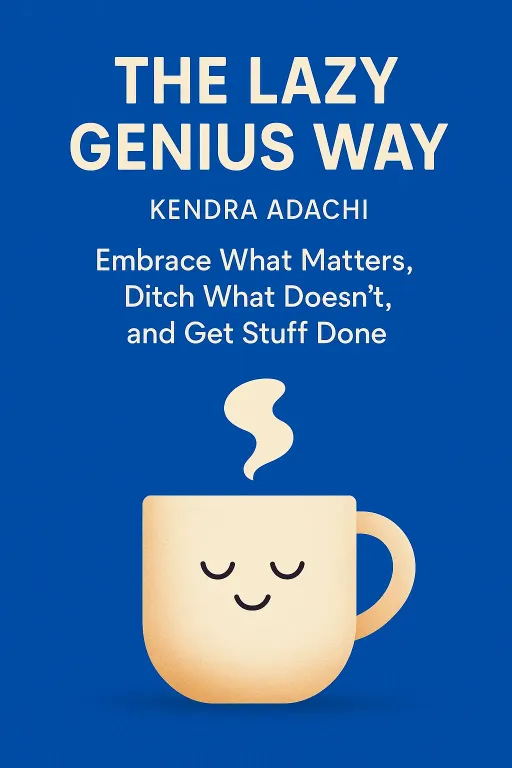
Dr. Warren Reed: What if I told you that the secret to a well-ordered life—the kind of focused existence philosophers like Seneca and strategists like Sun Tzu wrote about—isn't found in ancient texts, but in how you decide to clean your kitchen? It sounds absurd, but today we’re exploring a book,, that argues just that. It proposes a radical idea: that laziness, when used strategically, is the key to becoming a genius where it truly matters. I’m Dr. Warren Reed, and with me is Aibrarygg82f7, a thinker who loves to deconstruct systems of thought, from ancient philosophy to modern psychology. Welcome.
Aibrarygg82f7: It’s great to be here, Warren. The premise is provocative. I’m curious to see how you connect kitchen counters to universal truth.
Dr. Warren Reed: Exactly. And that's our project for today. We're going to treat this book as a codex for living. Today we'll dive deep into this from three perspectives. First, we'll explore the philosophy of 'Strategic Laziness' and how to allocate your energy like a master strategist. Then, we'll discuss the cognitive architecture of action, essentially how to build a personal operating system to automate your life. And finally, we'll focus on the unbreakable foundation of it all: why self-compassion is a strategic imperative, not a weakness.
Aibrarygg82f7: A strategy, an architecture, and a foundation. I like it. It’s a complete system. Let’s begin.
Deep Dive into Core Topic 1: Strategic Laziness
SECTION
Dr. Warren Reed: Let's start with that core philosophy. The book's central mantra is 'Be a genius about the things that matter and lazy about the things that don’t.' How does that land with you, as someone who studies grand strategy?
Aibrarygg82f7: It lands powerfully. Strategy, at its heart, is the art of applying finite resources to achieve a specific aim. Your most precious, non-renewable resource is your attention, your energy. The idea of being 'lazy' isn't about apathy; it's about a conscious, deliberate withdrawal of energy from low-impact areas to concentrate it where it can achieve a decisive result. It's the essence of focus.
Dr. Warren Reed: A decisive result. That’s the key. The author, Kendra Adachi, learned this through a particularly painful experience she calls the "Stuffed French Toast Fiasco."
Aibrarygg82f7: I'm already intrigued.
Dr. Warren Reed: Picture this. She’s newly married, just out of college, working at her old high school church. She’s surrounded by people who knew her as a kid, and she is desperate to prove she’s a competent adult. So, when the sign-up sheet for the monthly staff breakfast comes around, she volunteers. But she doesn't just want to bring donuts. She wants to be.
Aibrarygg82f7: The objective is validation. Not nourishment.
Dr. Warren Reed: Precisely. She decides to make stuffed french toast for thirty people. She’s never made it before and refuses to use a recipe. She goes out and buys expensive platters and linens. For the toast itself, she uses basic Wonder bread. And for the fillings? She makes two kinds: one with cream cheese and raspberry jelly, which sounds plausible, and another with… American cheese.
Aibrarygg82f7: Oh no. That’s a culinary war crime.
Dr. Warren Reed: It gets worse. Instead of dipping the sandwiches in a proper egg custard and frying them, she just bakes them in the oven. The result is a tray of warm, soggy bread with melted cheese and another with hot, weeping jelly. It was, by her own account, disgusting. People were disappointed, she was humiliated, and she considered quitting her job.
Aibrarygg82f7: It's a perfect, if painful, illustration of a misaligned objective function. In strategy, if you define the wrong victory condition, every action you take, no matter how brilliant, leads you further from success. Her victory condition was 'be impressive,' but her strategy was to make inedible food. It's what Sun Tzu warns against: fighting a battle you've already lost before it even begins.
Dr. Warren Reed: And the insight she had was that she was a 'genius' about all the wrong things—the platters, the idea of being impressive—and 'lazy' about the one thing that actually mattered: making food that people could eat.
Aibrarygg82f7: So the first step in this 'Lazy Genius' system isn't a to-do list, it's an act of introspection. You have to define what matters. It's a question of values. This connects directly to Jung's work on individuation—the process of becoming aware of your true, authentic self. You can't be a genius about what matters if you don't know who you are and what you value.
Dr. Warren Reed: Exactly. You have to name the right victory condition for your own life.
Deep Dive into Core Topic 2: The Cognitive Architecture of Action
SECTION
Dr. Warren Reed: That's a perfect pivot. Once you know what matters, you need a system to execute. The book offers principles that are essentially a cognitive algorithm for action. Let's look at two powerful ones: 'Decide Once' and 'Go in the Right Order.'
Aibrarygg82f7: Building a personal operating system. I love it.
Dr. Warren Reed: 'Decide Once' is a direct assault on decision fatigue. The author gives the example of creating a 'Monday uniform.' She got so tired of the mental energy it took to decide what to wear on the most hectic morning of the week, so she just decided: every Monday, she wears the same outfit. One decision, made once, that eliminates dozens of future decisions and saves her brainpower for things that matter more.
Aibrarygg82f7: It's a form of automation for the mind. You're creating a script that runs automatically, freeing up your cognitive RAM. The most successful people do this constantly, whether it's Steve Jobs' black turtleneck or a president's fixed daily schedule. They're not limiting their freedom; they're liberating their attention.
Dr. Warren Reed: And this pairs beautifully with the next principle, 'Go in the Right Order.' The book proposes a simple, three-step algorithm for tackling any task, from a messy room to a complex project. Step one: Remember what matters. Step two: Calm the crazy. Step three: Trust yourself.
Aibrarygg82f7: An algorithm for chaos. Explain 'Calm the crazy.'
Dr. Warren Reed: 'Calm the crazy' means identifying and neutralizing the single most disruptive element of a situation. The author uses the simple story of her kids' markers. They're always all over the house, caps off, a source of constant, low-grade chaos. So, she applies the algorithm. Step one,: 'My kids' creativity is a good thing. The markers are a sign of a creative home.' This reframes the problem from annoyance to a positive.
Aibrarygg82f7: It sets the intention. A vital first step.
Dr. Warren Reed: Step two,: She asks herself, 'What is the single most frustrating part of this?' And she realizes it’s not just picking them up; it's that half of them are dried out. So she spends ten minutes, just once, going through every marker and throwing out the dead ones. She has instantly reduced the scope of the problem.
Aibrarygg82f7: She identified the primary bottleneck in the system. Brilliant.
Dr. Warren Reed: Finally, step three,: With the dead markers gone, the next step becomes obvious. 'I just need a basket.' She gets a basket, puts it where the kids draw, and the problem is 80% solved. It's a micro-example of a powerful process.
Aibrarygg82f7: This is a practical framework for applied mindfulness. 'Remember what matters' is setting intention. 'Calm the crazy' is identifying the primary obstacle. And 'Trust yourself' is about empowering intuition after the analytical work is done. It's a beautiful loop of logic and intuition. You could apply this to anything, from writing a book to planning a military campaign.
Dr. Warren Reed: But can such a simple, domestic system really scale to a military campaign?
Aibrarygg82f7: The principles absolutely scale. The complexity of the variables changes, but the core human cognitive process for dealing with chaos remains the same. A general planning an offensive must first remember what matters—the strategic objective. Then, they must calm the crazy—identify the enemy's center of gravity or the biggest logistical hurdle. And finally, they must trust themselves and their commanders to execute the plan. The scale is different, but the architecture of thought is identical.
Deep Dive into Core Topic 3: The Unbreakable Foundation
SECTION
Dr. Warren Reed: And that brings us to the foundation that holds this entire system together, Principle 13: Be Kind to Yourself. Now, this might sound soft, especially after talking about military campaigns, but the author argues it's the most critical component.
Aibrarygg82f7: It's often the most overlooked. A system is only as strong as its operator. If the operator is at war with themselves, the system will fail.
Dr. Warren Reed: Exactly. And she tells a very raw, very human story about this. It's late one evening, after a brutal bedtime battle with her headstrong three-year-old. She's exhausted, hormonal, and feels like a complete failure. She comes downstairs, collapses into a chair, and tearfully confesses to her husband, 'I'm a terrible mom.'
Aibrarygg82f7: A moment of pure vulnerability.
Dr. Warren Reed: But her husband, Kaz, just sits there. He says nothing. And this enrages her. She accuses him of not caring, of not understanding. Later, after she's calmed down, she apologizes and asks him why he was silent. And his answer is the crux of the chapter. He says, 'Kendra, I knew that anything I said, you would have argued with. If I said, 'No, you're a great mom,' you would have listed all the reasons you're not. I couldn't give you a kindness that you weren't ready to give yourself.'
Aibrarygg82f7: Wow. That is profoundly insightful. He recognized that the problem wasn't external; it was internal. She couldn't receive external validation because her own internal narrative was one of self-rejection.
Dr. Warren Reed: The insight is that you cannot receive a kindness you are not prepared to believe. All the systems, all the strategies in the world, are useless if your internal monologue is one of constant self-criticism.
Aibrarygg82f7: This is the core of so much psychological and philosophical teaching. You see it in the Stoics' focus on inner judgment. You see it in humanistic psychology. And you absolutely see it in Nietzsche's concept of 'amor fati'—the love of one's fate. That isn't passive resignation; it's an active, affirmative embrace of your reality, your life, your self, flaws and all. Without that fundamental self-affirmation, any external system, no matter how 'genius,' will eventually crumble under the weight of self-sabotage. You become the single point of failure in your own design.
Synthesis & Takeaways
SECTION
Dr. Warren Reed: So there we have it. A complete system, hidden in a book about getting stuff done. First, a strategy for focus: be a genius about what matters and lazy about what doesn't. Second, an algorithm for action: remember what matters, calm the crazy, and trust yourself. And third, a foundational ethic: be kind to yourself, because without it, nothing else is sustainable.
Aibrarygg82f7: It's a complete personal philosophy. A codex for living an intentional life, using the everyday world as the training ground for strategic thinking and, ultimately, for self-mastery. It's not about having a perfect home; it's about building a well-ordered mind.
Dr. Warren Reed: Perfectly put. So, the challenge for our listeners is this: what is one small, recurring task in your life where you can apply the 'Decide Once' principle this week? What one decision can you make now to free up your mental energy for what truly matters?
Aibrarygg82f7: Start there. That's the first step in building your own empire of the mind. Don't try to conquer the world. Just decide on your Monday uniform. The rest will follow.