A No-Nonsense Guide to Stress-Free Productivity
Golden Hook & Introduction
SECTION
Nova: The average adult makes roughly thirty-five thousand decisions every single day. That is not just a statistic. That is the engine behind why you feel like your brain is running on empty by two in the afternoon. We are drowning in choice, and we think that having options is a sign of freedom, when in reality, it is a recipe for exhaustion.
Atlas: That number is staggering when you actually stop to think about it. Thirty-five thousand decisions. I feel like I have made about five hundred just trying to pick a podcast to listen to on my commute this morning. We treat every single decision like it is a high-stakes event, from what to eat for lunch to how to structure a project, and that is exactly where the wheels start to come off.
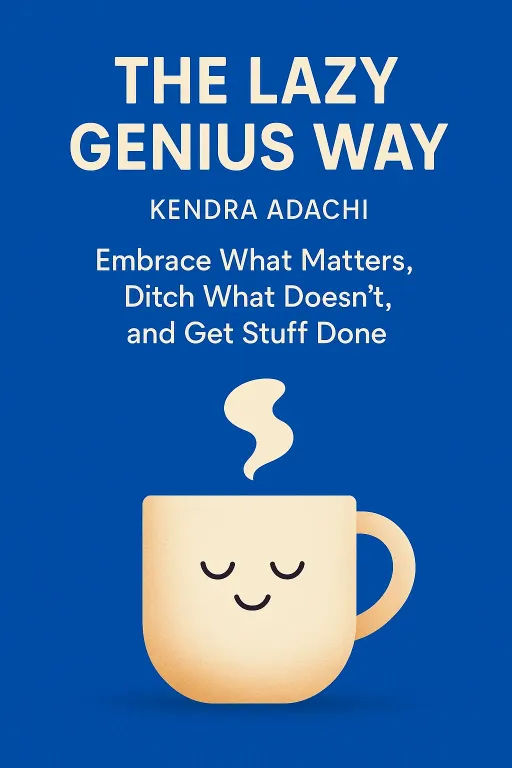
Nova: Exactly. We are trying to be genius about everything, which ultimately means we are being lazy about the things that actually matter. That is the core paradox we are looking at today. We are diving into two distinct but complementary approaches to reclaiming your mental bandwidth. We are talking about The Lazy Genius Way by Kendra Adachi, which offers a structural system for your daily life, and Calm the Fuck Down by Sarah Knight, which provides the emotional triage you need to stop wasting energy on things that are outside of your control.
Atlas: I love the pairing of these two. You have Adachi, who is the architect building the systems, and Knight, who is the bouncer kicking the useless worries out of your head. It feels like the perfect toolkit for anyone who is tired of the hustle culture narrative that says you have to be maxed out on everything all the time to be successful.
Nova: That is the perfect way to frame it. Kendra Adachi really revolutionized the conversation by arguing that you can be a genius about the things that matter, and lazy about the things that don't. It is about intentionality. And Sarah Knight, writing with a very different, let’s call it, punchier energy, helps you categorize those stressors so you aren't carrying the weight of the world when you only have the capacity to carry your own backpack.
Atlas: I am ready to dive in. Let’s start with the system. How does someone actually start being a genius about what matters without losing their mind in the process?
The Architecture of Intentionality
SECTION
Nova: The first step is realizing that most of the friction in our lives comes from trying to reinvent the wheel every single day. Adachi talks about the importance of small, systemic changes. We often fall into the trap of thinking that productivity requires some massive overhaul, a total life reset, or a complete change in career path. But the truth is that the most sustainable productivity comes from automating the mundane.
Atlas: Okay, I have to jump in there. That sounds great in theory, but for a lot of people, the mundane is where the chaos lives. It is the laundry, the inbox, the scheduling, the grocery list. If you are a high achiever, you are conditioned to believe that if you aren't putting 100 percent effort into everything, you are failing. How do you convince someone that being lazy about the dishes is actually a strategic move?
Nova: You have to reframe the definition of laziness. Most people view laziness as a moral failing or a lack of ambition. Adachi flips that. She defines it as a tool for preservation. If you are spending all your cognitive energy deciding what to wear, what to eat, or how to organize your digital files, you have nothing left for the complex, creative, or high-impact work that actually moves the needle in your life.
Atlas: So you are saying that by being lazy about the low-stakes choices, you are actually clearing the runway for the high-stakes decisions. That makes sense, but how do we stop the perfectionism from creeping in? Because even when I decide to be lazy about something, I still have that voice in the back of my head saying, I could do this better, I could do this faster, I could do this more efficiently.
Nova: That is where the Deciding Once rule comes in. This is one of the most powerful concepts in the entire Lazy Genius framework. You stop asking yourself the same questions every single day. If you struggle with what to cook for dinner, you don't decide that at five o'clock when you are tired and hungry. You decide once, maybe on a Sunday, that you are having tacos on Tuesday and pasta on Thursday. The decision is made. You don't have to engage with it again.
Atlas: I can see how that applies to home life, but let’s look at the workplace. I know many listeners are thinking about their professional lives. How does a professional apply this to something like communication or project management?
Nova: It is about templates and systems. If you find yourself writing the same three types of emails, or answering the same recurring questions from your team, you are wasting mental energy. Decide once on the structure of that communication. Create a template. Save it. When the situation arises, you aren't crafting a new message; you are simply plugging in the details. You are automating the process.
Atlas: That is essentially treating your daily life like a software program. You are building subroutines so the main processor doesn't have to handle every single line of code.
Nova: Precisely. And the beauty of this is that it creates space. When you are not bogged down by the trivial, you start to notice where your energy is actually leaking. And that is where we need to bring in Sarah Knight’s approach, because even when you have your systems in place, life is going to throw you curveballs. You are going to have anxiety, you are going to have stress, and you are going to have problems that feel like they are swallowing you whole.
The Triage of Control
SECTION
Atlas: This is where I think a lot of people get stuck. You can have the best systems in the world, but if your mindset is focused on things you cannot control, you are still going to burn out. I have seen so many talented people get completely derailed by things like office politics, industry trends they can't influence, or just general global anxiety.
Nova: Sarah Knight’s approach is refreshing because it is brutally honest. She suggests a triage system. When you are feeling overwhelmed, you have to stop and categorize your problems. You have two buckets. One bucket is for things you can control, and the other is for things you cannot.
Atlas: It sounds simple, but it is incredibly difficult to execute in the heat of the moment. When I am stressed, everything feels like it is in the control bucket. I feel like if I just worry about it enough, or if I just think about it from enough angles, I can somehow force a better outcome. It is a total illusion, but it feels so real.
Nova: That is the trap. You are describing the illusion of control. Knight points out that the more energy you pour into the uncontrollables, the less you have for the controllables. If you are worried about the economy, or your boss’s mood, or the fact that a competitor just launched a new product, you are burning fuel. You are not actually fixing the problem. You are just spinning your wheels.
Atlas: So, what does a practical application of this triage look like? Let’s say I am leading a project and the timeline shifts because of an external factor. I am stressed. I am anxious. What is the step-by-step here?
Nova: First, you identify the stressor. You name it. The timeline shifted. Then, you ask the golden question: Is this within my control? If the shift is due to a supply chain issue or a client decision, the answer is no. It is an uncontrollable.
Atlas: Okay, so if it is an uncontrollable, what do I do? Do I just ignore it? That feels irresponsible.
Nova: You don't ignore it. You manage your reaction to it. You shift your focus to what you can control. You can control how you communicate the delay to your stakeholders. You can control how you reallocate the resources you currently have. You can control your own schedule for the next week. You are essentially moving your energy from the external event to your internal response.
Atlas: That is a massive shift. Instead of trying to fix the unfixable, you are optimizing your own position within the new reality. It is almost like a stoic approach, but with a much more modern, practical edge to it.
Nova: It is exactly that. And this is why the combination of these two books is so powerful. Adachi gives you the systems to manage the day-to-day so you aren't overwhelmed by the small stuff. And Knight gives you the mental framework to handle the big stuff so you don't get paralyzed by anxiety.
Atlas: I am curious about the emotional side of this. We have talked about systems and we have talked about triage, but what about the fear of letting go? I think for a lot of high achievers, we have this deep-seated fear that if we stop caring about everything, if we stop worrying about every little detail, we will lose our edge. We will start to slip.
Nova: That is a very common fear. It is the belief that anxiety is the fuel for our success. But the research suggests otherwise. The research shows that chronic stress and anxiety actually degrade our cognitive function. They narrow our focus. They make us reactive instead of proactive. By letting go of the things you can't control, you are not losing your edge. You are sharpening it. You are redirecting that energy back into your core competencies.
Atlas: That is a great way to put it. It is not about caring less; it is about caring more about the right things. It is about precision versus volume.
The Synthesis of Productivity and Peace
SECTION
Nova: Precisely. And if we look at the trajectory of these ideas, they are really about reclaiming your agency. We live in a world that is designed to fragment our attention. Every notification, every email, every news alert is a demand for your limited cognitive resources. If you don't have a system to filter those demands, you are essentially living your life in response to other people's priorities.
Atlas: I have been thinking about how this connects to the concept of growth. For the audience listening, who are likely people focused on their own development, this isn't just about productivity hacks. This is about self-preservation. If you want to sustain a high-performance career or a meaningful life over the long term, you cannot run on high-octane anxiety forever. You have to build these sustainable systems.
Nova: You hit the nail on the head. Sustainability is the key. You can sprint for a while, but you cannot live your life as a sprint. The "Decide Once" rule and the triage system are the infrastructure that allows you to turn that sprint into a marathon. It allows you to maintain your momentum without burning out.
Atlas: Let’s ground this for our listeners. If someone is listening to this right now and they are feeling that weight, that sense of being overwhelmed, what is the one thing they should do today? Not tomorrow, not next week. Today.
Nova: Start with one minor task that drains you. Just one. Don't try to fix your whole life. Pick the thing that you do every day or every week that makes you groan. Maybe it is choosing what to wear in the morning, maybe it is managing your meal planning, maybe it is how you handle your email inbox.
Atlas: And then apply the Adachi rule to that one thing. Decide once.
Nova: Exactly. Make the decision, automate the process, and then let it go. And if you find yourself worrying about the outcome or about whether you are doing it "perfectly," apply the Knight triage. Ask yourself: Is this worry actually helping me? Can I control the outcome? If the answer is no, give yourself permission to stop spending energy on it.
Atlas: It is a cycle of simplifying and then protecting that simplicity. I like that. It is a defensive strategy for your mind.
Nova: And it is a defensive strategy that pays off in offensive results. Because when you stop fighting fires that you can't put out, and you stop wasting time on decisions that don't matter, you suddenly find yourself with an abundance of time and focus for the things that actually do matter.
Atlas: That is the ultimate goal, isn't it? It is not just about getting more done. It is about having the mental clarity to choose what is worth doing in the first place.
Nova: Absolutely. And that, I think, is the deepest insight we can take from both of these authors. Productivity is not the goal. The goal is a life that you are actually present for, a life where you are not just managing your stress but actively creating the conditions for your own well-being.
Atlas: This has been a fantastic breakdown. I feel like I have a much clearer roadmap for how to handle the inevitable chaos of the week ahead. It is not about being perfect. It is about being strategic.
Nova: Strategic, intentional, and perhaps a little bit lazy in the best possible way.
Atlas: I can definitely get behind that. Thank you for walking us through this, Nova. It has been a great conversation.
Nova: It has been a pleasure. And to everyone listening, remember: you don't have to carry it all. Pick your genius, embrace your lazy, and protect your peace. This is Aibrary. Congratulations on your growth!