The Alchemist of Time: Crafting Results in Care and Career
Golden Hook & Introduction
SECTION
Shakespeare: Time, that swift-footed thief, robs us of our days while we sit chained to our desks, counting the hours as if they were gold. But what if the true currency of life is not the time we spend, but the harvest we reap? Welcome, dear listeners, to a stage where we dismantle the clock and rebuild our days. Today, we are joined by a guest of noble pursuit, a guardian of health and nourishment, dietitian Büşra Bayıroğlu. Büşra, welcome to the spotlight.
Büşra Bayıroğlu: Thank you, Shakespeare. It is an absolute pleasure to be here. You know, when I look at time through the lens of nutrition, I see a striking parallel. In dietetics, we don't just look at the sheer volume of food someone consumes; we look at the nutrient density, the quality, the actual metabolic impact. Yet, in our professional lives, we often fall into the trap of measuring quantity—the hours we sit at our desks—rather than the quality of the outcomes we produce.
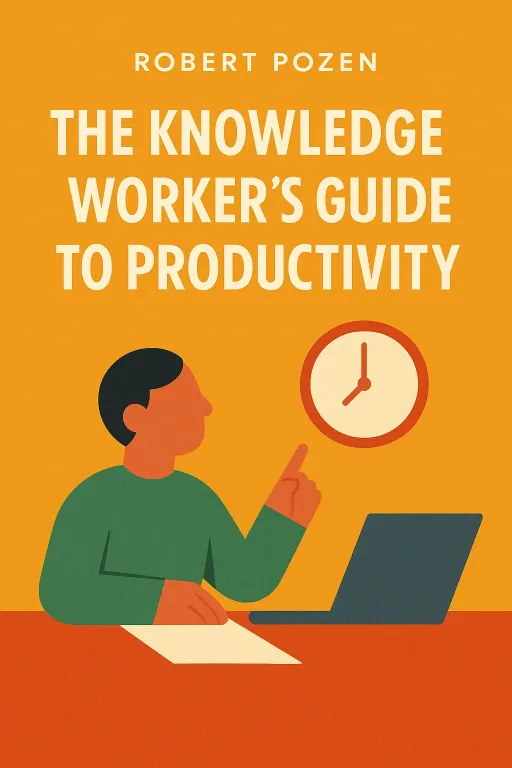
Shakespeare: Ah, a magnificent metaphor! The metabolism of time itself! Today, we shall dissect Robert Pozen's masterwork, The Knowledge Worker's Guide to Productivity, through three distinct acts. First, we shall unmask the illusion of the hourglass, exploring why hours spent are a poor measure of true value. Second, we shall venture into the sovereign realm of action, where trust and autonomy reign supreme. And finally, we shall seek the sanctuary of the hearth, learning to guard our personal boundaries against the encroaching tides of work. Let us draw back the curtain on our first act!
Deep Dive into Core Topic 1
SECTION
Shakespeare: Tell me, Büşra, have you ever observed the tragic comedy of the office martyr? The one who arrives before the sun and departs long after the stars have claimed the sky, yet accomplishes little of note? Pozen introduces us to two characters in his text, Fred and Ashley. Fred is a creature of habit, arriving early, staying late, his desk a permanent fixture of the office landscape. Ashley, however, jogs in the morning, arriving at ten, yet her mind is sharp, her actions disciplined. The corporate world often crowns Fred, but Pozen begs us to ask: who truly delivers the prize?
Büşra Bayıroğlu: It is such a common cognitive bias, Shakespeare. In fact, Pozen points to a fascinating study from 2010 involving thirty corporate offices in Northern California. The researchers discovered that managers subconsciously formed highly favorable opinions of employees simply because they were seen at their desks during normal hours, evenings, or weekends. They equated physical presence—what we call 'face time'—with dedication and quality of work. But as Pozen rightly argues, Fred might be spending half his day managing his fantasy football team or drowning in unproductive meetings, while Ashley is mentally synthesizing breakthrough ideas during her morning jog.
Shakespeare: Indeed! They mistake the stage-play of busyness for the actual triumph of performance! It reminds me of the ancient alchemists trying to turn lead into gold through sheer, mindless repetition. In Pozen's own life, when he was a partner at a prestigious law firm in Washington, D. C., he specialized in complex financial transactions. Because of his deep expertise, he could answer a client's burning question in a mere fraction of the time it would take others. Yet, the traditional billing system punished his efficiency! He was expected to bill by the hour. So, what did this clever strategist do? He wrote to his clients, announcing he would sharply increase his hourly rate to reflect his speed and value. And not a single client objected! One even dubbed him the fastest lawyer on the East Coast.
Büşra Bayıroğlu: That story is incredibly liberating, especially for someone in their first year of practice like me. In healthcare, we face a similar struggle. We can spend hours meticulously charting, filling out bureaucratic paperwork, and sitting in administrative meetings. But the real 'gold'—the true outcome—is patient health and recovery. If I spend three hours writing a perfect, overly detailed clinical note, but only fifteen minutes actually counseling a patient on their nutritional needs, I've misallocated my resources. I need to focus on the final product: a patient who understands their diet and feels empowered to change their life.
Shakespeare: A triumph of care over paperwork! But tell me, how does a young practitioner, standing at the dawn of her career, resist the siren song of the billable hour or the pressure of 'face time' from her superiors?
Büşra Bayıroğlu: It starts with shifting our own mindset from 'ready, fire, aim' to 'ready, aim, fire.' Pozen talks about starting at the end. Before we dive into a project or a day of clinical work, we must formulate tentative conclusions or clear targets. For instance, when I prepare a nutritional plan, instead of gathering reams of generic data, I start with a hypothesis of what this specific patient needs based on their clinical profile. I focus my research and energy on validating or revising that hypothesis. It saves hours of aimless wandering through medical journals.
Shakespeare: You speak of the scientific method applied to the hours of the day! To hypothesize, to test, and to refine, rather than to wander blindly in the forest of information. Pozen calls this the 'midflight check'—a moment to pause, look at the map, and adjust the sails before the ship runs aground.
Büşra Bayıroğlu: Exactly. And he shares a great example of this with an annuity product development team. The marketing experts surveyed customers and found they wanted guaranteed monthly payments plus stock market upside. But during a midflight check, they shared this with the portfolio managers, who immediately pointed out that this combination was financially impractical. Because they paused and communicated midway, the marketing team was able to redesign the survey and the product before wasting months on a dead end. In my work, a midflight check might mean touching base with a patient's physician or nurse practitioner early in the treatment plan to ensure our goals are aligned, rather than waiting for a formal, delayed multidisciplinary meeting.
Deep Dive into Core Topic 2
SECTION
Shakespeare: This coordination, this alignment of minds, brings us naturally to our second act: the sovereign realm of action! To rule a kingdom, or indeed a clinic, one must learn the art of yielding the sceptre. Pozen champions a magnificent principle he calls 'Owning Your Own Space.' Tell me, Büşra, how does this concept resonate within the halls of medicine?
Büşra Bayıroğlu: Oh, it is absolutely vital. 'Owning Your Own Space' is about giving employees the autonomy to decide to achieve a goal once the objective and metrics are clearly defined. It fosters an entrepreneurial spirit. Pozen illustrates this with a dramatic military example: the Marine Corps war games in the early 2000s. Lieutenant General Paul Van Riper commanded the simulated 'rogue' forces against the highly structured, top-down hierarchy of the United States military. Van Riper didn't micromanage; he gave his subordinates broad, decentralized authority to make decisions on their feet. The result? His forces completely outmaneuvered the traditional hierarchy, which was bogged down waiting for approvals from headquarters.
Shakespeare: Ah, the fog of war conquered by the light of trust! A poetic victory indeed! When we bind the hands of our lieutenants, we ensure our own defeat.
Büşra Bayıroğlu: Yes! And it applies to commercial settings too. Look at the study of the consumer electronics factory in the United Kingdom. Originally, the robotic machinery operators were strictly forbidden from repairing equipment; they had to wait for a specialist. But researchers convinced the factory to train the operators to make small repairs themselves—to own their space. The result was a thirty-nine percent reduction in downtime for the most trouble-prone machinery! When you empower the people on the front lines, productivity skyrockets.
Shakespeare: But tell me, Büşra, as a healthcare professional with less than a year of experience, how do you claim this autonomy without appearing presumptuous to the senior physicians and administrators who hold the keys to the kingdom?
Büşra Bayıroğlu: It is a delicate dance of building trust, which Pozen notes is the foundation of delegation. Trust is built through consistent, high-quality work and proactive communication. I think of Rosanne Badowski, who was the executive assistant to Jack Welch, the legendary CEO of General Electric, for over fourteen years. She didn't just wait for instructions. She studied Welch's calendar, anticipated the questions he would face over the next eight hours, and proactively gathered information from key executives. She owned her space by becoming indispensable. For me, it means not just identifying a patient's nutritional deficiency, but proactively researching the solutions, preparing the plan, and presenting it to the attending physician with clear, evidence-based reasoning. I'm not asking them to solve the problem; I'm presenting the solution for their approval.
Shakespeare: You do not merely bring them a broken machine; you bring them the tools and the blueprint for the repair! That is the true essence of managing up. But what of the fear of failure? In the clinical world, a mistake can be grave. How does one 'own their space' when the shadow of error looms so large?
Büşra Bayıroğlu: That is where the organizational culture must adapt. Pozen shares a wonderful story about an Illinois payroll services company that created the 'Best New Mistake' award—a yearly cash prize for an employee who tried something innovative, failed, but openly shared the lesson learned. In healthcare, we have 'Morbidity and Mortality' conferences, which are designed to analyze errors without blame, so the entire team can learn. We must tolerate well-intentioned mistakes made in the pursuit of improvement. If we punish every minor misstep, we breed a culture of fear and paralysis, where no one takes initiative.
Shakespeare: A culture of paralysis is a slow death for any enterprise. As my own character, Julius Caesar, once said, 'Cowards die many times before their deaths; the valiant never taste of death but once.' To take a calculated risk, to innovate in the care of a patient, is the mark of a valiant practitioner.
Deep Dive into Core Topic 3
SECTION
Shakespeare: Now, let us turn our gaze to the final act of our drama: the sanctuary of the hearth. We toil, we strive, we conquer our professional realms, but to what end if our own homes are left in ruins? Pozen speaks of the sacred necessity of work-life balance. He recounts his own steadfast commitment to family dinner. Every night, at seven o'clock, he would sit at the table with his wife and children, a boundary as unyielding as the stone walls of a castle.
Büşra Bayıroğlu: This is perhaps the most critical topic for caregivers and healthcare professionals. We are naturally drawn to our field because we want to help others—we are 'The Caregivers' by nature. But this empathy can become a double-edged sword. If we don't set boundaries, we succumb to compassion fatigue and burnout. Pozen references a survey of professional women, both with and without children, where sixty-eight percent stated they would choose more time over more money. We crave balance, yet we struggle to demand it.
Shakespeare: We are the authors of our own tragedies when we fail to speak our needs. Pozen himself had to practice this assertiveness. When he was an official at the Securities and Exchange Commission, he was offered the prestigious role of co-heading a major study on mortgage-backed securities. But the task force was scheduled to meet from seven to nine in the evening, three times a week. He initially declined the offer, standing his ground for the sake of his family dinner. And what happened? The organization adjusted! They rescheduled the meetings to five o'clock.
Büşra Bayıroğlu: It is a powerful lesson in negotiation. Often, we assume our employers are rigid, but as Pozen says, 'Your boss can't address your needs and desires unless you tell him or her what they are.' Hank Paulson, the former CEO of Goldman Sachs and Secretary of the Treasury, did the same. He realized his long hours were hurting his family, had a candid talk with his boss, and revised his schedule so he could read bedtime stories to his children. It takes courage to say 'no' to the relentless demands of a career, but it is the only way to survive.
Shakespeare: Yes, to preserve the instrument so that it may continue to play beautiful music! A cracked lute plays only discordant notes. Pozen also brings forth a fascinating study by Glen Kreiner of Penn State University, who examined how Episcopal parish priests set boundaries. Priests, much like healthcare workers, are expected to be available at all hours of the day and night. Yet, the most resilient priests were those who established sacred, unbreakable times of unavailability. One priest famously said, 'Thursdays are sacred time... I am absolutely not available unless you have just been run over by an eighteen-wheeler.'
Büşra Bayıroğlu: I love that! It is about setting clear expectations. If we don't define our boundaries, others will define them for us. And this is especially true when we transition from work to home. Another quote from Pozen's book really struck me. A manager observed, 'When I come home and try to get involved with my family, I have a difficult time switching from my cognitive, directive management style to a more emotional, cooperative one. The very things I'm paid to do well at work create disaster for me at home.'
Shakespeare: Ah, the actor who cannot shed his costume when the play is done! He brings the tempest of the stage into the quiet of his bedchamber.
Büşra Bayıroğlu: Exactly. We have to consciously transition. When I leave the clinic, I have to leave the clinical, analytical mindset behind and step into the warm, present space of my personal life. It requires a mental 'de-gowning,' if you will.
Synthesis & Takeaways
SECTION
Shakespeare: We have journeyed through the three acts of our drama: from the illusion of the hourglass, through the sovereign realm of autonomy, to the sacred sanctuary of the hearth. Büşra, as we prepare to lower the curtain, what is the grand synthesis of our discourse today?
Büşra Bayıroğlu: The grand synthesis is that productivity is not about doing things faster; it is about doing the things with intention so that we can live a whole, rewarding life. For my fellow healthcare professionals and knowledge workers, I leave you with two actionable strategies from Pozen's guide. First, embrace the OHIO principle: Only Handle It Once. When an administrative task, an email, or a non-urgent request lands in your lap, decide immediately whether to act, delegate, or discard it. Do not let it linger and drain your mental energy. Second, define your 'sacred dinner'—whatever that represents for you—and negotiate your professional life around it with absolute integrity.
Shakespeare: Spoken with the wisdom of a true alchemist of time! Let us remember, dear listeners, that the clock is but a tool of man, not his master. We are the playwrights of our own lives, and the script is ours to write. Go forth, focus on the harvest of your deeds, guard your sanctuary, and let your labor be a testament to your values. Büşra, thank you for sharing your light with us today.
Büşra Bayıroğlu: Thank you, Shakespeare. It has been an inspiring conversation.
Shakespeare: And to our audience, until the next curtain rises, fare thee well!