Sharpening Your Productivity Edge
Golden Hook & Introduction
SECTION
Nova: You know, Atlas, I’ve been thinking about the sheer volume of advice out there on productivity. It’s like a digital firehose. Everyone’s got a hack, a system, a morning routine. But what if the real secret to getting more done isn’t about doing things, but about fundamentally changing you think about what you’re doing?
Atlas: Oh man, you’re speaking my language. It’s like we’re constantly chasing the next shiny app or time-blocking method, hoping it’ll magically transform us into hyper-efficient robots. But a lot of us end up feeling more overwhelmed than productive. That’s going to resonate with anyone who’s ever stared at a to-do list that feels less like a guide and more like a taunt.
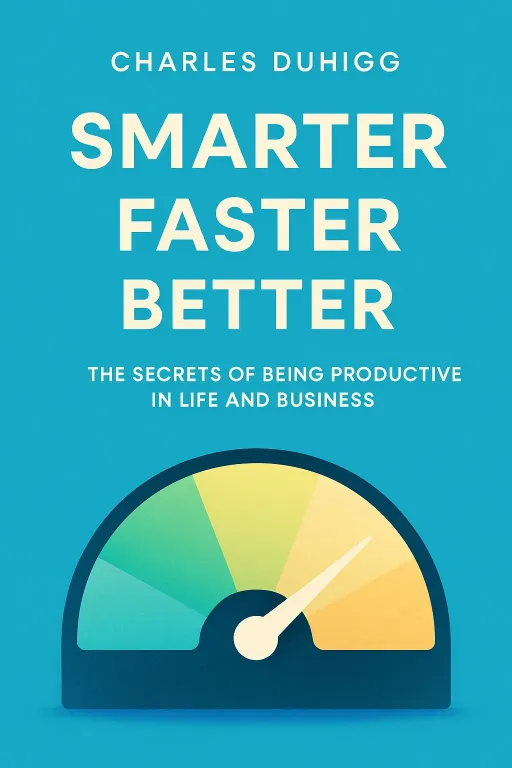
Nova: Exactly! And that’s why today we’re diving into two brilliant minds who approach productivity from vastly different, yet equally powerful, angles. We’re talking about Charles Duhigg’s groundbreaking book, "Smarter Faster Better: The Secrets of Being Productive in Life and Business," and Robert Pozen’s incredibly practical guide, "Extreme Productivity: The Knowledge Worker's Guide to Getting More Done in Less Time."
Atlas: Ah, Duhigg. I know him from "The Power of Habit," which basically rewrote how we understand personal change. His background as a Pulitzer-winning investigative journalist really shines through, doesn't it? He digs deep into the science and the stories. And Pozen, if I recall, he’s a formidable figure from the finance world—someone who actually the high-stakes, high-output life he writes about, right? So he’s not just theorizing; he’s been in the trenches.
Nova: Precisely. Duhigg, with his journalistic rigor, unpacks the psychological underpinnings of why some people and companies are just more effective. He's less about the 'what' and more about the 'why' and 'how' our brains work. Pozen, on the other hand, comes from a world where efficiency isn't just a buzzword, it's a survival mechanism. He’s a former executive at Fidelity and MFS Investment Management, and he’s known for his incredibly structured, actionable systems. So, you have one exploring the inner game, and the other, the outer game.
Atlas: That’s a powerful pairing. It sounds like one is giving us the mental framework, and the other is handing us the tactical playbook. Which, for our listeners who are always seeking growth and want to build their expertise, is exactly what we need.
The Inner Game: Choice & Storytelling
SECTION
Nova: So let’s start with Duhigg, because what he reveals about motivation and focus is truly transformative. He talks about eight key concepts, but two really stand out for me: the power of "making choices" and "telling yourself stories."
Atlas: Okay, making choices, that sounds pretty fundamental. But how does that unlock productivity? I mean, we all make choices every day, often feeling like we have choices, and sometimes they just lead to analysis paralysis.
Nova: That’s the common misconception. Duhigg isn't just talking about choosing what to have for lunch. He's talking about reframing our obligations as choices. Think about it: many of us feel like we're constantly reacting, being pulled in different directions by tasks that feel imposed. Duhigg argues that true productivity comes when we actively choose to engage with those tasks, even the mundane ones. It's about building an inner locus of control.
Atlas: So basically, instead of saying, "Ugh, I to do this quarterly report," you’re supposed to say, "I to do this quarterly report because it contributes to X, Y, Z goal"?
Nova: Exactly! He gives a fascinating example of how this played out in a military training exercise. Recruits were given a challenging, seemingly impossible task. Some felt overwhelmed and gave up. But those who were encouraged to explicitly state they were choosing to continue, even amidst the hardship—whether it was for their team, for their country, or for personal mastery—they performed significantly better. They weren't just enduring; they were actively choosing to persist.
Atlas: Wow, that’s a subtle but profound shift. It’s not about the task itself, but the internal narrative you build around it. So, how does the "telling yourself stories" part fit in with that? Because that sounds a bit like self-deception if you’re trying to convince yourself to like something you inherently dislike.
Nova: It’s not about self-deception at all. It’s about understanding the deeper motivations and connecting current actions to future aspirations. Duhigg illustrates this with a story about the creative process at Disney. When developing "Frozen," the team struggled with the character of Elsa. She was initially portrayed as a villain. But by telling themselves a different story about her—one of a misunderstood, powerful young woman struggling with her abilities, rather than just evil—they unlocked a whole new narrative that resonated globally.
Atlas: That’s brilliant. So, for our listeners who are building a business or mastering a skill, if they’re feeling stuck on a particular project, instead of just pushing through with grit, they should pause and ask, "What story am I telling myself about this task? And what story I tell myself?"
Nova: Precisely. It’s about creating a mental model where your current actions aren’t isolated chores, but chapters in a larger, meaningful story you’re writing for yourself. If you’re a builder, you’re not just laying bricks; you’re building a legacy. If you’re a seeker, you’re not just reading a book; you’re expanding your personal philosophy. It transforms obligations into intentional actions, fueling that purpose-driven drive in a way that sheer willpower often can’t sustain.
Atlas: I love that. It gives you agency. Instead of being a victim of your to-do list, you become the author of your day. It’s like taking the driver’s seat in your own life. But for someone who’s staring at a mountain of tasks, even with a great story, the sheer volume can still be paralyzing. How do you even begin to tackle that?
The Outer Game: Ruthless Efficiency & Prioritization
SECTION
Nova: And that, Atlas, is where Robert Pozen steps in with his "outer game" strategies. While Duhigg gives us the mental framework, Pozen provides the surgical tools. His book, "Extreme Productivity," is a masterclass in highly structured, actionable systems. He emphasizes prioritization, ruthless elimination of non-essentials, and efficient communication.
Atlas: "Ruthless elimination." That’s a phrase that gets my attention. For a pragmatist like me, or anyone trying to grow their ventures, that sounds like music to my ears. It suggests cutting out the fluff, which is often the hardest part.
Nova: It absolutely is. Pozen's approach is about maximizing impact by focusing on what truly matters. He shares a story about his time at Fidelity, where he was responsible for a massive division. He realized that simply working longer hours wasn't sustainable or effective. He had to identify the 20% of tasks that delivered 80% of the results, and then systematically cut out or delegate everything else. He was known for having "no-meeting" days and for returning emails only once a day to force himself to prioritize.
Atlas: That’s a bold move in a corporate culture often drowning in meetings and constant digital pings. So, he’s not just saying "prioritize," he’s saying "prioritize so aggressively that you actively eliminate anything that doesn't serve your highest priorities."
Nova: Exactly. He’s famous for a concept called "reverse prioritization." Instead of asking, "What should I do?" he asks, "What I need to do?" It’s a subtle but powerful reframing. He also advocates for strict time blocking, but not just to fill up your calendar. It's to proactively allocate time to your most important goals, protecting that time fiercely. He even shares how he would prepare for meetings by outlining his desired outcomes and the specific questions he needed answered the meeting, cutting down on aimless discussion.
Atlas: That’s fascinating. It’s almost like he’s saying, "If it doesn't directly serve your purpose, it’s a distraction." For someone in a high-stakes environment, or anyone trying to build expertise, that's invaluable. It's not just about doing tasks faster; it's about doing tasks that matter.
Nova: And that leads directly to his emphasis on efficient communication. He realized that a huge chunk of time is lost in unclear emails, rambling presentations, and unproductive meetings. He developed a system for writing concise emails, structuring presentations with clear takeaways upfront, and ensuring every interaction had a defined purpose. It’s about respecting everyone’s time, including your own.
Atlas: That’s a game-changer. I imagine a lot of our listeners, especially those managing teams or trying to scale a business, often feel buried under a mountain of communication. So, applying Pozen’s ruthless elimination to, say, a recurring team meeting, might mean asking: "Does this meeting to happen? What’s the absolute minimum we need to achieve? Can we do it in 15 minutes instead of an hour?"
Nova: Precisely. His work shows that productivity isn't just about personal discipline; it's about designing systems that you to be efficient and impactful. It’s a top-down, bottom-up approach to getting things done. He also shared how he used to grade his own performance and the performance of his teams on how well they adhered to these principles, making it a cultural expectation, not just a personal preference.
Synthesis & Takeaways
SECTION
Atlas: This is powerful, Nova. We have Duhigg showing us how to take control of our internal narrative and purpose, and Pozen giving us the practical, almost surgical tools to execute with precision. It’s the perfect blend for anyone who values growth and wants to make a real impact.
Nova: Absolutely. Duhigg reminds us that our internal state—our choices, our stories—are the ultimate drivers of sustained motivation. Without that inner alignment, even the best systems will eventually falter. You'll just be moving faster in the wrong direction.
Atlas: Right. And then Pozen comes along and says, "Okay, now that you've got your head straight and you know your 'why,' let's make sure you're not wasting a single moment on anything that doesn't propel you forward." It’s about building those efficient ways to learn and grow.
Nova: It’s the efficiency equation. Your internal clarity multiplied by your external effectiveness. So, for our listeners, here’s a tiny step you can take this week: identify one recurring task in your business or your daily life. It could be a report, a meeting, an email chain. Now, apply Pozen's 'ruthless elimination' principle. Can you automate it? Delegate it? Or significantly streamline it to minimize its time footprint?
Atlas: That’s a concrete challenge. And to layer Duhigg’s wisdom on top of that, here’s a deep question: How can you apply his concept of 'making choices' to gain greater control and motivation over your daily work? Think about an obligation that feels draining. How can you transform that into an intentional action by reframing your choice to engage with it, connecting it to your larger purpose or personal philosophy?
Nova: These aren't just productivity hacks, Atlas. These are profound shifts in how we approach our work and our lives. They offer a path to not just doing more, but doing what truly matters, with greater purpose and less burnout. It’s about anchoring your journey in clarity and impact.
Atlas: That’s actually really inspiring. It means we’re not just cogs in a machine; we’re the architects of our own output and our own story.
Nova: Indeed. It's about sharpening your productivity edge, not just to clear your inbox, but to truly build the life and the impact you envision.
Atlas: Thanks for breaking this down, Nova. This has been incredibly insightful.
Nova: My pleasure, Atlas.
Nova: This is Aibrary. Congratulations on your growth!