Mastering Your Time & Focus
Golden Hook & Introduction
SECTION
Nova: Alright, Atlas, quick game. Five words. Describe your ideal productive morning.
Atlas: Oh, I love this! Let’s see… Coffee. Clear mind. Deep work. Done.
Nova: Whoa, that’s aspirational. You’re good. Mine? Chaos. Coffee. Panic. Prioritize. Breathe.
Atlas: Oh, I know that feeling! That’s probably more relatable for most of our listeners, honestly. It definitely describes my Monday mornings more often than I’d like.
Nova: Right? And that chaotic, overwhelming feeling, that's what we're tackling today. Because for many of us, the quest for productivity often feels like a hamster wheel – more doing, less achieving. We're constantly chasing our tails.
Atlas: Exactly. It’s like, I want to be efficient, I want to make progress, especially when you’re trying to build something new, or learn deeply. But where do you even start when everything feels urgent and important? How do you cut through the noise?
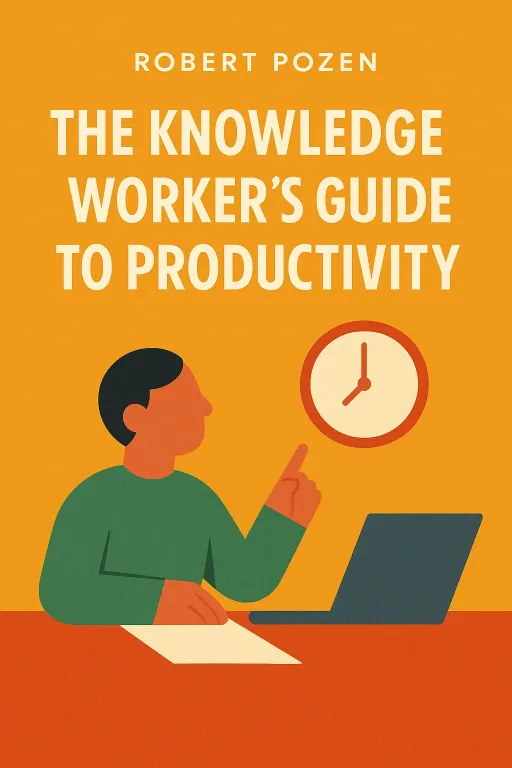
Nova: That’s the million-dollar question, and two brilliant minds have given us some incredibly sharp tools to answer it. Today, we’re diving into "The Knowledge Worker's Guide to Productivity" by Robert Pozen, and Brian Tracy's classic, "Focal Point."
Atlas: Pozen and Tracy, that’s a power duo. I know Brian Tracy as a legendary figure in self-development; his "Focal Point" is a culmination of decades of research, just distilled into these incredibly actionable principles. It's known for cutting through complexity.
Nova: Absolutely. And Robert Pozen, he’s a fascinating character. A former high-ranking executive at Fidelity and a Harvard Business School professor, he developed his system out of sheer personal necessity. He had an incredibly demanding career but also wanted to be present for his family. So, his book isn't just theory; it's a battle-tested, no-nonsense approach to managing a massive workload without sacrificing everything else.
Atlas: Wow, that’s actually really inspiring. It means these aren't just abstract ideas, but strategies forged in the fire of real-world demands. How do these two titans of productivity complement each other?
Strategic Prioritization & Workload Management
SECTION
Nova: They’re like two sides of the same coin, Atlas. Pozen gives you the structure, the scaffolding for how to think about your entire workload. He challenges the myth that productivity means doing. He says it's about doing the things, and doing them. It's all about "high-impact work."
Atlas: Okay, but "high-impact work" sounds great in a boardroom, but for someone aspiring to build a career, or even just learn deeply – like an aspiring architect trying to master complex software or design principles – everything feels important. How do you distinguish between urgent, important, and truly "high-impact?"
Nova: That’s where Pozen’s genius comes in. He argues that most people spend too much time on low-value tasks because they haven't explicitly defined their goals. His system starts with identifying your top priorities, then ruthlessly eliminating or delegating anything that doesn't directly contribute to those.
Atlas: Ruthless elimination. That sounds a bit out there. Especially if you’re, say, an intern or in a junior role. You can’t just tell your boss, "Sorry, that task isn't high-impact for goals."
Nova: That’s a valid point, and a common misconception. Pozen isn’t suggesting you shirk responsibilities. He’s suggesting you proactively manage them. For instance, he talks about handling emails. Instead of just reacting, he advises asking: "Does this email require action from me? If so, what's the smallest, most efficient action I can take?" He suggests a "two-minute rule" for quick tasks, but for everything else, it’s about strategic processing. Don't let your inbox dictate your day.
Atlas: Oh, I know that feeling. The inbox is a black hole of distraction. So, he's saying it's about being proactive and strategic, even with the mundane?
Nova: Exactly. He’s famous for his structured approach to meetings too. Before any meeting, he’d ask for a clear agenda and expected outcomes. If those weren't provided, or if he wasn't essential, he wouldn't attend. He understood that every minute spent in an unproductive meeting was a minute lost from high-impact work.
Atlas: Wow. That takes a certain level of courage, especially in a corporate environment. But it makes sense. It’s like saying, "My time is valuable, and I'm going to protect it for tasks that actually move the needle."
Nova: That’s the core of it. He encourages you to think of your day as a finite resource, not an endless well. He used to carry a small notebook everywhere, jotting down ideas and tasks, then at the end of the day, he'd categorize them into "must do," "should do," and "could do," always prioritizing the "must do" for the next day. This systematic categorization ensures you're always tackling the most important things first.
Atlas: That’s a great way to put it. It’s not just about doing, but about doing the less, if that makes sense. It sounds like it cultivates a sense of control, which, for someone who values inner well-being, is incredibly important.
Unwavering Focus on Highest-Value Activities
SECTION
Nova: It absolutely does. And that idea of ruthlessly prioritizing leads us perfectly to Brian Tracy's "Focal Point," which takes that concept of high-impact work and drills down into the required. Tracy’s core idea is deceptively simple: identify your single highest-value activity for the day, and then dedicate unwavering concentration to it until it's done.
Atlas: Unwavering concentration. That’s the dream, isn't it? For someone seeking growth and deep understanding, that might mean dedicated research, learning a new skill, or even just focused introspection. But the world is of distractions. How do we actually cut through all the noise of notifications, emails, and just general mental clutter? That constant distraction is draining.
Nova: It truly is. Tracy uses the famous analogy of "eating the frog." Your "frog" is your biggest, most important, and often most unpleasant task of the day. His advice? Eat that frog first thing in the morning. Get it done before you do anything else.
Atlas: Eat the frog. I’ve heard that before, but I’ve always thought, "What if my frog is really, really big?" Or what if I have, like, a whole pond full of frogs to eat every day? It sounds like it just pushes the overwhelm to the beginning of the day.
Nova: That’s a common reaction! But the power of "eating the frog" isn't just about getting an unpleasant task out of the way. It’s about the psychological momentum it creates. You start your day with a significant win. That feeling of accomplishment fuels the rest of your day, making you more likely to tackle other tasks with confidence and focus. It’s about building a positive feedback loop.
Atlas: That makes sense. It’s not just about discipline, but also about a mental shift, like a psychological hack. But what if that "frog" requires hours of deep, uninterrupted work? How do you maintain that "unwavering" focus when creative or deep thought often requires a bit of meandering, or even letting ideas percolate?
Nova: That’s where Tracy brings in the 80/20 rule, or the Pareto Principle. He applies it to every aspect of your life. 20% of your activities produce 80% of your results. The challenge is identifying that 20%. For your big "frog," it might mean breaking it down into smaller, 30-minute chunks, and committing to that first chunk, completely distraction-free.
Atlas: So, it's about breaking down the big frog into bite-sized frogs, and then eating one of those bite-sized frogs first.
Nova: Exactly! Imagine a writer working on a novel. The "frog" is finishing the book. That's huge. But their highest-value activity for today might be writing 500 words on a specific chapter, or outlining the next plot point. Tracy would say, dedicate your first hour to that. Turn off notifications, close other tabs, and just write. The feeling of making progress on that one, most important thing is incredibly motivating. It's about protecting that focused time like it's gold.
Atlas: That’s a great analogy. Protecting that time like gold. I can see how that would lead to a sense of profound accomplishment, not just busy-ness. It really connects to that desire for inner well-being, because constant distraction is the enemy of peace.
Synthesis & Takeaways
SECTION
Nova: It truly is. So, when we put Pozen and Tracy together, we see this beautiful synergy. Pozen gives us the macro-level structure: how to analyze your entire workload, define your goals, and ruthlessly prioritize. He helps you identify your high-impact work actually looks like across your responsibilities.
Atlas: And then Tracy comes in with the micro-level focus: once you've identified that high-impact work, he gives you the psychological and practical tools to actually. To concentrate on that one thing, that "focal point," with unwavering attention.
Nova: Precisely. It’s a symbiotic relationship. You can’t focus effectively if you haven’t prioritized correctly, and prioritization is useless without the discipline to focus. It’s about a deliberate dance between strategic planning and intense, single-minded concentration.
Atlas: So, it’s not just about doing more, or even doing things, but doing the smart things with focused intention. It sounds like a path to not just productivity, but also inner peace from reduced overwhelm, which I think resonates with so many of us who are trying to build something meaningful.
Nova: Absolutely. It’s about intentionality. And this brings us right back to our takeaways. The tiny step we suggest is to identify your single most important task for tomorrow morning and commit to working on it first, before anything else, for 30 minutes. Just 30 minutes.
Atlas: That tiny step is powerful because it builds momentum and confidence. It’s manageable. And then the deep question for our listeners: How can you apply the 80/20 rule to your current study or career exploration, ensuring your limited time is spent on truly impactful activities?
Nova: That question really forces you to look at your efforts strategically. What 20% of your learning or work activities will yield 80% of the results you're aiming for?
Atlas: It’s about getting clear on that "focal point" and then protecting it.
Nova: And that clarity, that focus, that’s where true growth happens.
Atlas: What an insightful discussion, Nova. This really makes me rethink my own mornings.
Nova: Me too, Atlas. And we hope it sparks some powerful shifts for all of you listening.
Atlas: Your input helps us all grow. Share your "focal points" or biggest "frogs" with us. How do you plan to apply these insights to your own journey?
Nova: This is Aibrary. Congratulations on your growth!