The Persistence Protocol: How Movement Fuels the Super-Individual
Golden Hook & Introduction
SECTION
Nova: aleck, as a solo developer, you know the feeling. You're deep in the zone, building something from nothing. It's a marathon of the mind, right?
aleck: Absolutely. It's hours of focus, problem-solving, and sometimes, just staring at a screen waiting for an idea to click. It definitely feels like an endurance sport.
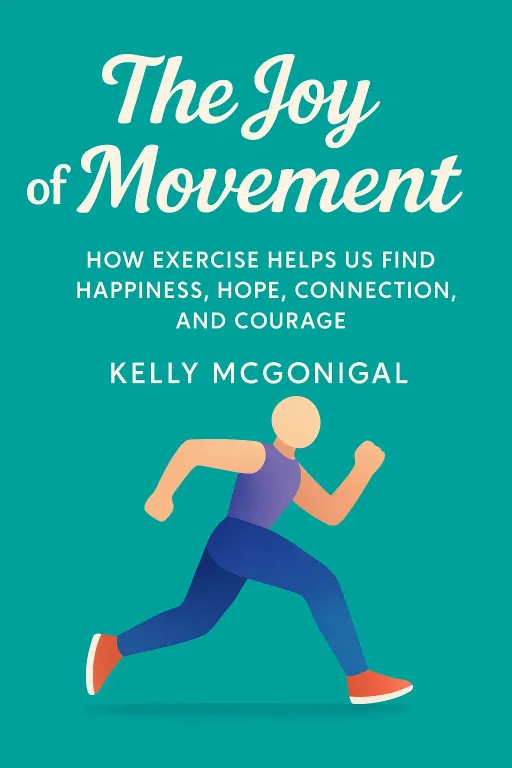
Nova: Exactly. But what if I told you the secret to winning that marathon—to staying creative, resilient, and avoiding burnout—isn't in your code editor, but hardwired into your muscles? The book we're diving into today, Kelly McGonigal's "The Joy of Movement," argues that our bodies are designed to reward persistence with a neurochemical cocktail that makes us more hopeful and courageous. It's a biological hack for the super-individual.
aleck: A biological hack... I like the sound of that. As someone who embraces AI and systems, the idea that our own biology has these built-in, optimizable protocols is really compelling.
Nova: I thought you'd say that! So today we'll dive deep into this from two perspectives. First, we'll explore the 'Persistence Protocol'—the science behind how sustained movement builds mental grit. Then, we'll discuss the 'Community Code'—how moving together can forge the powerful connections that every super-individual needs to thrive.
aleck: Fantastic. I'm ready. Let's deconstruct the system.
Deep Dive into Core Topic 1: The Persistence Protocol
SECTION
Nova: Alright, let's start with this idea of a 'persistence high.' Most of us have heard of the 'runner's high,' and we usually think it's about endorphins, which are basically the body's natural painkillers. But McGonigal shows us it's something much more profound.
aleck: Okay, so it's not just about numbing the pain of a long run?
Nova: Not at all. The real magic comes from something called endocannabinoids. And yes, that word 'cannabinoid' is no accident. These are chemicals your brain produces that are very similar to the active compounds in cannabis.
aleck: So, our own bodies can produce a substance that makes us feel... blissful?
Nova: Precisely. But unlike a drug, you can't get addicted in a harmful way. Instead, these endocannabinoids reduce anxiety, lift your mood, and even make you more open to social connection. They create this state of calm, optimistic euphoria. And here's the key: you don't get it from just any exercise.
aleck: Ah, so there's a specific trigger for this protocol. What is it?
Nova: It's continuous, moderate-intensity effort. McGonigal points to our evolutionary history. She tells the story of the Hadza, one of the last hunter-gatherer tribes in Tanzania. An anthropologist named Herman Pontzer studied them and found they spend hours every day in moderate-to-vigorous activity—hunting, foraging, walking. They aren't 'working out'; they're living. And they show almost no signs of modern anxiety or depression.
aleck: So their lifestyle is constantly activating this system.
Nova: Exactly. And a researcher named David Raichlen put this to the test in a lab. He had runners on a treadmill at different intensities. A slow walk? No change in endocannabinoid levels. An all-out sprint? Also no change. But a steady, moderate jog for thirty minutes? It their levels. It's not a 'sprint high' or a 'strolling high.' It's a 'persistence high.'
aleck: That is fascinating. It's not about peak intensity, but about consistency of moderate effort. It's like our brain has a built-in API that rewards the 'grind.' In development, we have these long periods of just chipping away at a problem. The big 'aha!' moment, the breakthrough, is rare. This suggests the joy can be found in the steady work itself, if we can learn to tap into this.
Nova: You've hit on the core of it! It completely reframes the experience of hard work. The reward isn't just the destination—the finished project, the finish line. The reward is baked into the process of persisting. It’s a biological mechanism to make us love the journey.
aleck: It makes me think about the feedback loop. If you're a solo developer and you're feeling stuck or burnt out, the conventional wisdom is to 'push through' or 'take a break.' But this suggests a third option: engage in a different kind of persistence. Go for a 30-minute jog. You're not just clearing your head; you're actively generating the neurochemicals of optimism and resilience that you can then bring back to your work.
Nova: You're hacking your own brain chemistry to make you a better creator. And what's more, these endocannabinoids, as I mentioned, make you more social. They literally make you enjoy being around other people more.
aleck: Which is a perfect bridge, because the other side of being a solo developer is... well, being solo. That isolation can be the biggest challenge of all. So how does movement fix that?
Deep Dive into Core Topic 2: The Community Code
SECTION
Nova: I'm so glad you asked, because that brings us to our second idea: the 'Community Code,' or what the book calls 'collective joy.' This is where movement becomes a social technology.
aleck: A social technology... you mean beyond just joining a sports team?
Nova: Much deeper than that. The book talks about a concept from sociology called 'collective effervescence.' It's that euphoric, transcendent feeling you get when you're part of a group, moving as one. Think of a crowd at a concert singing together, or a flash mob dancing in a square. You lose your sense of self and merge with the group.
aleck: And movement is the key to triggering this?
Nova: It's the most powerful trigger we have. And the crucial ingredient is. It's not just about exercising near other people; it's about moving them, in rhythm. McGonigal tells this beautiful story about the Ottawa Rowing Club.
aleck: Tell me.
Nova: Okay, picture this: it's a crew of eight women, all over fifty, on the Ottawa River. The coxswain is in the back, calling out the rhythm. The oars dip into the water, pull, and lift out in perfect, synchronized unison. They create this 'swoosh' sound that they jokingly call 'rowing cocaine' because it's so satisfying.
aleck: I can almost hear it.
Nova: One of the rowers, Kimberly Sogge, describes the feeling. She says, "It’s total attunement... it becomes not clear who is feeling what, because we’re one living entity. Not just with one another, but also the river." She says in those moments, the boundaries between them, the water, and the sky just... dissolve.
aleck: Wow. That's a powerful image. It's like a biological form of 'distributed consensus.' In a distributed computing system, individual nodes have to communicate and synchronize to agree on a single state. Here, individual humans are synchronizing their bodies, and their brains literally begin to perceive themselves as a single 'group state.' The feeling of belonging isn't just a nice idea; it's a physiological reality.
Nova: Yes! You're engineering connection at a neurological level. And the book shows this has real-world consequences that are just staggering. There's a story about a CrossFit gym that got evicted from its building. The owner was devastated. But the members, this community forged through thousands of synchronized burpees and kettlebell swings, didn't just send sympathetic texts. They showed up with three pickup trucks and a U-Haul and moved the entire gym out in eight hours. When he found a new spot, they all came back and helped him rebuild it. That bond is different. It's visceral.
aleck: That's incredible. It makes me completely rethink what 'community building' for developers should look like. We organize hackathons and online forums, which are great for exchanging information. But we're not building that visceral, physiological bond.
Nova: Right? The information layer is there, but the human connection layer is missing.
aleck: Maybe instead of another 24-hour hackathon fueled by pizza and energy drinks, we need a group hike. Or a dance class. Or even something like a group VR fitness game where everyone is moving to the same beat. Something that creates that shared physical rhythm. We're trying to build community in Slack channels when our biology is screaming for us to build it through synchronized movement.
Nova: That is such a brilliant application of the idea. You're not just adding exercise to a developer's life; you're using it as a tool to solve one of the biggest problems in that life: isolation.
Synthesis & Takeaways
SECTION
Nova: So, when we put it all together, we have these two incredibly powerful forces from the book. On one hand, we have the 'Persistence Protocol' to fuel our individual journey, making the grind itself neurochemically rewarding.
aleck: And on the other, we have the 'Community Code,' using synchronized movement to build deep, authentic connections that combat the loneliness that can come with being a 'super-individual.'
Nova: It’s a complete system for a resilient, creative, and connected life. So, aleck, for you and for everyone listening who is on this path of intense, often solitary creation, what's the final, actionable takeaway?
aleck: I think the takeaway isn't just 'go to the gym.' It's to be more strategic, like an engineer designing a system. It's about consciously designing your 'movement portfolio.'
Nova: I love that. 'Design your movement portfolio.' What does that look like?
aleck: It means you need to fill two buckets. First, find your 'persistence' activity. This is your solo grind. Maybe it's a daily 30-minute jog, a long bike ride on weekends, or even just a brisk, continuous walk every day. This is what will build your personal resilience and optimism. Second, find your 'synchrony' activity. This is your community code. Join a running club, a yoga class, a dance group, or that VR fitness league I mentioned. It doesn't have to be intense, it just has to be together, in rhythm.
Nova: So you're building both individual strength and collective support.
aleck: Exactly. Don't just exercise your body. Use movement to exercise your capacity for joy and your fundamental human need for connection. That’s the real hack.
Nova: A perfect, actionable thought to end on. aleck, thank you for these incredible insights. This has been fantastic.
aleck: The pleasure was all mine, Nova. Thank you.