Personalized Podcast
Golden Hook & Introduction
SECTION
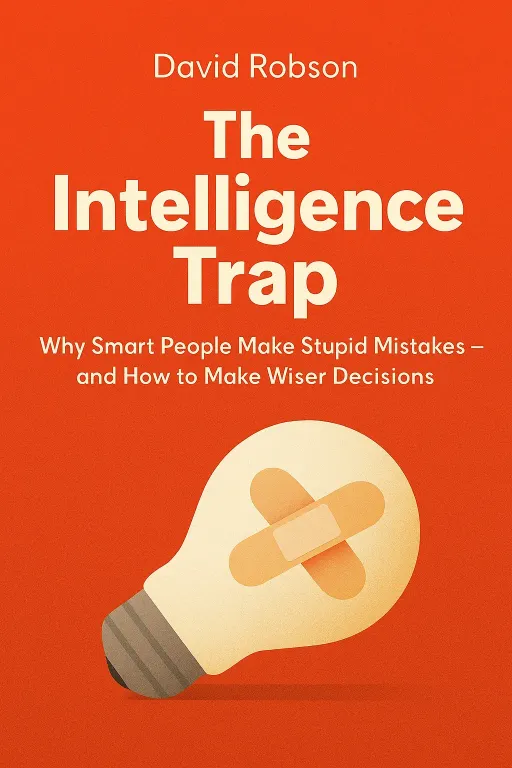
Dr. Warren Reed: Imagine being a Nobel Prize-winning scientist, the mind behind PCR technology, yet genuinely believing you were abducted by a glowing, raccoon-like alien. Or being a world-class physicist, lured across continents by an online model, only to end up carrying a suitcase packed with two kilograms of cocaine. Why do brilliant minds make such baffling, catastrophic mistakes? Today, we are tackling David Robson's groundbreaking book,, from three distinct angles. First, we will expose dysrationalia—our brain's addiction to being right. Second, we will dissect the curse of expertise and how automatic mental scripts blind professionals to obvious warning signs. And finally, we will hand you the ultimate toolkit for cognitive sobriety—actionable strategies to build intellectual humility and make wiser decisions. I am Dr. Warren Reed, and joining me is analytical thinker George. Let's get straight to the point. George, when you look at these extreme cases of brilliant people failing, what is the strategic pattern you see?
George: Thanks, Warren. It is great to be here. When I read about Kary Mullis or Paul Frampton, I do not just see isolated lapses in judgment. I see a profound, systemic issue that looks a lot like a behavioral addiction. As analytical thinkers, we tend to treat our intelligence as an unalloyed good. But Robson's book shows that a high IQ is actually a high-powered engine. If your steering wheel is broken, a faster engine just means you crash into the wall at a much higher speed. We get addicted to the feeling of certainty. We crave the dopamine hit of being right, of having the smartest answer in the room. And because highly intelligent people have superior verbal and analytical skills, they are actually better equipped to build elaborate, sophisticated justifications for their worst decisions. They are not just making mistakes; they are outsmarting themselves.
Dr. Warren Reed: Spot on. The data supports this. General intelligence does not guarantee real-world rationality. Keith Stanovich coined a term for this: dysrationalia. It is the explicit mismatch between IQ and rational thinking. Let's look at the facts. One: IQ tests only measure a narrow band of cognitive processing, like working memory and pattern recognition. Two: they completely ignore cognitive reflection, intellectual humility, and the ability to override intuitive biases. Three: studies show that highly educated people are just as likely, if not more likely, to believe in paranormal phenomena, psychic healing, and conspiracy theories. It is a massive blind spot.
George: It really is. And that concept of a bias blind spot is key here. It is the psychological tendency to recognize biases in others while remaining completely blind to them in ourselves. If you are highly intelligent, you have a larger library of facts and a sharper logical scalpel. But if you use those tools exclusively to defend your pre-existing beliefs, you are essentially using your intellect to feed an addiction. You are rearranging your prejudices and calling it thinking, as William James famously put it.
Deep Dive into Core Topic 1
SECTION
Dr. Warren Reed: Let's look at a classic historical case study of this exact phenomenon: Arthur Conan Doyle and the Cottingley Fairies. Doyle was a medical doctor, a brilliant author, and the creator of Sherlock Holmes—the ultimate literary symbol of cold, hard, deductive logic. Yet, in the early twentieth century, Doyle became completely obsessed with spiritualism. He was utterly convinced that two young cousins, Elsie Wright and Frances Griffiths, had photographed real, living fairies in their garden in Yorkshire. The photos were laughably crude cardboard cut-outs held up by hatpins. But Doyle did not see that. Why? Because his desire to prove the supernatural overrode his critical faculties.
George: That story is mind-blowing, Warren. What makes it even more fascinating is how Doyle reacted when people pointed out the flaws. When experts noted that the fairies' hairstyles looked suspiciously like modern fashion trends, Doyle did not pause to reflect. Instead, he used his immense creativity to argue that fairies obviously had their own spiritual fashion sense and wore clothes made of light. He even interpreted the visible hatpins holding up the cardboard cut-outs as the fairies' belly buttons! This is the perfect example of motivated reasoning. He had a deep, emotional craving to believe in spiritualism—partly to cope with the tragic loss of his son in World War I. His intelligence did not protect him from the hoax; it gave him the mental gymnastics required to defend it.
Dr. Warren Reed: Exactly. He outsmarted himself. And look at his relationship with the magician Harry Houdini. Houdini was a massive skeptic of spiritualism. He spent years debunking fraudulent mediums. In 1922, Doyle invited Houdini to a private séance in Atlantic City, where Doyle's wife, Jean, claimed to contact Houdini's deceased mother. Jean entered a trance and wrote a long, emotional letter in fluent English, filled with Christian crosses. But Houdini's mother was a Jewish woman who spoke almost no English and would never have used Christian symbols. Houdini immediately saw through the fraud. But Doyle? He was so entrenched in his belief that he argued Houdini was actually a powerful medium himself, but was simply in denial of his own supernatural powers!
George: It is a literal addiction to a narrative. Doyle could not tolerate the withdrawal symptoms of admitting he was wrong. The psychological discomfort—the cognitive dissonance—was too high. So, his brain doubled down, manufacturing increasingly absurd justifications to keep the belief alive. This is exactly what happens in motivated reasoning. When we encounter information that contradicts our core identity or deeply held beliefs, our brain treats it as a physical threat. We go into fight-or-flight mode. If you have a high IQ, your 'fight' response is incredibly sophisticated. You do not just deny the evidence; you build a fortress of rationalizations to protect your ego.
Dr. Warren Reed: Let's extract the strategic takeaway here. For our listeners, and especially for someone like you, George, who loves analyzing complex systems, the lesson is clear: your intelligence is a tool, not a shield. If you do not actively practice cognitive reflection, your brain will use its power to deceive you. You have to treat your own beliefs with a healthy dose of skepticism. You have to ask yourself: am I seeking the truth, or am I just looking for evidence to prove that I was right all along?
George: That is the ultimate question, Warren. It is about shifting our relationship with our own minds. We have to stop treating our thoughts as absolute truth and start treating them as hypotheses that need to be tested. If we do not, we are just feeding the addiction. We are letting our cognitive biases run the show, using our intelligence to justify our blind spots.
Deep Dive into Core Topic 2
SECTION
Dr. Warren Reed: That brings us to our second core topic: the curse of expertise. We often assume that deep training and years of experience make us immune to errors. The data says otherwise. In complex, fast-moving environments, expertise can actually create a rigid straightjacket. It leads to what psychologists call earned dogmatism. Because you are an expert, you feel you have earned the right to be closed-minded. You stop paying attention to the details. You rely on automatic mental scripts. Let's look at the Brandon Mayfield case. It is a chilling example of how expert judgment can fail catastrophically.
George: This is the 2004 Madrid train bombings case, right? The FBI fingerprint match?
Dr. Warren Reed: Yes. March 11, 2004. Terrorist attacks in Madrid kill 191 people. The Spanish National Police find a bag of detonators with a partial fingerprint. They share the digital image with the FBI. The FBI's supercomputer generates a list of potential matches. At the top of the list is Brandon Mayfield, an American lawyer and Muslim convert living in Oregon. Now, three highly experienced FBI fingerprint examiners—the absolute elite of the forensic world—examine the print. They declare a one hundred percent positive match. They are completely certain. They even bring in an independent, court-appointed expert, Kenneth Moses, to verify it. Moses looks at the print and agrees. It is a match. Mayfield is arrested and thrown into solitary confinement.
George: But he was completely innocent, wasn't he? He had not even left the United States in years.
Dr. Warren Reed: Completely innocent. His passport had expired. He was thousands of miles away. So, how did four world-class experts get it so wrong? It was a classic case of confirmation bias fueled by the curse of expertise. The initial examiner made a quick, intuitive judgment based on a few matching points. Once that initial hypothesis was formed, the subsequent examiners did not look at the print objectively. They were told that a senior colleague had already found a match. They were also given background information about Mayfield's Muslim faith and his legal defense of a suspected terrorist. This emotional, high-stakes context created a powerful expectation. They looked at the print, saw the similarities, and completely ignored the glaring discrepancies. They literally saw what they expected to see.
George: And the Spanish National Police actually found the real match, right? An Algerian man named Ouhnane Daoud.
Dr. Warren Reed: Exactly. The Spanish police looked at the same print, compared it to Daoud, and realized the FBI had made a massive error. When they pointed out the differences, the FBI examiners initially dismissed them. They were too entrenched in their own expertise to admit they could be wrong. It was only when the Spanish police proved Daoud's match that the FBI was forced to release Mayfield, issue a public apology, and pay him two million dollars in compensation. This is the curse of expertise in action. The examiners' deep training and reliance on pattern recognition actually made them less flexible, less attentive to detail, and highly susceptible to confirmation bias.
George: It is fascinating how their expertise became their undoing. In cognitive science, we talk about how experts rely on chunking—they group information into large, automatic schemas so they can process it quickly. This is great for routine tasks. A master chess player can scan a board in seconds and see the best move. But if the rules of the game change slightly, or if there is a subtle anomaly, that automatic processing can be disastrous. The expert's brain just glides right over the discrepancy because it is running on autopilot. It is a form of functional stupidity.
Dr. Warren Reed: Let's define that. Functional stupidity is a concept developed by Mats Alvesson and André Spicer. It is the deliberate absence of reflexivity, justification, and substantive reasoning in a workplace. Organizations actually encourage this because it keeps things running smoothly in the short term. It reduces friction. If everyone just follows the script, does their job, and does not ask difficult questions, productivity stays high. But it creates a massive, systemic vulnerability. It is how you get disasters like the Deepwater Horizon oil spill or the implosion of Nokia.
George: Nokia is a perfect example of organizational functional stupidity. In the early 2000s, they were the undisputed kings of the mobile phone market. They had half the global market share. Their engineers were brilliant. They saw the iPhone coming. They knew their operating system, Symbian, was outdated and could not handle sophisticated touchscreen apps. But the corporate culture was built on fear and optimism. Middle managers were terrified of delivering bad news to senior executives. They were told that Nokia was a winning company, and that they needed to focus on short-term sales targets. So, everyone feigned expertise. They massaged the data. They pretended everything was fine. They ran on their historical success, completely blind to the fact that the ground had shifted beneath their feet. By the time they realized the truth, it was too late. They went from market dominance to selling their mobile division to Microsoft in 2013.
Dr. Warren Reed: They were addicted to their own success story. They could not tolerate the pain of a strategic pivot, so they chose functional stupidity instead. Let's look at the contrast. High-reliability organizations—like nuclear power plants or aircraft carriers—actively fight this. They have a preoccupation with failure. They treat near misses as red flags, not as proof of safety. They encourage dissent. They defer to expertise on the ground, not to the hierarchy. They build a culture of collective mindfulness.
George: That is a crucial distinction, Warren. In a high-reliability organization, they understand that safety is not the absence of accidents; it is the active presence of capacity to navigate unexpected events. They do not let themselves get comfortable. They do not get addicted to a clean record. They are constantly looking for the cracks in the system. They practice what we might call cognitive sobriety.
Deep Dive into Core Topic 3
SECTION
Dr. Warren Reed: So, how do we build this cognitive sobriety? How do we escape the intelligence trap? Robson outlines a powerful toolkit of evidence-based wisdom. It starts with intellectual humility—the explicit recognition of the limits of your own knowledge. Let's look at Benjamin Franklin. He is the ultimate historical model for this. In 1787, during the Constitutional Convention in Philadelphia, the delegates were completely deadlocked. The small states and large states were at war over representation in Congress. The entire project of the United States was on the verge of collapse. Franklin, who was the oldest delegate, stepped up. He did not deliver a fiery, dogmatic speech. Instead, he urged every member to doubt a little of his own infallibility. He championed the Great Compromise, dividing Congress into the House and the Senate. He literally wrote: 'When a broad table is to be made, and the edges of planks do not fit, the artist takes a little from both, and makes a good joint.'
George: That is a beautiful metaphor, Warren. And it is so rare in today's polarized environment. Franklin's wisdom was not just about his high IQ—though he was incredibly smart. It was about his intellectual humility. He actively practiced what Keith Stanovich calls actively open-minded thinking. He did not treat his opinions as possessions to be defended. He treated them as drafts to be revised. He famously wrote that a frank acknowledgment of one's ignorance is the easiest way to obtain information.
Dr. Warren Reed: Yes. He systematically weighed pros and cons using a method he called moral algebra. He would divide a sheet of paper into two columns: Pros and Cons. Over three or four days, he would write down all the points that occurred to him. Then, he would assign weights to each point, cross out equal factors on both sides, and see where the balance lay. This simple, structured process forced him to slow down. It bypassed the cognitive miserliness of the brain. It prevented him from relying on the most easily recalled facts—the availability heuristic—and forced a comprehensive, balanced analysis.
George: It is a brilliant way to externalize your thinking. When you write things down like that, you take them out of the emotional, reactive space of your working memory and put them on paper where you can analyze them objectively. This connects directly to the work of Ethan Kross on self-distancing. Kross investigated what he calls Solomon's Paradox. King Solomon was legendary for his wise counsel to others, yet his personal life was a complete disaster of bad decisions, greed, and poor judgment. Why? Because we reason much more wisely about other people's problems than our own. We have emotional distance from their dilemmas, but our own problems trigger hot, self-centered cognition.
Dr. Warren Reed: So, how do we bridge that gap? How do we apply Solomon's wisdom to ourselves?
George: Kross's research shows that we can use self-distancing techniques to step outside of our own heads. One of the simplest and most effective ways is to talk to yourself in the third person. Instead of asking, 'Why am I so stressed about this decision?' you ask, 'Why is George stressed about this decision?' It sounds incredibly simple, almost silly, but the neurological effects are profound. It shifts your brain's processing from the hot, emotional amygdala-driven network to the cool, reflective prefrontal cortex. It is like stepping back from a painting to see the whole canvas instead of getting lost in a single brushstroke. You become an objective observer of your own mind.
Dr. Warren Reed: It is a cognitive intervention. It breaks the immediate, impulsive craving for a quick, comfortable answer. Another powerful tool is emotion differentiation. Lisa Feldman Barrett's research shows that people who can describe their emotions with high precision—using a rich, nuanced vocabulary—are far better at regulating them. If you just feel bad, you are reactive. But if you can identify that you are feeling frustrated, anxious, or perhaps just hungry, you can address the root cause. You do not let the background noise of your body hijack your logical thinking.
George: That is so true. It is about building a high emotional IQ to support your analytical IQ. If you do not understand your emotional compass, your feelings will silently steer your logic. You will use your high intelligence to build a brilliant, logical defense for a decision that was actually made by your unexamined anxiety or pride. That is the ultimate intelligence trap.
Synthesis & Takeaways
SECTION
Dr. Warren Reed: Let's synthesize this into a direct, actionable checklist for our listeners. If you want to break your addiction to being right and escape the intelligence trap, here is your strategic protocol. First: practice intellectual humility. Actively seek out dissenting opinions and ask yourself, 'What would have to be true for this person to be right?' Second: slow down your decision-making. Use Franklin's moral algebra. Write down your pros and cons over several days to bypass your brain's default, lazy shortcuts. Third: use self-distancing. When facing a high-stakes personal or professional dilemma, analyze it in the third person. Treat yourself as a client who is paying you for objective advice. And fourth: build reflective competence. Do not just rely on your expertise or your gut feelings. Pause, reflect, and actively look for the warning signs you might be missing. George, what are your final thoughts on this?
George: I think the most powerful takeaway from Robson's book is that wisdom is not an innate trait. It is not something you are born with or that is measured by an IQ test. Wisdom is a set of habits. It is a practice. It is about having the courage to admit when you do not know, the curiosity to explore alternative perspectives, and the discipline to question your own assumptions. If we want to build a wiser society, we have to stop worshiping raw intelligence and start cultivating these intellectual virtues. We have to stage a cognitive intervention on ourselves.
Dr. Warren Reed: Well said, George. Let's leave our audience with a final, sharp question to ponder. Think about your most deeply held professional or personal belief. What is the one piece of evidence that, if presented to you today, would force you to change your mind? If you cannot answer that question, you might just be caught in the intelligence trap. Thank you for listening. Until next time, stay sharp, stay humble, and keep questioning.
George: Thanks, everyone. Take care.