Stop Guessing, Start Scaling: The Guide to High-Output Management.
10 minGolden Hook & Introduction
SECTION
Nova: Atlas, if I say 'scaling a business,' what's the first thing that pops into your head?
Atlas: Oh, easy. It's that mythical beast everyone chases, usually while tripping over their own shoelaces and wondering why their brilliant idea isn't magically multiplying itself. It's the entrepreneur's elusive unicorn.
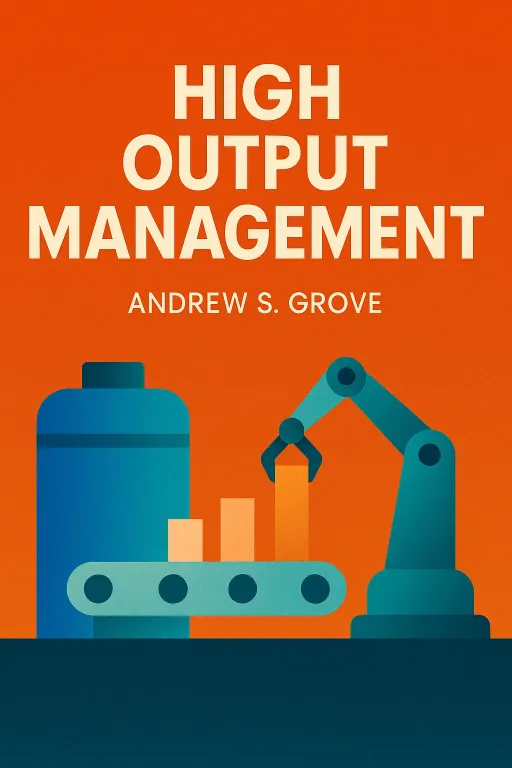
Nova: That's a perfect, slightly cynical, but entirely accurate image. Because, let's be honest, scaling isn't just about big ideas, is it? It's about clear processes, effective leadership, and a whole lot of grit. And that's exactly what we're diving into today, drawing insights from two titans of management thinking: Andrew S. Grove's seminal work,, and Ben Horowitz's brutally honest.
Atlas: Grove and Horowitz... that's a powerful combination. One, the architect of operational efficiency, and the other, the battle-hardened veteran of the tech trenches.
Nova: Absolutely. Andrew Grove, a Hungarian immigrant, not only co-founded Intel but famously steered the company through a pivotal shift from memory chips to microprocessors, transforming it into an absolute powerhouse. His pragmatic, engineering-driven approach to management became the bedrock for Silicon Valley's operational excellence. Ben Horowitz, on the other hand, built and sold Loudcloud, a pioneering cloud computing company, through the dot-com bust, sharing his raw, often brutally honest experiences in a way most tech founders wouldn't dare. Together, these two offer an unparalleled look at the practical, often messy, side of scaling. And it all starts with reframing how we even define a manager's role.
The 'High Output' Mindset: Management as a Team Sport
SECTION
Atlas: So, reframing the manager's role. What does Grove, the operational guru, tell us about that? Because for many, 'manager' just means 'the person who tells me what to do.'
Nova: Well, Grove flips that on its head. His core argument, and it's truly revolutionary, is that a manager's output isn't just their own individual work. It's the output of their organization the output of the neighboring organizations under their influence. It’s management as an interconnected, high-leverage team sport.
Atlas: Okay, so it’s not about how many tasks complete, but how much my completes, and even how much teams my team contribute because of my involvement. That sounds incredibly empowering, but also potentially overwhelming.
Nova: Exactly. Think of it like this: a manager is less a star player and more a conductor. The conductor's output isn't the sound of their own instrument, but the harmonious, powerful performance of the entire orchestra. Grove implemented this at Intel, moving beyond individual heroics to process-driven, team-centric management. He shifted the focus from a product-centric view to a process-centric view, where managers are essentially information processors and decision facilitators.
Atlas: I see. So, the manager's job is to create an environment where everyone else can perform at their best, and then to ensure those performances are aligned. But a curious learner might ask: doesn't that sound incredibly bureaucratic? How do you keep the 'human' in 'human resources' when it's all about optimizing 'output'?
Nova: That's a great question, and it's where Grove's concept of 'leverage' comes in. He defines managerial leverage as the output generated by a manager's activity. A high-leverage activity is one that impacts many people, or impacts a few people in a very significant way. This means a manager spends less time doing individual tasks and more time on things like training, decision-making, and setting clear objectives. Training, for example, is incredibly high-leverage. You teach one person a skill, and suddenly their output increases exponentially, and that cascades through the team.
Atlas: So, it’s about empowering, not micromanaging. That makes sense. But what about the pressure? Does this framework account for the sheer mental and emotional toll of constantly optimizing everyone else's output? I imagine someone trying to apply this might feel like they're responsible for.
Nova: Grove addresses this by emphasizing clear tasks, delegation, and robust training as ways to reduce friction and build capability. It’s not about demanding more, but about creating systems that allow people to more, more effectively. He famously said, "The output of a manager is the sum of the results of the units under his supervision." It's a collective responsibility, not a solitary burden, made lighter through process and clarity. The goal isn't to work harder yourself, but to make the entire system work smarter.
Atlas: That's a powerful distinction. It shifts from individual burden to systemic design. It makes me think about how many small businesses or new ventures struggle because the founder is still doing everything, and they haven't understood that their role needs to evolve from 'doer' to 'enabler.'
Nova: Precisely. And that natural evolution, that constant adaptation, brings us to our next insight, one that often acts as a stark counterpoint to Grove's structured efficiency, yet is equally crucial for any leader. Because while Grove gives us the manual for optimizing, Ben Horowitz reminds us that sometimes, the manual gets thrown out the window when things go sideways.
Leading Through Adversity: The Unfiltered Reality of Hard Choices
SECTION
Atlas: Ah, the 'sideways' moments. The "Hard Things" as Horowitz so aptly puts it. I imagine Grove's meticulous processes can't account for.
Nova: You're right. Horowitz's core message, honed in the crucible of the dot-com bust, is that there are no perfect answers in leadership or entrepreneurship, only choices. And often, those choices are incredibly difficult, fraught with uncertainty, and come with significant personal cost. This isn't about data optimization; it's about conviction.
Atlas: So, Grove provides the blueprint for the machine, and Horowitz tells us what happens when the machine breaks down and you have to rebuild it with duct tape and sheer will? Is there a tension between these two? Does optimizing for 'high output' make you less resilient when the truly hard things hit?
Nova: It’s not a tension as much as a necessary complement. Grove gives you the foundation for healthy growth, but Horowitz prepares you for when that foundation is shaken to its core. He vividly recounts his experience building Loudcloud, a pioneering cloud computing company, through the brutal dot-com bust. Imagine a market collapsing around you, investors pulling out, and having to make the agonizing decision to pivot the entire company to a software product, renaming it Opsware.
Atlas: I can only imagine the pressure. That's not just a business decision; that’s a deeply personal one for everyone involved.
Nova: It absolutely is. Horowitz talks about the 'hard things' – firing friends, navigating a dying market, making impossible choices under extreme pressure. He lays bare the emotional weight of leadership decisions, the sleepless nights, the feeling of being solely responsible for hundreds of livelihoods. He doesn't sugarcoat it. He talks about the loneliness of being CEO, the moments when you feel like you're failing everyone.
Atlas: Wow, that’s kind of heartbreaking, but also incredibly honest. Most business books paint this rosy picture of success. Horowitz seems to say, 'Here's the ugly truth, and you still have to lead through it.'
Nova: Precisely. He emphasizes that in these moments, you don't have the luxury of perfect information or a clear-cut Grove-ian process. You have to make a call, often with incomplete data, and then have the conviction to stand by it, communicate it authentically, and rally your team, even when you're terrified. He writes about the importance of being brutally honest with your employees, even when the news is bad, because trust is paramount.
Atlas: For someone who's constantly trying to learn and apply new knowledge, how do you balance the desire for structured efficiency—which Grove champions—with the brutal reality that sometimes you just have to gut it out and make an imperfect choice, as Horowitz describes?
Nova: That’s the true art of leadership, isn't it? Grove gives you the tools to build a strong, scalable engine. Horowitz teaches you how to drive that engine through a war zone, making split-second decisions when the map is useless. The balance comes from understanding that process creates stability, but conviction creates momentum in chaos. It's about building the best possible system, but also developing the emotional intelligence and resilience to lead when the system inevitably breaks down. It's about knowing when to optimize and when to simply.
Synthesis & Takeaways
SECTION
Atlas: So, it sounds like both authors, despite their very different tones and focuses, ultimately converge on a similar profound insight: effective leadership isn't about being a lone genius. It’s about understanding the mechanics of output, yes, but also the deeply human element of resilience and conviction.
Nova: You've hit on the core of it, Atlas. Grove gives us the framework for multiplying impact through process and people, turning management into a science of leverage. Horowitz gives us the courage to navigate the inevitable storms, reminding us that leadership is often about making the least worst choice and owning it with absolute conviction. Together, they tell us that scaling isn't just growth; it's about building a robust, adaptive system having the guts to steer it through the unknown. It's about what you achieve, but also how you empower others and lead with courage when the path is unclear.
Atlas: That’s actually really inspiring. It grounds the abstract idea of 'scaling' in practical steps, but also in the very real, often difficult, human experience of leading. It makes me wonder what small, tangible step our listeners could take to embody some of this.
Nova: Well, building on our discussion today, and something directly inspired by the tactical insights we covered, here’s a tiny step for everyone listening: identify one recurring task in your business or even your personal life. Document its steps clearly, as if you were writing a manual. Then, aim to delegate it by the end of the week. Start small. Learn to leverage.
Atlas: I love that. It's actionable, and it directly relates to Grove's ideas of process and delegation. We'd love to hear what task you've decided to delegate, or perhaps a 'hard thing' you've navigated using conviction. Share your insights with us on social media.
Nova: This is Aibrary. Congratulations on your growth!