The 'History Repeats Itself' Myth: How Understanding Cycles Unlocks Predictive Power
Golden Hook & Introduction
SECTION
Nova: Alright, Atlas, quick game: I'll throw out a word, you hit me with the first thing that comes to mind. Ready?
Atlas: Oh, I like that. Always ready for a challenge. Hit me.
Nova: History.
Atlas: Dates. Battles. Old stuff.
Nova: Future.
Atlas: Unknown. Progress. Technology.
Nova: Change.
Atlas: Linear. Inevitable. Faster.
Nova: Exactly! And that, right there, is our blind spot. We're conditioned to see history and change in this very specific, often misleading, linear way. It's a comfortable illusion that actually limits our ability to truly see what's coming.
Atlas: So, we're not just talking dusty textbooks then, are we? This sounds like it has real-world stakes. For anyone looking to sharpen their thinking and communication, this shift in perspective feels critical. Which thinkers are really breaking down this old way of thinking?
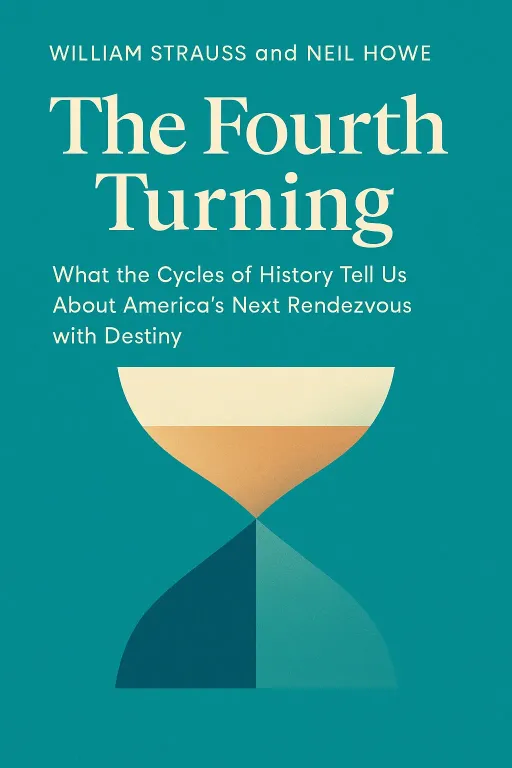
Nova: Well, today, we're diving into two incredibly influential works that shatter this linear myth: "The Fourth Turning" by William Strauss and Neil Howe, and "Principles for Dealing with the Changing World Order" by the legendary investor, Ray Dalio. What's fascinating about Dalio, in particular, is that his insights aren't just academic musings. This is a man who built one of the most successful hedge funds in history, and he credits much of his foresight to understanding these deep historical and economic cycles. He literally put his money where his historical analysis was.
Atlas: Wow, that gives it a whole different weight. It’s one thing for a historian to theorize, but for a world-class investor to say, "This is how I predict the future," that's a game-changer.
The Myth of Linear History – Our Blind Spot
SECTION
Nova: Absolutely. And that's where we need to start – by dismantling this idea that history is either a straight line of progress or just a series of disconnected, random events. This linear view is a profound blind spot because it prevents us from recognizing the underlying patterns and rhythms that actually govern human societies.
Atlas: But isn't 'progress' a good thing? Aren't we always moving forward, inventing new things, solving old problems? It feels intuitive to think of history as an upward climb.
Nova: That’s a great point. And progress certainly happens. We're not denying innovation or societal advancement. The issue is our of the path of that progress. We often mistake the surface-level events – the daily news cycles, the latest tech gadget – for the deep currents that are truly shaping our trajectory. It’s like watching a single wave break on the shore and thinking that's the entire ocean, rather than understanding the powerful, cyclical tides moving beneath it all.
Atlas: Okay, so if we’re just looking at the waves, we’re constantly going to be surprised when the tide goes out or a tsunami hits. Can you give me a historical moment where this 'linear view' really missed the boat, where people were genuinely blindsided because they weren't seeing the deeper patterns?
Nova: Think about the period leading up to World War I. Europe, at the turn of the 20th century, was experiencing unprecedented industrial growth, technological advancement, and a sense of cosmopolitanism. Many believed humanity had evolved beyond large-scale conflict. There was a prevailing optimism, a belief in continuous, upward progress. People genuinely thought that the intricate web of economic ties and diplomatic alliances made a major war unthinkable.
Atlas: Right, they were looking at all the surface connections, the new inventions, the prosperity, and thinking, "We're too advanced for that now."
Nova: Precisely. They missed the underlying geopolitical tensions, the arms race, the rising nationalism, the rigid alliance systems that were actually creating an incredibly brittle environment. When Archduke Franz Ferdinand was assassinated, it wasn't seen as the trigger for a global catastrophe, but a regional incident. The linear, progressive mindset blinded them to the cyclical build-up of great power rivalry and the inherent instability of an unaddressed power vacuum. The outcome, as we know, was catastrophic, surprising almost everyone because they were reading the wrong map.
Atlas: So, if we’re constantly surprised, it means we’re fundamentally misreading the map, right? For anyone trying to build compelling arguments or understand global affairs, that's a huge problem. It means our interpretations are constantly playing catch-up, rather than anticipating.
The Power of Cyclical Thinking for Prediction
SECTION
Nova: Exactly, Atlas. And that's where thinkers like Strauss and Howe, and Dalio, offer us a profound new compass. They argue history isn't just a sequence of events, but a series of predictable cycles. It’s about recognizing that while the actors and technologies change, the fundamental human responses and societal dynamics often repeat in discernible patterns.
Atlas: Predictable cycles? That sounds almost too neat. How do they even begin to break that down without it feeling like some kind of historical determinism, like we're just fated to repeat the exact same mistakes?
Nova: It’s not about exact repetition, but about recurring archetypes and phases. Strauss and Howe, in "The Fourth Turning," propose a fascinating theory of American history, suggesting that generations and historical events unfold in predictable 80-100 year cycles, or 'saecula,' each divided into four 'turnings.'
Atlas: Okay, so it’s not just that things repeat, but there’s a to the repetition? Like seasons, but for society? Tell me about these 'turnings.'
Nova: That’s a very apt analogy. The four turnings are: the High, the Awakening, the Unraveling, and the Crisis. The High is a period of strong institutions, collective purpose, and conformity, often following a major crisis. Think post-World War II America. Then comes the Awakening, a period of spiritual and cultural upheaval, challenging the established order—the 1960s counterculture is a perfect example.
Atlas: So, a period of unity, then a period of questioning. What comes next?
Nova: Next is the Unraveling. This is characterized by individualism, institutional distrust, and a weakening of civic authority. The late 20th and early 21st centuries, with rising polarization and a sense of societal drift, fit this perfectly. And finally, the Crisis. This is a period of profound societal transformation, often marked by a major war, economic collapse, or political revolution, where the old order dies and a new one is born. Think the Great Depression and World War II.
Atlas: So, based on this, how does this 'Fourth Turning' apply to what we're seeing? Because a lot of what you just described about the Unraveling and the potential for Crisis feels very familiar to our current global landscape.
Nova: It does, doesn't it? Strauss and Howe argued that we entered an Unraveling around the 1980s, and then moved into a Crisis period beginning around the late 2000s, especially with the 2008 financial crisis. This period is characterized by a breakdown of the old order, increasing tribalism, and a sense that fundamental institutions are failing. They predicted a period of profound danger and opportunity, where the stakes are incredibly high, and the outcome will redefine the nation for the next century. It's about collective action, often forced by external threats or internal collapse, that forges a new societal consensus.
Atlas: That makes a lot of sense. And Dalio, coming from the world of finance and global power, how does his cyclical view complement this? Is he seeing the same kind of patterns, just through a different lens?
Nova: He absolutely is, but on a grander, geopolitical scale. Dalio's "Principles for Dealing with the Changing World Order" analyzes the rise and fall of major empires over the last 500 years. He identifies a 'Big Cycle' that typically takes about 100-200 years for an empire to rise to global dominance, thrive, and then decline.
Atlas: So, what does that cycle look like for an empire? What are the key indicators?
Nova: Dalio outlines a predictable sequence: a new world order emerges after a major conflict, leading to peace and prosperity. This fosters rising productivity, innovation, and competitiveness. Then, wealth and power accumulate, leading to rising debt, declining education standards, and growing internal conflicts between the rich and the poor. Eventually, the empire becomes less competitive, falls into debt, and faces challenges from rising new powers. This often culminates in a major war and a new world order.
Atlas: So, an empire's lifecycle, from birth to maturity to decline, is fundamentally predictable if you know what to look for. Can you give us an example where this played out, so we can really grasp the cause and effect?
Nova: Consider the British Empire. After its rise to global dominance, particularly in the 19th century, it experienced immense prosperity and influence. But as the 20th century progressed, you saw the signs Dalio describes: increasing debt from two world wars, a decline in relative economic competitiveness as other nations rose, growing internal social pressures, and eventually, the inability to maintain its vast global footprint. The post-World War II era saw the rapid decolonization and a clear shift in global power dynamics, ushering in the American-led world order. It wasn't a sudden collapse, but a gradual, predictable unwinding following a discernible pattern.
Atlas: So, both are essentially saying that if you understand the pattern, you can anticipate the next phase, whether it's generational shifts or the shifting world order. It's about recognizing the 'deep currents' you mentioned earlier. It’s about not being surprised by what seems like unprecedented change, because you’ve actually seen its echoes before.
Synthesis & Takeaways
SECTION
Nova: Precisely. The 'History Repeats Itself' myth isn't a myth of repetition itself, but a myth of repetition. It’s not about identical events, but about understanding the complex, predictable rhythms beneath the surface. It shifts us from merely reacting to events to strategically anticipating them.
Atlas: This really transforms how you approach any current event, doesn't it? Instead of just reacting to the headlines, you're asking, 'Where are we in this cycle? What's the historical precedent for this kind of tension? What are the likely next phases?' For anyone trying to master clear communication, this framework provides incredible clarity for explaining complex global issues. It moves you beyond just reporting facts to interpreting them with a deeper, predictive lens.
Nova: Absolutely. It's about elevating your formal expression by grounding it in a deeper, more predictive understanding of how the world truly works. And the deep question we'd leave our listeners with today is: How might applying this cyclical view to a current global event you're following change your interpretation of its potential trajectory?
Atlas: That’s a powerful question because it turns passive observation into active, strategic thinking. It’s about empowering yourself with foresight.
Nova: Indeed. It's about seeing the forest for the trees, and understanding that the future isn't just random, but often rhymes with the past.
Atlas: And with that, we've unlocked a whole new way to look at history, and perhaps, our own futures.
Nova: This is Aibrary. Congratulations on your growth!