How to Navigate the 'Long Now': Applying Deep Time to Geopolitical Strategy
Golden Hook & Introduction
SECTION
Nova: Atlas, five words to describe how short-term thinking feels in geopolitics right now. Go.
Atlas: Panic, chaos, blind, reactive, exhausting. Honestly, sometimes it feels like a really bad improv show where no one knows the script.
Nova: Brutal, but accurate. And today, we're talking about how to escape that exact feeling. We’re diving into the concept of the 'Long Now,' a way of thinking that radically shifts our perspective from daily headlines to centuries-long cycles.
Atlas: Oh, I like that. For anyone feeling overwhelmed by the constant churn of news, the idea of stepping back and seeing a bigger picture, a 'Long Now,' is incredibly appealing. It’s like trying to understand a novel by only reading a single sentence.
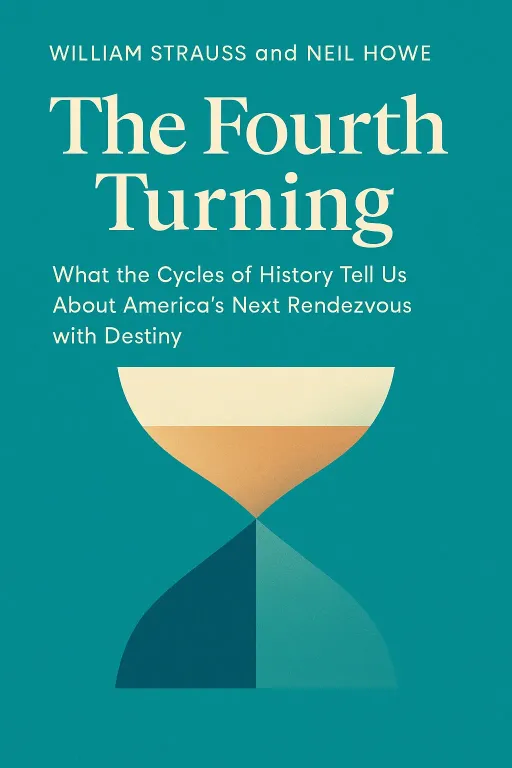
Nova: Exactly. And two foundational works have really shaped this idea for us. First, we have an incredibly influential book, 'The Fourth Turning' by William Strauss and Neil Howe. Now, these weren't just academics; they were historians who spent decades looking at American history, not as a linear progression, but as a series of repeating generational cycles. Their work is a surprisingly compelling framework for understanding societal shifts.
Atlas: And then, for an even broader sweep, we look to 'The Lessons of History' by Will and Ariel Durant. This is a condensed masterpiece, the culmination of their monumental, eleven-volume 'Story of Civilization' project. Imagine spending your entire life documenting human history across millennia, and then boiling down its essential truths into a single, concise book. That’s what the Durants did. It’s like the ultimate cheat sheet for understanding humanity.
Nova: It absolutely is. And together, these books offer a powerful lens to interpret current events.
The Rhythm of Time: Generational Cycles and the Fourth Turning
SECTION
Nova: So, let's start with Strauss and Howe and this fascinating idea of the 'Saeculum.' They propose that history moves in recurring generational cycles, much like seasons. Each cycle, or Saeculum, lasts about 80 to 100 years, roughly the length of a long human life, and it’s made up of four distinct 'Turnings.'
Atlas: Okay, so you’re saying it’s not just random, but there’s a predictable rhythm to how generations behave and shape society? That sounds a bit out there. Like, are we just fated to repeat the past?
Nova: That’s a common misconception. It's not about exact repetition, but about archetypal patterns. Think of it like this: Spring always follows winter, but each spring is unique. The first turning is the 'High' – a period of strong institutions, collective purpose, and relative conformity. Think post-WWII America.
Atlas: Like the 1950s? Golden Age vibes, everyone knew their place.
Nova: Exactly. Then comes the 'Awakening,' a time of spiritual upheaval, counter-culturalism, and individualism. The 1960s and 70s are a classic example. Society questions everything that was established during the High.
Atlas: Oh, I can definitely relate to that. The generational clashes, the questioning of authority… it sounds familiar.
Nova: Then the 'Unraveling,' which we arguably just lived through. Institutions weaken, individualism peaks, and people feel increasingly alienated. Trust erodes, and society becomes more fragmented. It’s when the seeds of the next crisis are sown.
Atlas: So, we've had the High, the Awakening, the Unraveling… which naturally brings us to the 'Crisis.' That’s the fourth turning, right? And it sounds… intense. What exactly does that look like?
Nova: It’s the period of profound societal transformation. The last Crisis was the era of the Great Depression and World War II. Imagine a country grappling with economic collapse, then uniting against an existential global threat. Institutions are challenged, old orders break down, and new ones are forged. It's a time of immense danger, but also collective sacrifice and purpose, eventually leading to a new 'High.'
Atlas: Wow, that’s kind of heartbreaking, but also inspiring. The idea that out of profound societal breakdown, a new sense of collective purpose can emerge. So, if we’re looking at the world today, are we supposed to be in one of these Crisis periods?
Nova: Strauss and Howe's theory suggests we are indeed in a 'Fourth Turning' right now, one that began roughly around the early 2000s and is projected to last into the 2020s or 2030s. It’s characterized by a perceived threat to the nation's survival, requiring a collective response. The current global tensions, the economic shifts, the political polarization – they all fit the pattern of an Unraveling transitioning into or deepening aspects of a Crisis.
Atlas: That gives me chills. So, it’s not about predicting a specific event, but understanding the underlying societal mood and the kind of challenges we're likely to face. It's about recognizing the season we're in, rather than being surprised by the weather.
Echoes of Eternity: Universal Historical Patterns in Geopolitics
SECTION
Atlas: So if generations move in these cycles, what about humanity as a whole? The Durants looked at thousands of years of history. What did they find were the universal patterns that transcend these shorter generational rhythms?
Nova: That's a perfect pivot. The Durants, after dedicating their lives to documenting civilization, found profound wisdom in the constancy of human nature. They observed that while technology and culture change, human desires, fears, and reactions to power, wealth, and conflict remain remarkably consistent across millennia.
Atlas: Can you give an example? Because it feels like modern geopolitics, with nuclear weapons and globalized economies, is fundamentally different from, say, the Roman Empire.
Nova: Absolutely. Take their observation on the cyclical nature of wealth distribution. They noted that all economic history is the slow concentration of wealth, which eventually reaches a point where it's either redistributed peacefully through legislation or violently through revolution. This pattern has played out repeatedly, from ancient Rome to medieval Europe to the French Revolution, and we see echoes of it in contemporary discussions about economic inequality.
Atlas: So basically you’re saying, the tools change, but human greed and the societal consequences of extreme inequality don't. That's a powerful point. But how does knowing that power is cyclical help a leader today? Isn't that just fatalism?
Nova: Not at all. It’s about foresight, not fatalism. Imagine a doctor understanding a patient’s long-term health trends – their genetic predispositions, their lifestyle patterns over decades – versus just reacting to an acute fever. The doctor can anticipate potential issues, recommend preventative measures, and understand the deeper causes of recurring symptoms.
Atlas: Right, like understanding the deep current, not just the surface waves. So, for geopolitics, it means recognizing that certain tensions or power imbalances, while manifesting differently, have historical precedents and predictable outcomes if left unaddressed.
Nova: Precisely. The Durants remind us that war, for instance, is one of the constants of history. While we strive for peace, understanding the historical triggers and dynamics of conflict – resource scarcity, ideological clashes, power vacuums – allows strategists to anticipate potential flashpoints and perhaps mitigate them, rather than being caught off guard. It’s about playing chess over centuries, not just individual moves.
Atlas: That makes me wonder, then, what are the limitations? Can we really apply lessons from the fall of empires to the rise of AI and global climate change?
Nova: That's a critical question. The Durants themselves would caution against drawing overly simplistic analogies. Their 'lessons' are broad principles, not specific prophecies. They offer a framework for understanding human behavior and societal forces, not a crystal ball. The specific circumstances are always new, but the human element – our pursuit of power, our need for belonging, our cycles of belief and disillusionment – those are the 'long now' patterns that persist. It moves us beyond reactive short-termism to proactive strategic anticipation.
Synthesis & Takeaways
SECTION
Nova: So, by combining the cyclical generational insights of Strauss and Howe with the universal historical patterns observed by the Durants, we gain this incredible 'Long Now' perspective. It helps us see that the chaos we often perceive in current events isn't just random noise, but often part of a much larger, albeit complex, symphony of history.
Atlas: That’s actually really inspiring. It means we're not just passengers on a runaway train. We’re in a specific season, a specific turning, and understanding that gives us context. It reminds us that past crises were navigated, and new eras emerged. What does it mean for us, then, to live in a time that historical patterns suggest is ripe for transformation? How do we find our place in such a grand narrative?
Nova: It means trusting your ability to find meaning in complexity, as our listeners often do. Your insights matter. The tiny step we can all take, right now, is to identify one current global tension – whether it's a conflict, an economic shift, or a social movement – and consider where it might fit within a larger historical cycle. Ask yourself: Is this an echo of something past? Is it a turning point?
Atlas: And then, share your observations. Engage in discussions to refine your thinking. That’s how we move from simply reacting to actively participating in shaping the 'Long Now.'
Nova: Absolutely. Understanding these patterns doesn't just reveal the past; it illuminates the potential pathways of the future.
Atlas: Incredible. Thank you, Nova.
Nova: Always a pleasure, Atlas.
Atlas: This is Aibrary. Congratulations on your growth!