Market-Driven Intelligence: Validating Agentic Value Propositions
Golden Hook & Introduction
SECTION
Nova: Think building a game-changing AI agent is all about the code? About perfecting its decision logic and optimizing its performance? Think again. The real challenge? Ensuring your brilliant tech actually solves a problem someone desperately needs fixed.
Atlas: Oh man, that's going to resonate with anyone who's ever poured their heart into a system only to find it… well, gathering digital dust. It’s like building a supercar for a road that doesn't exist.
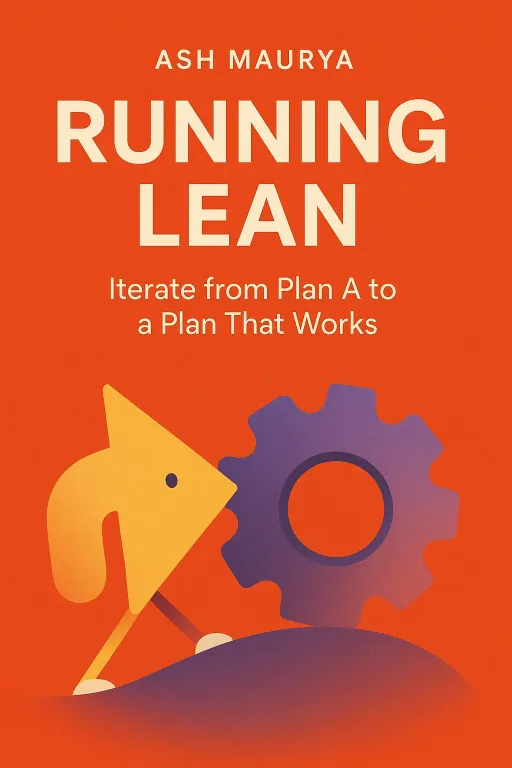
Nova: Exactly! And that's precisely why today, we're diving into the timeless wisdom of two giants in the startup world: Ash Maurya, author of "Running Lean," and Steve Blank, who penned "The Four Steps to the Epiphany." Steve Blank, in particular, is often hailed as the "father of Customer Development," a methodology that fundamentally shifted how startups approach finding customers, rather than just building products. It’s a powerful idea that’s more relevant than ever for our Agent architects.
Atlas: That's a great point. For us, building Agentic systems, we're often so focused on the technical elegance, the stability, the scalability. It's easy to get lost in the how, and forget the.
Nova: Precisely. The core of our podcast today is really an exploration of how these timeless startup validation principles are absolutely critical for the success of even the most cutting-edge Agentic systems. We'll explore Maurya's approach to rapid iteration, then dive into Blank's customer development imperative, and finally, connect these powerful ideas to building robust, market-driven Agents.
Deep Dive into Core Topic 1: Ash Maurya's "Running Lean"
SECTION
Nova: So let's start with Ash Maurya and "Running Lean." His whole philosophy revolves around the idea of iterating from "Plan A" to a plan that actually works. It's about speed, learning, and getting to that validated solution as quickly as possible. He essentially took the Lean Startup principles and made them incredibly actionable, especially with tools like the Lean Canvas.
Atlas: I see. So it's not just about building fast, but fast what the to build is. But for an Agent, isn't "Plan A" usually the code itself, the initial architecture, the first iteration of its decision logic? How do we iterate we build, or at least in the build?
Nova: That's the million-dollar question, Atlas, and it's where Maurya's insights shine. He emphasizes validating problem-solution fit you invest heavily in scaling. Think of it this way: many Agent projects start with an assumption. "We assume users need an Agent to automate X process." That's Plan A. Maurya would say, don't just build out the entire complex Agent to do X. First, validate if X is truly a high-value pain point, and if your proposed Agentic solution is even desired.
Atlas: Okay, so it’s about testing the hypothesis of the and the with minimal viable effort. For an Agent, that might mean mocking up interactions, running simple scripts, or even just conducting interviews to see if the proposed automation is actually a relief or just an added complexity.
Nova: Exactly. Imagine a team building an Agent designed to automatically manage all meeting schedules and follow-ups. Their Plan A is a sophisticated NLP engine, deep calendar integration, and proactive communication. They spend months perfecting the decision logic, making it incredibly smart. But they skipped the "Running Lean" part. They didn't validate if people actually an Agent to completely take over their calendar, or if they preferred a simpler, human-in-the-loop assistant, or even if the problem they were solving – meeting overload – was the pain point for their users.
Atlas: Oof. That's a classic trap. We’ve all seen those projects where the tech is brilliant, but the adoption is… lukewarm. Because the problem it solved wasn't the problem, or the solution wasn't the solution for that problem. So, Maurya is pushing us to get out of the building, metaphorically speaking, even with Agents.
Nova: Absolutely. He advocates for continually testing your assumptions. What's the riskiest assumption you're making about your Agent's value proposition? Is it that users will trust its autonomous decisions? Is it that the data exists to train it effectively? Is it that the perceived pain point is actually acute enough to warrant an Agentic solution? Maurya's framework forces you to identify those assumptions and de-risk them rapidly, often through qualitative interviews and simple prototypes, before committing to complex, scalable decision logic.
Atlas: That makes sense. It’s like, instead of building a whole robotic chef, maybe start with a robotic toaster and see if people even want their toast made by a machine, or if they just want a better toaster.
Nova: Perfect analogy! It’s about finding that working plan, that proven problem-solution fit, before you invest in the full-blown, scalable Agent chef with all its intricate decision-making layers.
Deep Dive into Core Topic 2: Steve Blank's "Customer Development"
SECTION
Nova: Now, building on that idea of learning and validating, Steve Blank takes it a step further with his "Customer Development" methodology. He famously states that startups fail not from a failure of product development, but from a. This is a profound shift in perspective.
Atlas: That's a powerful statement. For us in Agent engineering, we often think in terms of technical debt or scaling challenges as the primary failure modes. But Blank is saying, even if your Agent scales perfectly, if no one wants it, it’s still a failure.
Nova: Exactly. Blank's framework outlines four steps: Customer Discovery, Customer Validation, Customer Creation, and Company Building. The first two, Discovery and Validation, are absolutely crucial for our Agent builders. Customer Discovery is where you identify your target customers and their problems. You’re trying to understand their world, their pain points, their unarticulated needs.
Atlas: I’m curious, for an Agent architect, we're often deep in the tech. How do you even 'discover' customers for an Agent? Isn't the Agent itself the 'customer' in a way, if it's interacting with other systems? Or are we talking about the human users who benefit from the Agent's actions?
Nova: That's a really insightful question, Atlas. Blank's core idea is that you need to understand the problem, even if the Agent is interacting with other systems. Who is the ultimate beneficiary? Who feels the pain point that the Agent is designed to alleviate? It could be the end-user, the business analyst who needs better reports, the IT manager who needs systems optimized, or even the executive making strategic decisions. You need to talk to them, observe them, understand their workflow, their frustrations, their aspirations.
Atlas: So, we're talking about putting on our detective hats and doing the hard work of understanding human needs, even for something as futuristic as an Agent? It’s not just about building the coolest tech, but the tech.
Nova: Precisely. I remember a scenario where a team developed an incredibly sophisticated Agent to automatically optimize cloud spending. From an engineering perspective, it was a marvel: it could predict usage, spin up and down resources, and adjust configurations in real-time. But they skipped customer discovery. It turned out the CFO, their supposed "customer," wasn't primarily concerned about spending within their existing cloud provider. Their biggest pain point was vendor lock-in and the difficulty of migrating to a multi-cloud strategy. The Agent solved a real problem, but not the pain point for their actual decision-maker.
Atlas: Wow. That's a stark example. The Agent was technically excellent, but strategically misaligned. It highlights how crucial it is to validate that the 'problem' your Agent solves isn't just problem, but a pain point. One that people are actively seeking solutions for, or would pay significantly to alleviate.
Nova: And that's where Customer Validation comes in. After discovering potential problems, you validate that your proposed solution actually addresses those problems effectively and that customers would adopt it. Blank advocates for getting minimum viable products – even just sketches or conceptual models – in front of potential users to get feedback, iterate, and refine, you build out the full, complex Agent. It’s about testing your value proposition early and often.
Atlas: That makes total sense. It's like, don't just assume your Agent's decision logic, however advanced, will inherently create value. You have to prove that value, incrementally, with real people and real pain points. Otherwise, you're just building a highly optimized system for a ghost town.
Synthesis & Takeaways
SECTION
Nova: Absolutely, Atlas. Bringing Maurya and Blank together, the message for anyone building Agentic systems is crystal clear: Before you even think about scaling your Agent's decision logic, you validate that the 'problem' your Agent solves is actually a high-value pain point for your users.
Atlas: This really shifts the mindset. It’s not just about building a technically brilliant Agent, but building a Agent. For us architects focused on stability and scalability, this means that validation isn't a post-launch activity; it's an integral part of the earliest design stages. It's about designing for demand, not just for elegance.
Nova: Exactly. The cost of building and scaling complex Agentic systems is astronomical. To invest in sophisticated AI, advanced decision-making frameworks, and robust infrastructure, only to discover that the core problem you're addressing isn't critical enough for your users, is a colossal waste of resources. These frameworks force us to be disciplined, to ground our innovation in real-world utility.
Atlas: So, the 'growth advice' for our listeners, especially those building Agents, is to truly break boundaries between tech and business. It means deeply researching user pain points, not just in theory, but through active discovery and validation, before we even consider optimizing an Agent's internal processes. It means understanding the human element that drives the need for the Agent in the first place.
Nova: It’s about building Agents that don't just things, but that to people. It's the difference between a technological marvel and a transformative solution. And that transformation begins with understanding the problem, not just perfecting the code. It’s about applying that rigorous, real-world validation to the cutting edge of AI.
Atlas: That’s a powerful call to action for anyone in the Agent space. It forces us to think beyond the algorithms and deeply into the human experience.
Nova: Indeed. The smartest Agent in the world is useless if it's solving a problem nobody cares about. Validate first, scale later.
Atlas: I love that. Validate first, scale later. It should be a mantra for every Agent builder.
Nova: This is Aibrary. Congratulations on your growth!