Thinking in Systems: Unlocking Hidden Levers for Change
8 minGolden Hook & Introduction
SECTION
Nova: Atlas, I’m going to give you a classic book,. Give me your five-word review.
Atlas: Oh, I like that! Hmm… 'Whack-a-mole no more, finally!'
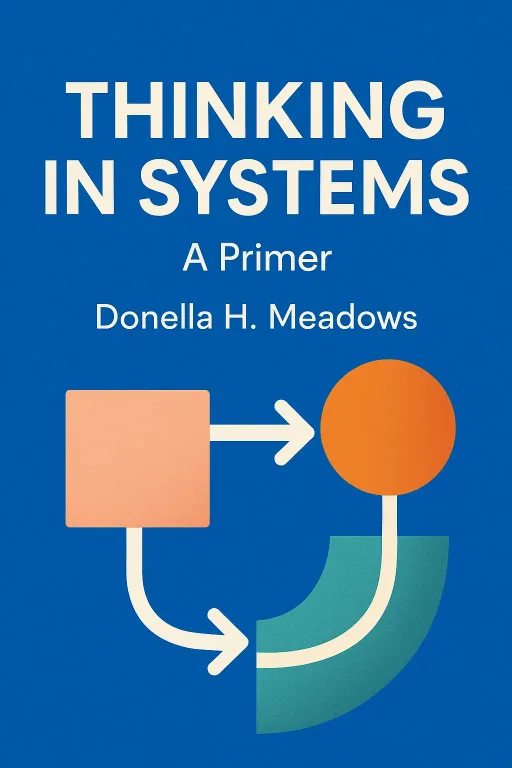
Nova: 'Whack-a-mole no more!' I love it! Because today, we’re unpacking a true masterpiece: by the brilliant Donella H. Meadows. She was an environmental scientist and a pioneer in systems thinking, whose work at MIT literally shaped how we understand global challenges, especially around environmental sustainability and resource management. This book, published posthumously, distilled decades of her groundbreaking research into an incredibly accessible guide, a kind of Rosetta Stone for complex problems.
Atlas: Whack-a-mole no more, finally! That phrase just jumped out at me because it perfectly encapsulates that feeling of constantly battling issues that just keep popping back up. So, how does Meadows' work help us stop playing whack-a-mole and actually solve things? Is that what 'systems thinking' truly unlocks?
Nova: Absolutely, Atlas. It's about recognizing that most of the problems we face, whether in our businesses, our communities, or even our personal lives, are rarely isolated incidents. We often try to fix them by addressing their symptoms, which is like trying to empty a bathtub with a teaspoon while the tap is still running.
Atlas: Oh, I know that feeling. It’s like when you try to boost team morale with a pizza party, but the underlying issue is crushing deadlines and a hostile work environment. The pizza is great for an hour, then everyone goes back to being miserable.
Nova: Exactly! That’s what Meadows calls 'the blind spot.' We see the event—low morale, traffic congestion, a child's poor grades—and we react directly to it. But this linear thinking misses the deeper, interconnected structures at play. We're so focused on the immediate symptom, we fail to see the larger system generating it.
The Blind Spot: Symptoms vs. Systems
SECTION
Nova: Let's paint a vivid picture of this blind spot. Imagine a bustling city, let's call it Metropolia, grappling with severe traffic congestion. Commutes are unbearable, tempers are flaring, and businesses are complaining. The mayor, eager for a quick win, proposes a seemingly logical solution: widen the main highway. More lanes, faster traffic, right?
Atlas: That sounds like a classic move! It feels intuitive, like, if there's a bottleneck, just make the bottle wider.
Nova: Precisely. So, they pour millions into construction, expand the highway to eight lanes, and initially, there's a sigh of relief. Traffic flows beautifully for a few months. But then, a curious thing happens. People start to notice the faster commute, so they decide to live further out, drive more often, or even buy a second car. Businesses relocate to the now-accessible outskirts.
Atlas: Wait, so the wider road actually more driving? That's counter-intuitive.
Nova: It is, but it's a classic system behavior known as 'induced demand.' The perceived solution—more road capacity—actually changed the behavior of the system's components—the drivers and businesses. Over time, the new lanes fill up, and Metropolia finds itself with even worse congestion than before, a sprawling, car-dependent urban landscape. They just paved over the problem, literally, and made it bigger.
Atlas: That's incredible. It's like painting over rust, as I said earlier, but on a city-wide scale. You think you're solving it, but you're just creating an illusion of improvement while the underlying issue festers or even expands. So, the blind spot isn't just about missing the cause, it's about how our 'solutions' can actually become part of the problem.
Nova: That's a great way to put it. The emotional frustration of this cycle is immense. We invest time, money, and energy, only to find ourselves back at square one, or worse. This is why Meadows argues we need to look beyond events to patterns, and from patterns to the underlying structures that generate them. It's about asking, 'What is the system to do that's producing this outcome?' rather than just 'How do I stop this outcome?'
Atlas: That sounds rough, but also really powerful if you can get past that initial frustration. So, if widening the road is a symptom fix, what would a 'systems thinking' approach look like for Metropolia's traffic? That feels like a big leap from just fixing what's broken in front of you.
Unlocking Leverage: The Power of Systems Thinking
SECTION
Nova: It is a leap, but it's a profoundly empowering one. This frustration of the 'blind spot' naturally leads us to the second key idea we need to talk about: unlocking leverage. What if we could actually for lasting solutions, not just react? Meadows teaches us that within every system, there are 'leverage points'—places where a small shift can produce big changes in the system's behavior. Think of it like balancing a seesaw: a tiny push at one end has far more impact than a huge effort right in the middle.
Atlas: Wow, so it's not just about finding the 'root cause,' but the root cause that actually moves the needle significantly?
Nova: Exactly! It’s about understanding the system's dynamics, its feedback loops, and identifying those points where intervention creates disproportionate positive change. Let's take another example, perhaps a company struggling with high employee turnover, which is a common problem for many of our listeners building teams.
Atlas: Oh, I've been there. The traditional fix is often to just throw more money at it, increase salaries, offer bigger bonuses.
Nova: And that's often a symptom fix. It might stem the immediate bleeding, but if the underlying system dynamic is, say, a lack of growth opportunities, poor communication, or a toxic culture, the higher salary might just attract people who are only motivated by money, leading to a new set of problems. A systems thinker would look deeper.
Atlas: So, what would be a leverage point in that scenario that isn't just about higher pay?
Nova: A high-leverage point might be investing in leadership training for middle managers, focusing on empathy and effective feedback. Or creating transparent career paths and mentorship programs. Or fostering a culture of psychological safety where employees feel heard and valued. These aren't quick fixes; they're structural changes that alter the system's behavior over time. This aligns beautifully with Peter Senge's work in, where he talks about building 'learning organizations'—companies that are designed to continuously adapt and innovate by understanding their own interdependencies.
Atlas: That gives me chills. So, it's about shifting from being a mechanic to being an architect of change, as you said. For someone trying to build robust systems or cultivate a vibrant community, how do they even begin to these hidden levers? It sounds powerful, but also a bit overwhelming to identify where to push.
Nova: It can feel that way at first. But a simple starting point is to begin mapping out the connections and feedback loops in whatever system you're observing. Who influences whom? What causes what? What are the delays? Even a rough sketch can reveal surprising insights. Meadows emphasizes that often, the most powerful leverage points are in the or that govern the system. Change how people think, and you change the system.
Synthesis & Takeaways
SECTION
Nova: So, ultimately, the real power of systems thinking isn't just problem-solving, but understanding the intricate dance of cause and effect, and learning to influence it wisely. It’s about cultivating resilience and designing for sustainable growth, moving beyond reactive firefighting to proactive, impactful design. It's about trusting your intuition as much as your data, and letting that inner compass guide your vision for profound impact.
Atlas: That makes perfect sense. It's about foundational impact and lasting value, moving beyond the surface to the true drivers of change. So, ultimately, it's about shifting from being a mechanic to being an architect of change, then?
Nova: Precisely, Atlas. It's about becoming a master architect of your own destiny, and the destinies of the systems you're a part of.
Atlas: That's a truly inspiring thought.
Nova: So, for all our listeners out there, what seemingly isolated problem are you facing right now that might actually be a symptom of a larger, unseen system dynamic?
Atlas: And how might just that system change everything you thought you knew about solving it?
Nova: This is Aibrary. Congratulations on your growth!