Stop Reacting, Start Anticipating: The Guide to Strategic Foresight
8 minGolden Hook & Introduction
SECTION
Nova: What if I told you that the harder you work, the more problems you might actually be creating for yourself?
Atlas: Oh, come on, Nova. That sounds like a paradox, or maybe just an elegant excuse for slacking off. My instinct is always to push harder when things get tough.
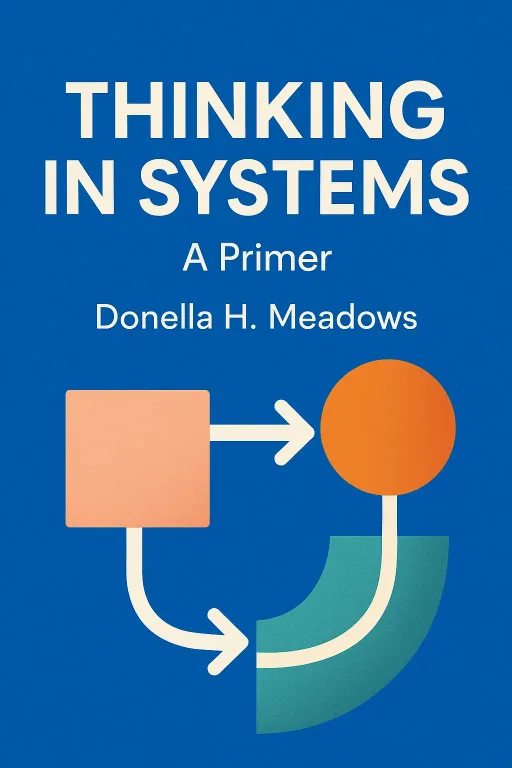
Nova: Exactly! And that instinct is precisely what we're going to challenge today as we dive into two truly foundational works: "Thinking in Systems: A Primer" by the brilliant Donella H. Meadows, and "The Fifth Discipline" by Peter Senge.
Atlas: So we're talking about getting smarter, not just working harder. I like the sound of that.
Nova: Absolutely. Meadows was a true pioneer, whose early work, including the groundbreaking 'Limits to Growth' report, used computer modeling to show the interconnectedness of global systems long before most people even grasped the concept. She laid the groundwork for understanding how our actions ripple through complex environments.
Atlas: Wow. So she was seeing the whole forest when most of us were still staring at individual trees.
Nova: Precisely. And today, we're going to explore why so many leaders get trapped in this reactive cycle, always firefighting, and how a systems approach, championed by Meadows, offers a profound way out. Then, we'll discuss how Peter Senge's 'Fifth Discipline' shows us how to embed this foresight into the very DNA of our organizations, turning them into adaptive learning powerhouses. It’s really an exploration of how we can move beyond simply reacting to problems and instead cultivate a powerful mindset of strategic foresight, transforming challenges into opportunities for lasting change.
The Reactive Trap & Systems Thinking
SECTION
Nova: Many leaders, despite their best intentions, find themselves caught in what I call the "reactive trap." They're constantly responding to crises, patching up problems, and generally just putting out fires. It drains energy, limits innovation, and frankly, it's exhausting.
Atlas: I totally know that feeling. It's like you're running on a treadmill, moving fast, but not actually getting anywhere. For anyone managing a team, or even just their own workload, that constant pressure to react is brutal.
Nova: It is. Imagine a manufacturing company that's constantly dealing with product defects. Their first instinct might be to add more quality control inspectors at the end of the production line. More checks, more scrutiny, more. They’re working harder, but are they solving the root cause?
Atlas: Probably not. They're just catching the mistakes later.
Nova: Exactly. Donella Meadows, with her incredible insights into systems thinking, would tell us that complex problems often stem from the of the system itself, not just isolated incidents or individual actions. She’d urge that manufacturing company to look. Are their suppliers providing faulty parts? Is the machinery old and prone to breakdowns? Are workers undertrained, or perhaps overworked, leading to errors?
Atlas: So instead of just patching the leaks, you're finding out why the boat has holes in the first place. That makes a lot of sense.
Nova: Her genius was in identifying what she called "feedback loops." These are the circular relationships where a result of an action eventually influences the next action. In our factory example, if adding more quality control leads to slower production, which then puts more pressure on workers, potentially leading to defects, that’s a feedback loop. Meadows teaches us to spot these loops and, crucially, to find the "leverage points" within them—the small changes that can produce big results.
Atlas: That’s a great way to put it. So, you're saying that by understanding these hidden connections, we can predict behavior and intervene proactively, rather than just endlessly reacting?
Nova: Precisely. It’s about shifting your gaze from the symptom to the structure. It's about making the invisible forces that shape our problems visible, so we can finally stop playing whack-a-mole and start designing better systems. It's a profound shift in perception.
From Systems Thinking to Learning Organizations
SECTION
Nova: And that naturally leads us to the second key idea we need to talk about, which often acts as a counterpoint to what we just discussed: how do we apply this deep systems understanding in a collective, organizational setting? This is where Peter Senge's groundbreaking work, "The Fifth Discipline," comes into play.
Atlas: Okay, so Meadows gives us the individual lens to see systems. Senge, then, sounds like he's giving us the blueprint for a whole team or company to use that lens?
Nova: You got it. Senge emphasizes that true effectiveness, especially for organizations, comes from becoming a "learning organization." This isn't just about training programs; it's about fostering collective aspiration and continuous adaptation. It's about seeing the whole picture, not just the parts.
Atlas: That makes me wonder, for leaders looking to transition their teams, how do you actually make an entire organization think in systems? It sounds like a huge cultural shift, especially when everyone's so focused on their own departmental goals.
Nova: It a huge cultural shift, and Senge acknowledges that. He talks about five disciplines, with systems thinking being the "fifth" and integrating one. Imagine a tech company that used to celebrate individual "hero" developers who would swoop in at the last minute to fix critical bugs, working all night to save the day.
Atlas: Oh, I’ve heard that story a hundred times. The "rockstar" developer, right?
Nova: Exactly. But Senge would argue that while admirable, this is still a reactive stance. A learning organization would ask: What the bug in the first place? How can we share knowledge across teams to prevent similar bugs? How can we create a culture where mistakes are learning opportunities, not blame games? It’s about collective inquiry, shared mental models, and a common vision.
Atlas: So, it’s not just about one person understanding the system, but the entire organization collectively mastering it to anticipate issues rather than just mop them up. That gives me chills, honestly, because it’s about preventing that burnout cycle.
Nova: Absolutely. It’s about moving from a culture that rewards individual firefighting to one that values collective foresight and systemic improvement. Senge's work shows that when an organization truly embraces systems thinking, it can adapt faster, innovate more effectively, and ultimately, achieve sustainable growth. It’s about building an organization that learns and evolves, rather than just reacts.
Synthesis & Takeaways
SECTION
Nova: The real power here, Atlas, is realizing that the ability to stop reacting and start anticipating isn't some mystical foresight, achievable only by a select few. It's a skill, rooted in understanding how things are connected.
Atlas: And these books make it clear that it's about shifting your perception, not just your workload. That’s going to resonate with anyone who struggles with feeling like they’re always behind, always just responding.
Nova: Exactly. The "Tiny Step" from our content today is so potent: Identify one recurring problem in your work. Map out the key elements and connections that create it. This isn't just an intellectual exercise; it's the first step towards finding those leverage points Meadows talks about, and building the kind of learning culture Senge envisions.
Atlas: That's actually really inspiring. It means we don't have to wait for a crisis to start being strategic. We can start small, right now, by just looking at our own recurring headaches and seeing them as interconnected systems.
Nova: Absolutely. And that shift from 'what's broken now?' to 'how does this system work?' is the difference between constant struggle and true, sustainable growth. For our aspiring leaders and strategic thinkers, this week, take that tiny step. You might be surprised at what you uncover.
Atlas: Fantastic. Thank you, Nova, for shedding light on these profound insights.
Nova: My pleasure, Atlas.
Nova: This is Aibrary. Congratulations on your growth!