Stop Guessing, Start Systemizing: The Guide to Strategic Foresight
7 minGolden Hook & Introduction
SECTION
Nova: Alright, Atlas, quick game. I'm going to throw out a financial term, you give me the first thing that comes to mind, but make it... honest. Ready?
Atlas: Oh, I like that! My brain is perpetually honest. Lay it on me.
Nova: "Market crash."
Atlas: Panic. Pure, unadulterated panic.
Nova: "Investment portfolio."
Atlas: Hope. Followed quickly by anxiety.
Nova: "Economic forecast."
Atlas: Dartboard. Maybe a crystal ball if I'm feeling fancy.
Nova: Exactly! That dartboard, that panic, that anxiety – it’s often because so many complex financial scenarios feel like we’re just guessing. We’re reacting to isolated events, hoping for the best.
Atlas: That definitely resonates with anyone trying to make sense of, well, anything financial these days. It often feels like we're constantly on the back foot.
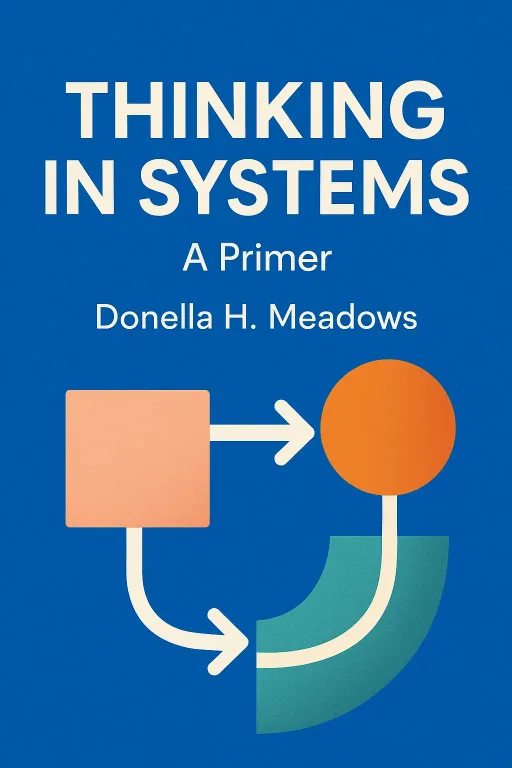
Nova: Which is precisely why today, we're diving into the world of strategic foresight, guided by two absolute titans: Donella H. Meadows' groundbreaking "Thinking in Systems" and Peter M. Senge's transformative "The Fifth Discipline." Meadows, for instance, was a pioneering environmental scientist, one of the lead authors of "The Limits to Growth" report. She used systems dynamics to model global resource depletion, showing how interconnected decisions lead to unforeseen consequences long before most of us even understood the term 'system.'
Atlas: Wow, that's a serious pedigree. So, we're moving beyond just reacting to headlines and gut feelings, then? We're talking about really understanding the 'why' behind the 'what'?
The Illusion of Isolated Events & Unveiling Feedback Loops
SECTION
Nova: Precisely. The cold, hard fact is that many complex financial scenarios feel like a tangled mess because we often focus on isolated events. We see a stock drop, we see inflation tick up, we see a company miss earnings, and we react to that specific event.
Atlas: That makes sense. We’re wired to see distinct problems and try to fix them directly. It’s like when my car makes a weird noise, I don't immediately think about the entire engine ecosystem; I just think, "fix the noise."
Nova: Exactly! But what if that noise is a symptom of a much larger, interconnected system problem? True strategic thinking comes from understanding the underlying systems and interconnections, allowing you to anticipate shifts rather than just react to them. Meadows teaches us that.
Atlas: Hold on, so when we miss these underlying systems, we’re essentially just playing whack-a-mole with our investments or our business strategies, right? We hit one problem, and another pops up somewhere else?
Nova: You've got it. Meadows highlights how to identify feedback loops – these are crucial for understanding market dynamics and policy impacts. Imagine a reinforcing feedback loop in a housing market: prices go up, people feel wealthier, they borrow more against their homes, which drives demand, which drives prices up even further. It’s a self-fulfilling prophecy until something breaks the loop.
Atlas: Oh, I see. And then there are balancing loops? Like, if inflation gets too high, central banks might raise interest rates, which cools down the economy and brings inflation back down. That's a system trying to self-correct.
Nova: Yes, a balancing loop. Meadows teaches you to see these invisible levers. She shows how these loops dictate the behavior of systems, whether it's an ecosystem, a climate model, or a financial market. Her work was so impactful because she could take something as vast as global resources and break it down into these understandable, interconnected parts.
Atlas: That’s a great way to put it. It’s like getting the x-ray to see the bones, not just looking at the skin. It fundamentally shifts our focus from symptoms to root causes.
Mastering Systems Thinking & Breaking Free from Mental Models
SECTION
Nova: And that naturally leads us to the second key idea we need to talk about, which often acts as a counterpoint to what we just discussed, especially when we consider the human element: Peter Senge's "The Fifth Discipline." Senge emphasizes that learning organizations master systems thinking to continuously adapt. But he also introduces a critical concept: mental models.
Atlas: Mental models. That sounds a bit abstract. Are we talking about our beliefs, our assumptions about how the world works?
Nova: Exactly. Your deeply ingrained assumptions, generalizations, and even images that influence how you understand the world and how you take action. Senge argues that these mental models can trap us, blind us to new possibilities, especially in complex financial structures.
Atlas: That makes me wonder, how do we even identify our own mental models, especially in high-stakes financial scenarios? It sounds like we're fighting ourselves if our own thinking is the trap.
Nova: It’s challenging because they're often subconscious. Senge talks about the discipline of personal mastery and building shared vision, which involves constantly scrutinizing and refining these models. Think of a company that keeps launching the same type of product, convinced "that's what our customers want," even as sales decline. Their mental model about their customer base might be outdated, but it's so ingrained they can't see alternatives.
Atlas: So, they're stuck in a reinforcing loop of their own outdated ideas. But what if challenging those models feels inherently risky in a volatile market? Is there a safe way to start 'seeing the invisible levers' without blowing up the whole system?
Nova: That’s where Senge’s emphasis on "learning organizations" comes in. It's not about making drastic, immediate changes, but about fostering an environment where challenging assumptions, engaging in dialogue, and collective inquiry are encouraged. A financial firm, for example, might hold regular "pre-mortem" meetings, where they imagine a future failure and work backward to identify the mental models that led to it.
Atlas: That's actually really insightful. It's like a controlled experiment for your beliefs. It empowers proactive strategic decision-making by forcing you to look beyond your immediate biases. This isn't just theory; it's about empowering strategic decision-making and navigating complexity.
Synthesis & Takeaways
SECTION
Nova: Absolutely. It's the synergy between Meadows' structural understanding of systems – those feedback loops, stocks, and flows – and Senge's focus on the human element, how our mental models shape our perception of those systems. Together, they fundamentally shift your focus from merely reacting to symptoms to truly understanding and influencing root causes.
Atlas: It’s about taking that intuitive compass we all have, but then sharpening it with a deep, analytical understanding of the terrain. So, what's a tiny step our listeners can take to start applying this today?
Nova: Here's a tiny step: identify one recurring financial problem you face – maybe it's constantly feeling behind on budgeting, or consistently making the same investment mistake. Then, map its key components as a system: what are the inputs, outputs, and feedback loops?
Atlas: That’s powerful. It turns a frustrating problem into a fascinating puzzle. It's about empowering yourself to not just guess, but to truly understand and systemize your approach to the future.
Nova: Exactly. It's about moving from being a passenger in a chaotic market to becoming a navigator.
Atlas: This is Aibrary. Congratulations on your growth!