Stop Chasing Symptoms, Start Solving Systems: The Blueprint for Lasting Change
10 minGolden Hook & Introduction
SECTION
Nova: What if everything you've been taught about solving problems is actually making them worse?
Atlas: Hold on, worse? I thought we were getting better at this! We're constantly innovating, finding new solutions. Are you suggesting our best efforts are... counterproductive?
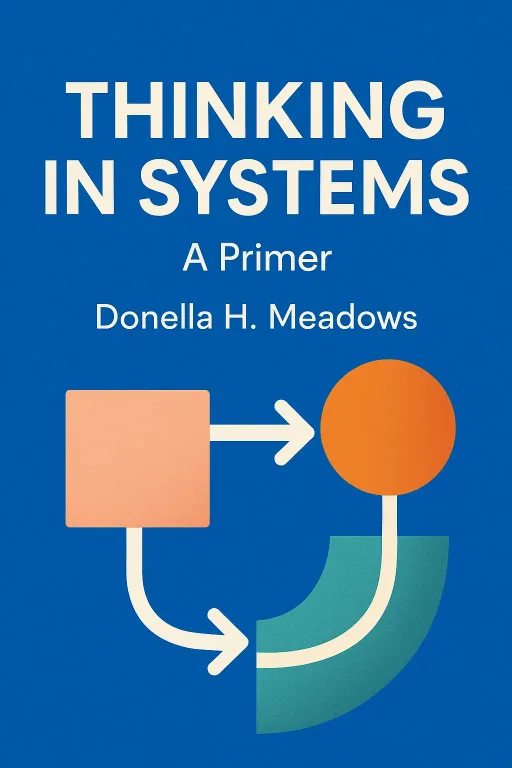
Nova: Absolutely, Atlas. And that's precisely the provocative, yet profoundly insightful, premise of the ideas we're exploring today. We're diving into the blueprint for lasting change, which is all about stopping the relentless chase after symptoms and instead, starting to solve the underlying systems. This paradigm shift is inspired by two titans of thought: Donella Meadows, with her foundational work "Thinking in Systems," and Peter Senge's transformative "The Fifth Discipline."
Atlas: Donella Meadows! I know her name rings a bell. Wasn't she one of the early pioneers in environmental modeling?
Nova: Exactly! Meadows was a brilliant scientist and environmentalist, a lead author of the groundbreaking "Limits to Growth" report for the Club of Rome. What made her so extraordinary was her unique ability to take incredibly complex ecological and economic models – the kind that make most people's eyes glaze over – and translate them into accessible, powerful principles that anyone could understand and apply. Her work is a testament to making the invisible forces of our world visible.
Atlas: So, she wasn't just observing systems, she was making them understandable for the rest of us. That's a crucial distinction.
Nova: It really is. And the core of her insight, which forms the bedrock of our conversation today, is that we all share a massive "blind spot." We're incredibly good at spotting problems – the messy room, the missed deadline, the budget overrun. But we almost always tackle them at the "event level." We clean the room, we rush the deadline, we cut the budget.
Atlas: Right. That's just... what you do. That's problem-solving 101, isn't it?
Nova: And that, my friend, is why so many problems are like hydras. You chop off one head, and two more grow back. The blind spot is our relentless focus on these isolated events, rather than the underlying structure – the system – that continually generates them. It’s like constantly patching a leaky roof without ever asking the roof keeps springing leaks.
Atlas: Oh, I know that feeling. Honestly, that sounds like my Monday mornings with my to-do list. I tackle one urgent email, and three more pop up. It feels like I'm constantly bailing water.
Seeing the Invisible Wires (Meadows' Framework)
SECTION
Nova: And that's a perfect example, Atlas. You're experiencing the classic "symptom trap." What Meadows teaches us is that beneath those events, there are patterns of behavior, and beneath those patterns are the underlying structures of the system. To truly solve a problem, you have to go down to that structural level.
Atlas: Okay, so "event-level thinking" is like seeing a single wave. "Systems thinking" is understanding the ocean currents, the wind, the moon's gravity – everything that the wave. Is that what you mean by stocks, flows, feedback loops, and delays? These are the hidden mechanics?
Nova: Precisely! They are the invisible wires. Let's break it down with your messy room example. The "stock" is the amount of stuff in your room. The "flows" are things coming in and things going out. If your inflow consistently exceeds your outflow, your stock – your clutter – will grow, no matter how many times you clean.
Atlas: That makes perfect, horrifying sense. So, my frequent "cleaning sprees" are just a temporary fix to a flow problem. I'm not addressing stuff gets in, or it doesn't get out efficiently.
Nova: Exactly. Now, a "feedback loop" is where the output of a system influences its input. In a messy room, a feedback loop might be: the more cluttered your room gets, the more overwhelmed you feel, the less motivated you are to clean, which leads to clutter. It's a vicious cycle.
Atlas: Wow, that's kind of heartbreaking. It’s like the system itself is conspiring against me. So, what's a feedback loop then? Is that like... when the mess gets so bad, I finally snap and clean it all?
Nova: You got it! That "snap" is a balancing loop kicking in to bring the system back to some perceived equilibrium, even if it's a temporary one. But Meadows also highlights "delays." In your room, the delay might be the time between when you buy something new and when you decide where it actually. If that delay is too long, the item just contributes to the accumulating clutter.
Atlas: I see. So, if I just focus on "cleaning the room" – the event – I'm missing the entire dynamic interplay of stocks, flows, feedback loops, and delays that keep generating the mess. I'm just treating the symptom.
Nova: And that's why these problems recur. You're pushing on the wrong leverage point. The most effective leverage points often aren't obvious; they're in altering those underlying structures, shifting the feedback loops, or addressing the delays. It's about designing a system that leads to a tidier room, rather than constantly fighting the mess.
Organizational Intelligence & Personal Leverage (Senge's Application)
SECTION
Nova: But what happens when these individual blind spots scale up into entire organizations? That's where Peter Senge's "The Fifth Discipline" comes in, building beautifully on Meadows' foundational ideas. Senge applies systems thinking to cultivate what he calls the "learning organization."
Atlas: Oh, I've heard that term! "Learning organization." It sounds very corporate, very... MBA. Is it just for big companies, or can I, a humble individual trying to manage my own chaos, actually use this?
Nova: Absolutely not just for MBAs, Atlas! While Senge's work profoundly influenced management thinkers, its core principles are universally applicable. He argues that organizations often fail for the same reasons your room gets messy: they're full of smart people who are great at event-level problem-solving, but terrible at seeing the bigger system they're a part of. They're constantly fighting fires without asking the fires keep starting.
Atlas: So, they're trapped in the same symptom chase, just on a grander scale. Can you give me an example of how this plays out in a company?
Nova: Think about a company struggling with employee burnout. Management notices high turnover, low morale, and decreased productivity – these are the symptoms. Their event-level solutions might be: "Let's offer more yoga classes!" or "We need a new coffee machine!"
Atlas: Yeah, I can definitely relate to that. The "perks" approach to a systemic problem.
Nova: Precisely. But a systems thinker, inspired by Senge, would look deeper. They'd ask: What are the of work? Are deadlines realistic? What are the? Is there a culture of "heroics" where people are rewarded for working unsustainable hours, inadvertently creating a reinforcing loop of overwork? Are there in decision-making that bottleneck projects and cause last-minute scrambles? They might discover that the "solution" isn't a better coffee machine, but a complete redesign of project management processes, or a shift in cultural values that prioritizes sustainable work-life integration.
Atlas: That's a perfect example! So, the learning organization isn't just about individual learning, but about the collective ability to see and understand these hidden dynamics. It's about challenging those deeply ingrained "mental models" that keep us stuck in the symptom trap.
Nova: Exactly. They cultivate collective intelligence by understanding interconnectedness and constantly challenging those mental models – the deeply held assumptions and beliefs that influence how we see the world and act within it. If everyone believes "hard work means long hours," that mental model will drive behavior, regardless of the burnout symptoms.
Atlas: I’m curious, how does this empower an individual? Because my "practitioner" side is itching for some actionable insight here. How can I, or any listener, use this to tackle a persistent challenge in our own work or personal life? What are the leverage points for us?
Nova: That's the beauty of it, Atlas. The same principles apply. Think about your own "persistent challenge." Maybe it's perpetually feeling overwhelmed, or struggling with procrastination, or even a recurring conflict in a relationship. Instead of just trying to "be more organized" or "just get it done", ask yourself: What are the and in this situation? What are the – both reinforcing and balancing – that are at play? And what are the that create bottlenecks?
Atlas: So basically, instead of just cleaning the mess, I'm analyzing my personal "mess-generating system." This is about proactively my life, rather than reactively responding to it.
Nova: Exactly! It shifts your focus from reactive problem-solving to proactive system design. It allows you to anticipate outcomes, identify those high-leverage points for change, and truly influence your long-term success and well-being. It's about becoming the architect of your own experience, not just a passenger.
Synthesis & Takeaways
SECTION
Nova: So, what we've really uncovered today is that many of our deepest frustrations, both individually and collectively, stem from a fundamental misunderstanding of the world around us. We're living in a world of complex, interconnected systems, but our brains are often wired for simple, linear cause-and-effect.
Atlas: It's like we've been trying to put out a forest fire by extinguishing individual flames, when we should have been looking at the drought, the dry underbrush, and the wind patterns that are fueling the entire blaze. Understanding systems isn't just a different way to solve problems; it's a different way to the world. It gives you a sense of agency you didn't even know you were missing.
Nova: Absolutely. It's the ultimate superpower for anyone who craves unique insights, enjoys challenging conventional thinking, and seeks intellectual inspiration and profound life wisdom. It empowers you to move beyond temporary fixes and create truly lasting, impactful change.
Atlas: So, for our listeners, consider a persistent challenge in your work or personal life right now. How might viewing it as a system, rather than a series of isolated events, change your approach to solving it? What are the stocks, flows, and feedback loops operating beneath the surface?
Nova: Think about it. The answers might surprise you, and the path to lasting change will become incredibly clear.
Atlas: This is Aibrary. Congratulations on your growth!