Decoding the Female Brain: An Engineer's Guide to Love, Hormones, and Human Connection
Golden Hook & Introduction
SECTION
Shakespeare: Hast thou ever stood perplexed, a witness to a sudden tempest of emotion in a loved one, a storm that seems to arise from a tranquil sea? You search for the cause, the logical trigger, but find none. What if the answer lies not in the events of the day, but in a hidden, biological rhythm—a code written into the very architecture of the brain?
zeus: That's a question I think many of us have asked, Shakespeare. It can feel like you're working with an incomplete schematic, trying to understand a system without knowing all the variables.
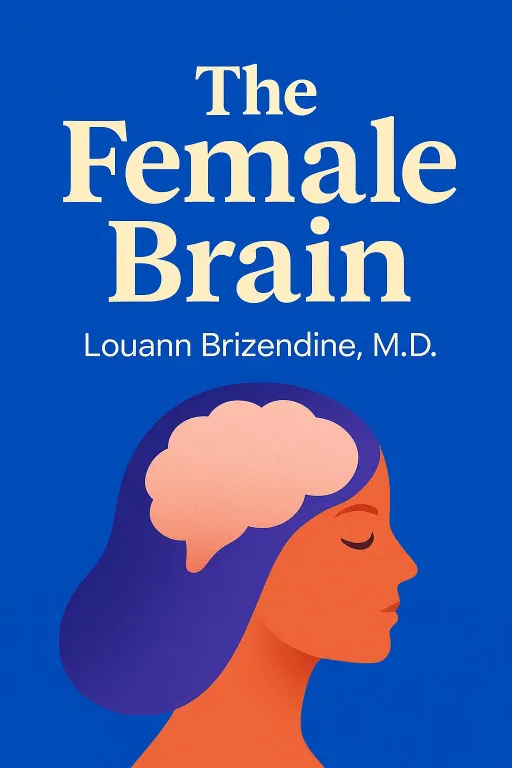
Shakespeare: An incomplete schematic! I love that. Well, this is the provocative territory we explore today, guided by Dr. Louann Brizendine's 'The Female Brain.' We'll dive deep into this from two perspectives. First, we'll explore how hormones act as the brain's powerful, ever-changing 'software,' shaping a woman's reality from the inside out.
zeus: And then, we'll decode the fascinating neurochemistry of connection, looking at love and attraction as a biological system you can actually understand.
Shakespeare: Indeed. And who better to join me on this quest for understanding than zeus, an engineer whose mind is trained to find the elegant systems within apparent chaos. Welcome, zeus.
zeus: It's great to be here. I'm fascinated by this idea that we can apply a kind of systems thinking to something as personal as emotion and relationships. It feels like unlocking a new level of understanding.
Deep Dive into Core Topic 1: Hormones as the Brain's 'Software'
SECTION
Shakespeare: So, zeus, let's begin with this idea of a biological 'operating system.' The book presents a compelling case that a woman’s reality can be radically different from one week to the next. To paint a picture of this, allow me to share the tale of Shana, a fifteen-year-old girl from the book.
zeus: I'm listening.
Shakespeare: Imagine a bright, happy girl, the light of her mother Lauren's life. Then, puberty arrives, a tide of new hormones. Suddenly, Shana is a stranger in her own home. She obsesses over boys, her appearance, her social standing. One moment she is joyful, the next she is screaming at her mother with a rage that seems to come from nowhere, leading to the first time her mother ever slapped her.
zeus: That's an intense shift. So the external circumstances didn't change, but her internal state did, dramatically.
Shakespeare: Precisely. The drama escalated. Shana became sexually active, then started cutting herself. Her mother, Lauren, was terrified, lost. She saw a rebellious, out-of-control daughter. But a doctor saw something else. Shana was diagnosed with Premenstrual Dysphoric Disorder, or PMDD. Her brain was having an extreme, allergic-like reaction to the normal ebb and flow of her own hormones.
zeus: Wow. So the underlying 'hardware'—her personality, her intelligence—was the same, but the hormonal 'firmware' update during puberty caused a massive system conflict. It's like her emotional responses were being amplified by a factor of ten, but only during specific parts of the cycle.
Shakespeare: A perfect analogy. The book says her brain's stress and emotion centers were becoming hyper-reactive. And the solution was not punishment or discipline, but biology. She was given a low-dose birth control pill to stabilize the hormonal fluctuations. And within a short time, the storm passed. Shana was herself again. She could focus in school, the obsessions faded, the rage was gone.
zeus: That's incredible. It completely reframes the problem. Her mother, not having the 'user manual' as you said, interpreted it as a personal failing or a behavioral problem. But the doctor understood the system's vulnerability.
Shakespeare: And what does that shift in perspective do for someone trying to be a supportive partner or parent?
zeus: It changes everything. It moves you from a place of judgment to a place of curiosity and compassion. The question is no longer, 'Why are you acting this way toward me?' but 'What state is the system in right now, and how can I help stabilize it?' That's a much more compassionate and, frankly, a more effective starting point for communication. It's about recognizing that the perception of reality itself can be a variable.
Shakespeare: 'The perception of reality itself can be a variable.' A profound and chilling thought. It makes one realize how much of our world is built by the unseen chemistry within.
zeus: Exactly. And if you don't know that, you're just reacting to the output without understanding the code.
Deep Dive into Core Topic 2: The Neurochemistry of Connection
SECTION
Shakespeare: And that idea of a 'system state' leads us perfectly to our second act: the realm of love and attraction. If hormones are the operating system, then falling in love is like running the most resource-intensive, all-consuming application imaginable. The book argues this, too, is not magic, but chemistry.
zeus: The chemistry of connection. I like that. It implies there are rules, components, a process.
Shakespeare: There are indeed. Dr. Brizendine describes a 'love cocktail.' You have dopamine, the neurochemical of craving and motivation—it's what makes you obsess. Then you have oxytocin, the bonding hormone, which creates feelings of trust and calm attachment. This potent mix is what we call 'falling in love.'
zeus: So it's a feedback loop. The person becomes the trigger for a dopamine rush, which makes you seek them out more, which then builds oxytocin, strengthening the bond.
Shakespeare: You've mapped the circuit perfectly. And the initial spark? That's a whole other system at play. The book tells the story of Melissa, a film producer in her thirties. She's at a salsa club, and across the crowded room, she spots a man named Rob. Instantly, she feels an intense, magnetic pull. Her brain, in a fraction of a second, has scanned him and lit up.
zeus: A signal acquisition, you could say. What was her brain scanning for?
Shakespeare: This is where it gets fascinating. It was running an ancient evolutionary program. The book cites research by David Buss, who studied over ten thousand people in thirty-seven cultures. He found that universally, men prioritize visual cues of youth and fertility in a partner, while women prioritize signs of resources, social status, and the potential for commitment. Melissa's brain saw Rob—tall, handsome, confident—and the ancient circuits screamed, 'Good genes! Potential provider!'
zeus: So, attraction isn't a random event. It's a sophisticated pattern-matching algorithm running in the background, optimized for reproductive success. Melissa's brain identified Rob as a 'high-value target' based on a set of pre-programmed parameters.
Shakespeare: A 'high-value target'! Spoken like a true engineer. But yes! And the intense feeling of attraction, that 'spark,' is the brain's reward system flooding her with chemicals to ensure she pursues that target. It's a biological imperative dressed up as romance.
zeus: That's not unromantic to me, though. It's actually more beautiful. It shows how deeply programmed we are for connection. It also explains why heartbreak is so physically and mentally devastating. It's not just an emotional loss; it's a chemical withdrawal. The system was getting a constant, high-dose supply of dopamine and oxytocin from that person, and suddenly the source is gone. The system crashes.
Shakespeare: A system crash. That is a powerful and deeply empathetic way to think about the pain of a breakup. It's not a weakness; it's a predictable biological response.
zeus: Exactly. It gives dignity to the pain. It's a testament to how profoundly we are designed to attach to one another. Understanding the mechanism doesn't cheapen the experience; it deepens our respect for it.
Synthesis & Takeaways
SECTION
Shakespeare: So, as our time draws to a close, we've journeyed through two of the great acts of the human drama, as seen through the lens of the female brain. We've seen it as a system governed by the dynamic software of hormones...
zeus: ... and we've seen love as a powerful neurochemical program, designed for connection and propagation.
Shakespeare: What, then, is the grand takeaway for an analytical mind like yours, zeus? Does this knowledge make the world colder, more mechanical?
zeus: Not at all. It's the opposite. In engineering, the most complex and elegant systems are the ones we admire most. Understanding the underlying biological and chemical rules doesn't diminish the human experience. It actually enhances our ability to navigate it with more empathy and intelligence. It's not about reducing people to machines, but about appreciating the beautiful, intricate complexity of the machine.
Shakespeare: A beautiful and fitting conclusion. So, we leave our listeners with this thought, this call to action, perhaps.
zeus: I think it's this: The next time you encounter an emotional reaction in a partner, a friend, or even yourself that seems puzzling or disproportionate, pause. Instead of asking the judgmental question, 'Why are you being this way?' try asking the engineering question...
Shakespeare: Which is?
zeus: 'What's the underlying system state?' The answer might just change everything.