The Leader's Extended Mind: Systems for Smarter Thinking
Golden Hook & Introduction
SECTION
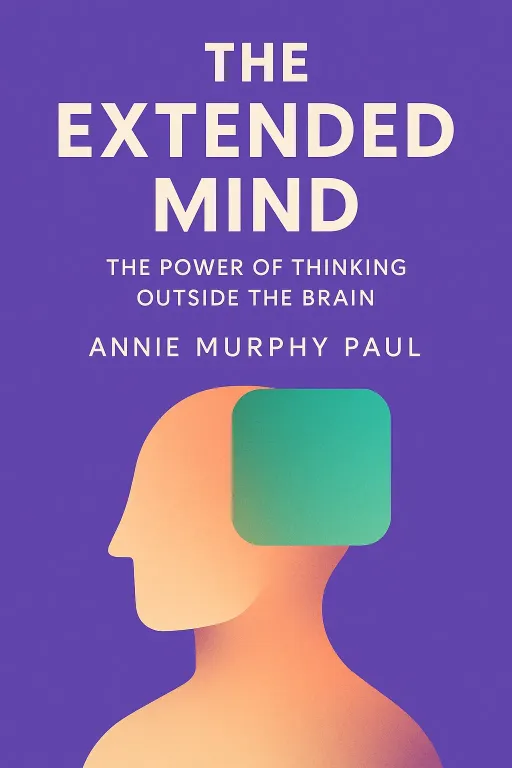
Nova: What’s the most common advice we get when facing a tough problem? 'Use your head.' But what if our relentless focus on the brain is actually limiting our intelligence? Our guest today, Ahmed, is an analytical leader who loves exploring new systems for peak performance, and we're diving into a book that turns this idea on its head: 'The Extended Mind' by Annie Murphy Paul. It argues our best thinking doesn't happen the brain, but of it.
Ahmed: It's a fascinating premise. As leaders, we're always looking for an edge, a better way to process information and make decisions. The idea that the tools for better thinking are already all around us, and even within us, is pretty radical.
Nova: It really is! And that's what we're going to unpack. Today we'll dive deep into this from two powerful perspectives. First, we'll explore how to think, tapping into everything from gut feelings to the power of a simple walk. Then, we'll discuss how to think, turning our physical spaces into cognitive partners. Ahmed, welcome. Are you ready to think outside the box... literally?
Ahmed: Absolutely. Let's get into it. I'm curious to see how this applies in the real world.
Deep Dive into Core Topic 1: Thinking with the Body
SECTION
Nova: Fantastic. Let's start with the body. We're all taught to sit still to concentrate, right? But the book opens with this fantastic story about the philosopher Nietzsche, who believed all great thoughts are conceived while walking. He even said ideas from a desk have, and I'm quoting here, 'cramped intestines'!
Ahmed: I can relate to that feeling. After hours in meetings, your thinking definitely feels a bit cramped.
Nova: Exactly! And the book argues this isn't just a poetic idea; it's biological. It tells the incredible story of a man named John Coates. He had a PhD in economics from Cambridge and went to work as a trader on Wall Street for Goldman Sachs and Deutsche Bank. He was a pure numbers guy, building these brilliant, analytical models for trades.
Ahmed: The classic quant. I know the type.
Nova: Precisely. But here's the thing: his meticulously planned trades kept losing money. Meanwhile, he noticed that when he acted on a sudden 'gut feeling'—a real, physical sensation—those trades were almost always profitable. It drove him crazy. This went against everything he was trained to believe.
Ahmed: So his body was outperforming his PhD.
Nova: In a way, yes! He became so obsessed with this that he left Wall Street and became a neuroscientist to figure it out. He brought traders into his lab and had them do a simple test. He asked them to count their own heartbeats for a minute without taking their pulse. It's a test of something called 'interoception'—your awareness of your body's internal state.
Ahmed: So, a literal measure of your 'gut feeling.' What did he find?
Nova: The results were stunning. The traders who could more accurately count their heartbeats—the ones with better interoception—were consistently more profitable. Not only that, they also survived longer in the high-turnover world of trading. Their 'gut feeling' was a real, measurable, and profitable signal.
Ahmed: That's a game-changer. It reframes intuition from the realm of magic to biology. As a leader, you're constantly processing incomplete data. This suggests that interoception—that awareness of your internal state—is a vital data stream. It's not about ignoring the spreadsheet, but about integrating it with the signals your own body is sending you.
Nova: You've hit it exactly. The book calls it 'thinking with sensations.' That tension in your shoulders before a big decision, that's not just noise. It's data.
Ahmed: So how does one cultivate that kind of awareness? We spend so much time in our heads, it feels like a muscle we haven't used.
Nova: The book suggests simple practices like mindfulness or a 'body scan,' where you just take a minute to mentally check in with different parts of your body. But it's not just about passive feeling, it's also about active movement. The book brings up the Nobel-winning psychologists Daniel Kahneman and Amos Tversky. Kahneman said he did the best thinking of his life on long, leisurely walks with Tversky.
Ahmed: That directly challenges the whole culture of back-to-back Zoom meetings chained to a desk. It makes you wonder, how much creativity and insight are we losing by designing movement of our workday? A walking one-on-one meeting could be far more productive than a formal sit-down in a conference room.
Nova: Absolutely. You're getting your body involved in the thinking process. You're extending your mind.
Deep Dive into Core Topic 2: Architecting Intelligence
SECTION
Nova: And that idea of designing your workday leads us perfectly to our second point: thinking with our surroundings. If our mind isn't just in our head, then the space we're in becomes part of our thinking process. It can be a tool or a hindrance.
Ahmed: I'm very interested in this. The idea of intentionally architecting an environment for better thinking is the definition of being systems-driven.
Nova: Well, you'll love this example. The book talks about Robert Caro, the legendary biographer who wrote these monumental books on President Lyndon B. Johnson. We're talking thousands of pages, based on decades of research and millions of documents.
Ahmed: The sheer volume of information is overwhelming to even think about. How did he manage it?
Nova: Not with a computer, at least not primarily. In his office, he dedicates an entire wall to his outline. He physically pins up index cards, notes, pages from interviews, and key documents. The entire structure of the chapter he's writing is laid out in physical space in front of him.
Ahmed: So he's creating a physical, analog version of what we try to do with digital tools like Trello or Miro.
Nova: Exactly! But the physicality is what's key. He says, "I don't want to stop while I'm writing, so I have to know where everything is." He's not just storing information on the wall; he's offloading his working memory onto the room itself. He can see the whole narrative, notice new connections between ideas, and never lose his train of thought by having to click through digital files. The room becomes an extension of his brain.
Ahmed: I love that. He's using his spatial memory—a very old and powerful part of our brain that's great at remembering 'where' things are—to manage complex, abstract information. It's a brilliant system. It makes the abstract tangible.
Nova: It's a total system! And the book contrasts this with environments that actively work our thinking. There's a fascinating study it cites from a mobile phone factory. The factory was a typical assembly line, with workers being constantly monitored for speed and efficiency.
Ahmed: Maximum oversight, minimum privacy.
Nova: Right. Then researchers tried an experiment. For one group of workers, they simply hung a curtain, shielding them from the supervisors' view. They gave them a bubble of privacy. And what happened? Their productivity and innovation by 15 percent!
Ahmed: That's incredible. And it makes perfect sense. They had the psychological safety to experiment, to try a slightly different or faster way of doing things, without the fear of being judged for deviating from the norm. They could tinker.
Nova: They could tinker! They could fail for a moment, and then succeed. This is a huge lesson for leadership. We often design open-plan offices for 'collaboration,' but we might actually be killing deep, innovative work because we remove that private, curtained-off space to think and experiment.
Ahmed: It's a paradox. To get better group work, you need to provide better private space. It's not one or the other. A truly intelligent system, an extended mind for a team, needs to support both modes of thinking: the collaborative and the deeply focused and private. We need to design spaces that allow for both.
Synthesis & Takeaways
SECTION
Nova: That's such a powerful synthesis. So, when we pull it all together, the big idea from 'The Extended Mind' is that intelligence isn't some fixed IQ score locked in our heads. It's a dynamic system that we can actively build and improve.
Ahmed: Exactly. It's a system that includes our bodies, with their internal signals and need for movement. And it includes our physical spaces, which we can architect to be active partners in our thinking, not just passive containers. It's about moving from just 'using your head' to consciously designing a whole system for intelligence.
Nova: It's a much more empowering and holistic way to think about being smart. And it's something anyone can do.
Ahmed: It is. It's not about being a genius; it's about building a genius system around you.
Nova: I love that. So for everyone listening, here's the challenge. As Ahmed said, it's about design. So, what is one small change you can make to your environment this week to start building your own extended mind?
Ahmed: Could you take one meeting while walking? Could you put up a small whiteboard in your office to map out a problem visually instead of just keeping it in your head?
Nova: Simple, powerful steps. Start there, and you're already on your way to unlocking a smarter, more creative way of thinking. Ahmed, thank you so much for exploring these ideas with us.
Ahmed: My pleasure. It's given me a lot to think about—both in and out of my head.