Beyond the Storm: A User's Guide to Your Emotional World
Golden Hook & Introduction
SECTION
Nova: What if I told you that the goal of mental health isn't to be happy? That for years, we've been sold a lie by a wellness industry that profits from our fear of feeling bad. The author Lisa Damour says, 'Somewhere along the way, we became afraid of being unhappy,' and that fear is especially messing with how we see ourselves and our emotions. It’s this idea that powerful feelings are a bug in our system, something to be fixed or medicated away, when in reality, they might be our greatest feature.
Mel: That first idea already feels so freeing. The pressure to perform happiness is real, especially for our generation. You see it everywhere online. I'm excited to get into this.
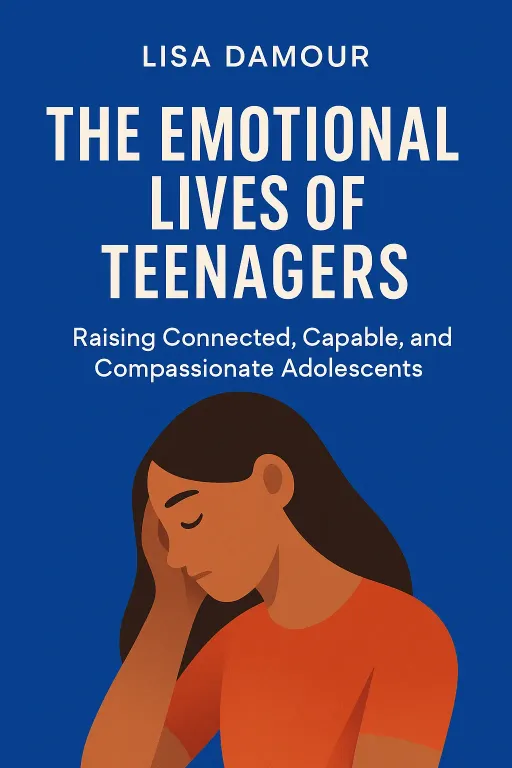
Nova: Me too! And that's why we're diving into Lisa Damour's book, 'The Emotional Lives of Teenagers.' Now, I know what you're thinking, 'teenagers?' But this book is really a user manual for anyone who's ever been a teenager, which is... all of us! It's about reclaiming our own emotional wiring. Today we're going to tackle this from two powerful perspectives. First, we'll dismantle the myth that negative emotions are the enemy, exploring why discomfort is actually the secret ingredient to growth.
Mel: Okay, I'm ready for that.
Nova: Then, we'll crack the 'gender code' to understand the hidden rules that dictate how we're 'supposed' to feel, and how to break free from them.
Mel: This sounds like exactly what I need. Let's do it.
Deep Dive into Core Topic 1: The Myth of Negative Emotions
SECTION
Nova: Fantastic! So let's start with that first big myth: that difficult emotions are a problem to be fixed. Damour argues they're normal, expected, and even healthy. She tells this incredible story about a mother who called her in a panic. It was June, and her family had just found out they were moving from Denver to Seattle. Her son, Will, was about to be a high school senior.
Mel: Oh no. That’s like, the worst possible time to move a teenager.
Nova: Exactly! And Will was acting accordingly. He was cranky, tearful, and just miserable. His mom was terrified he was sliding into a serious depression. She was ready to find him a therapist, maybe even look into medication.
Mel: Which seems like a caring and responsible reaction from a parent.
Nova: Totally. But when she described the situation to Damour, the author asked a simple question: Is he always like this, or just when the move comes up? The mom thought about it and said, well, no, he's fine when he's with his friends, but the moment the move is mentioned, he falls apart. And Damour’s response was, essentially, "Congratulations. Your son is mentally healthy."
Mel: Wow. That's a huge reframe. So his sadness wasn't a symptom of a problem, it was a sign that he was mentally healthy and attached to his life. It makes you think about how quick we are to label any strong negative feeling as 'anxiety' or 'depression' when maybe it's just... grief. Or appropriate anger.
Nova: Precisely! He was having the right feeling at the right time. And Damour links our cultural fear of this to a few things, but one of the big ones is the rise of the $131 billion wellness industry. It's an industry that out-earns the entire global entertainment industry, all by selling us the idea that we can buy our way to a state of constant ease.
Mel: Right, like a face mask or a bath bomb is the solution to deep-seated disappointment. It's a temporary distraction, not a tool for growth. This connects to what the book says about substance abuse, right? How it stops maturation?
Nova: You've hit on a crucial point, Mel. It's the exact same principle, just a different method of avoidance. Damour shares this powerful story from her early training as a psychologist. She was discussing a case with a senior supervisor, a thirty-year-old client who drank heavily. The supervisor stopped her and said something she never forgot: "People stop maturing at the point when they start abusing substances."
Mel: That is a chilling thought.
Nova: Isn't it? His logic was that drugs and alcohol are incredibly effective at blocking emotional pain. But if you numb the agony of a breakup, or the shame of a failure, or the grief of a loss, you never actually process it. You never learn from it. You don't build the psychological muscle to handle the next one. The emotional pain itself is what promotes growth.
Mel: Wow. So real self-care isn't about avoiding the pain, it's about having the strength and support to move it. That's a much more empowering way to think about building self-confidence and resilience. It’s not about never falling, it’s about knowing how to get back up because you’ve felt the sting before and survived.
Nova: You've got it. It’s about building that emotional strength. And that leads us perfectly to our second big idea, because the we're taught to move through our feelings is often dictated by these invisible, gendered rules.
Deep Dive into Core Topic 2: Cracking the Gender Code
SECTION
Mel: Okay, I'm fascinated by this. The idea that there's a script we're all following without even realizing it.
Nova: It's so powerful. Damour boils it down to a simple, if overgeneralized, starting point: "Boys distract, girls discuss." And she tells the story of a teenage couple, Zach and Mara, that illustrates this perfectly. They're texting one night, and Mara asks Zach a question that makes him uncomfortable—basically, are they exclusive?
Mel: The dreaded "what are we?" talk, but via text. A minefield.
Nova: A total minefield! And Zach’s reaction is to just... stop replying. He feels that wave of anxiety and immediately opens up the game World of Warcraft and plays until two in the morning. He distracts. Mara, on the other hand, is left hanging. What's her likely next move?
Mel: Oh, I know this one. She's immediately screenshotting that conversation and sending it to her three closest friends with the caption "WHAT DOES THIS MEAN?!?" And then they'll spend the next three hours analyzing every word, every punctuation mark, every timestamp.
Nova: Exactly! You just perfectly described what the book calls "co-rumination." And this is where it gets tricky. We socialize girls to believe that talking about feelings is the healthy thing to do. And it can be! But Damour warns that co-rumination—this pattern of endlessly rehashing a problem without moving toward a solution—is strongly linked to higher rates of anxiety and depression in girls.
Mel: That makes so much sense. It feels supportive in the moment, but it's like being emotionally stuck in quicksand. You're just swirling around in the negative feeling together. It doesn't actually build empathy or solve anything, it just amplifies the anxiety for everyone involved.
Nova: It's a feedback loop of distress. And on the flip side, what's happening with the boys? They are policed by their peers from a very young age with one simple, brutal rule: "Don't show weakness." This pressure to shut down vulnerability is just as damaging. Let's talk about anger, for example.
Mel: An emotion girls are definitely not 'supposed' to show.
Nova: Right. The book cites this fascinating study called the "Hot Sauce Experiment." Researchers made participants angry by giving them harsh, insulting feedback on an essay they wrote. Then, in a supposedly separate study, they were told to dish out hot sauce for the person who graded their essay to taste. The catch was, some were told they'd meet the person, and some were told they wouldn't.
Mel: Let me guess. The women's behavior changed based on whether they'd be held accountable.
Nova: You nailed it. When they thought they'd have to face the person, the women gave significantly less hot sauce. But when it was anonymous? They dished out just as much fiery revenge as the men.
Mel: So girls and women feel anger just as much, but we're socialized to know there's a higher social price for showing it. We do a constant, subconscious risk assessment before expressing a perfectly valid emotion. That's exhausting, and it definitely impacts self-confidence—feeling like you can't, or shouldn't, take up space with your anger.
Nova: It's an invisible labor that we're performing all the time. And it all stems from these scripts we learned so long ago.
Synthesis & Takeaways
SECTION
Nova: So, let's pull these two giant ideas together. On one hand, we've seen that our feelings, even the most painful and uncomfortable ones, are valuable data. They're not the enemy; they're messengers.
Mel: And on the other hand, we've seen how these unspoken gender scripts can push us into unhealthy patterns for dealing with those messengers—either getting stuck in a loop of rumination or pretending we never got the message at all.
Nova: Exactly. It feels like the goal is to become a better emotional scientist for ourselves. To get curious about our feelings instead of just reacting to them or judging them based on these old, unwritten rules.
Mel: I love that phrase—'an emotional scientist.' It takes the judgment out of it. It’s not about 'good' or 'bad' feelings, it's just data to be analyzed. What is this telling me about my values, my boundaries, my needs?
Nova: Yes! And that brings us to a really practical takeaway for everyone listening. Damour offers a new definition of mental health that I think is so useful. It's not about feeling good. It's about "having the right feelings at the right time and being able to manage those feelings effectively."
Mel: That feels so much more achievable and realistic than just "be happy."
Nova: It is! So, the challenge for all of us, the first step in becoming our own emotional scientist, is this: the next time a strong, uncomfortable emotion comes up—sadness, anger, jealousy, whatever it is—just pause. Instead of pushing it away or getting stuck in it, just ask one simple question: "What information is this feeling trying to give me?"
Mel: That's a habit I can definitely start building. It's about listening to your gut, and the book says we should trust it because it will almost always keep us on the right track. That feels like the first real step to building authentic self-confidence. Not pretending you're fine, but trusting that you have the tools to handle not being fine.
Nova: Beautifully said. It’s not about being fearless, it’s about being courageous enough to feel. And that’s a journey worth taking.