Stop Guessing, Start Systemizing: The Guide to Predictable Progress.
Golden Hook & Introduction
SECTION
Nova: Atlas, five words. Give me your instant, gut-level review of "Stop Guessing, Start Systemizing."
Atlas: Predictable progress, less chaos. Pure gold.
Nova: Pure gold! I like that. And that's exactly what we're diving into today with "Stop Guessing, Start Systemizing: The Guide to Predictable Progress." It's a book that really hammers home a powerful truth. It suggests that by implementing clear, concise checklists and documented processes, we don't just create reliability and minimize waste, we actually free up our mental energy for true innovation.
Atlas: Frees up mental energy? Wow. That almost sounds too good to be true for anyone trying to manage a complex project or, say, a sprawling construction supply chain. I mean, my brain usually feels like a tangled string of Christmas lights, not a well-oiled machine ready for innovation.
Nova: Exactly! And that's where we start, Atlas. Because before we get to the gold, we have to look at "The Cold Fact" this book confronts us with. It's a stark reminder that many complex projects fail not from a lack of knowledge, but from a simple oversight. Even the most seasoned experts, in their dynamic environments, can miss crucial steps.
The Peril of Oversight: Why Experts Fail
SECTION
Nova: It’s counterintuitive, isn't it? We assume that with experience comes infallibility. That the more you know, the less likely you are to make a mistake. But the book points out that relying solely on memory, especially in high-stakes, fast-moving situations, is actually an invitation to costly errors and inefficiencies. Think about it: a construction supply chain, for example, has so many moving parts, so many dependencies. One tiny forgotten detail can cascade into massive delays and budget overruns.
Atlas: Hold on. So even the best in their field, the ones with decades of experience, can mess up on the basics? That’s going to resonate with anyone listening who manages high-pressure teams. You'd think experience would be enough. What's actually happening there? Are they just getting complacent?
Nova: That’s a great question, Atlas, and it’s not about complacency. It’s about cognitive load. Our brains are incredible, but they have limits. When you’re an expert, you’re often dealing with incredibly complex problems, nuanced decisions, and a constant stream of new information. The simple, routine steps can get pushed aside or forgotten, not because they’re unimportant, but because your mental bandwidth is consumed by the really tough stuff.
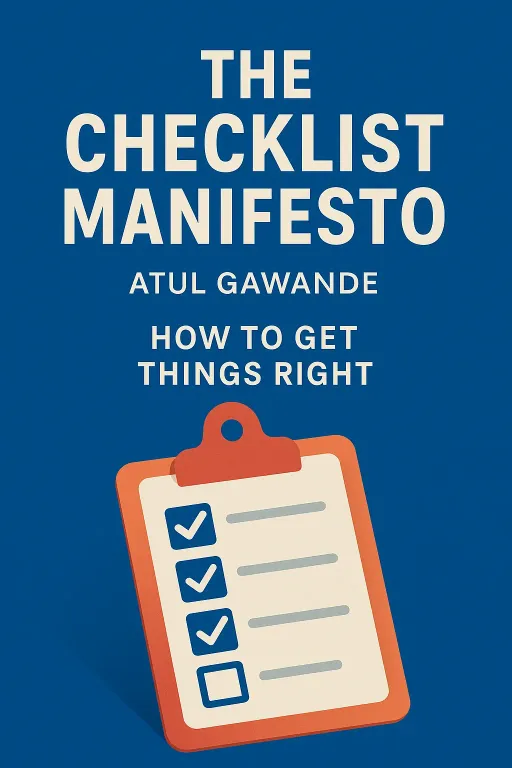
Nova: This is where Atul Gawande’s work, particularly "The Checklist Manifesto," becomes so illuminating, and it's a key tactical insight in our book today. Gawande, a surgeon himself, witnessed firsthand how brilliant medical professionals, despite their vast knowledge, would sometimes make preventable errors. He tells this incredible story about a hospital in Michigan that implemented a simple, five-item checklist for a specific surgical procedure. Things like "confirm patient identity," "mark surgical site," "confirm allergies." These were things everyone knew, but in the heat of the moment, under pressure, they could be missed.
Atlas: I can imagine. The operating room is probably one of the most high-pressure environments on the planet. One wrong move…
Nova: Exactly. And the results were profound. Just by implementing this basic checklist, complications were reduced by a staggering 36%, and deaths were cut by 47%. Think about that. Not a new drug, not a revolutionary technique, but a simple list. It wasn't about teaching them new knowledge; it was about ensuring they didn't forget the knowledge they already possessed. It created a forced pause, a moment of intentionality, preventing those simple oversights that could lead to catastrophic outcomes.
Atlas: Wow. That's kind of heartbreaking, but also incredibly hopeful. It makes me wonder, though, if that applies to something as technical as surgery, how does that translate to, say, managing material flow or installation sequences in construction? It feels like those are often about dynamic problem-solving, not just following a rigid script.
The Power of Simple Systems: Checklists and Standardization
SECTION
Nova: That's a crucial distinction, Atlas, and it's where the book moves from problem to solution, weaving in insights from "The E-Myth Revisited" by Michael E. Gerber. Gerber's core message is that successful businesses run on systems, not just on people. It's not about making people robots, but about providing them with a reliable framework so their unique talents can truly shine.
Nova: Think of it this way: when every single step of a process, from ordering supplies to installing a component, is left to individual memory or ad-hoc decision-making, you have chaos. You have inconsistency, waste, and a constant drain on mental energy trying to reinvent the wheel. Gerber argues that you should design your business as if you were going to franchise it. Every process, every task, should be documented, standardized, and repeatable.
Atlas: Okay, so it’s not about stifling creativity, but about building a predictable foundation so people can more creative and innovative within that structure? That makes sense for anyone who values efficiency and tangible results. But I can already hear some people pushing back, saying, "My work is too unique, too complex for a checklist."
Nova: That's a common misconception, Atlas! And it brings us right back to Gawande. He was very clear: checklists don't replace expertise; they it. They handle the mundane, the easily forgotten, the critical but repetitive steps, so the experts can focus their high-level thinking on the truly innovative, complex problems that actually require their unique intellect.
Nova: Imagine a small manufacturing business. For years, the owner, a brilliant craftsman, handled everything. Orders came in, he’d eyeball the stock, make a few calls, and somehow, things got done. But it was always a scramble. Deliveries were inconsistent, quality varied, and he was perpetually stressed. Then he read Gerber and decided to systemize. He started with a simple, 5-step checklist for order fulfillment: 1. Confirm order details with client. 2. Verify material availability. 3. Schedule production slot. 4. Initiate quality control check. 5. Confirm shipping and notify client.
Nova: It sounds almost too basic, right? But suddenly, his team knew exactly what to do. Less confusion, fewer forgotten steps, consistent quality. He wasn't just building products; he was building a reliable system. This minimized waste, both in materials and time, and freed him up to actually innovate on new product designs, which is what he loved doing.
Atlas: That’s a perfect example. It's like building a strong foundation for a house. You don't try to innovate on the concrete mix every time; you use a proven system so you can focus your creative energy on the architecture and the interior design. So, for our listeners who are strategists, innovators, and stewards of progress, what’s the tiny step they can take to start building that foundation?
Nova: The book has a brilliant "Tiny Step" for exactly that: identify one recurring task in your supply chain planning. Just one. And then, design a simple, 5-step checklist for it. It could be anything from preparing a monthly report to initiating a new supplier onboarding. The goal isn't perfection; it's predictability.
Synthesis & Takeaways
SECTION
Nova: You know, Atlas, what truly resonates with me about this book, and with the insights from Gawande and Gerber, is how it reframes our understanding of progress. We often chase big, flashy innovations, but predictable progress, the kind that truly moves us forward sustainably, often comes from mastering the fundamentals. It's about creating an environment where genius isn't wasted on repetitive tasks, but is unleashed on the truly challenging, creative endeavors.
Atlas: Absolutely. It’s like the ultimate efficiency hack that also happens to be deeply human. It connects with that core drive for progress, for building better, that I know so many of our listeners share. It’s not just about getting more done; it’s about getting the things done, reliably, and with less friction. It allows us to connect with the 'why' behind the 'what,' as our user profile suggests.
Nova: Exactly. These simple systems, these checklists, they’re not just tools for efficiency; they’re tools for liberation. They free up our mental real estate, allowing us to engage with the human element, to seek diverse perspectives, and to truly innovate. They create reliability, which in turn fosters trust, reduces stress, and ultimately, allows for more profound, sustainable impact.
Atlas: That's actually really inspiring. So, if you're out there listening, and your brain feels like that tangled string of Christmas lights, try Nova’s suggestion. Pick one recurring task, any task, and give it a five-step checklist. What chaos could you transform into clarity this week?
Nova: A powerful question, Atlas. And a perfect place to leave our listeners today.
Atlas: This is Aibrary. Congratulations on your growth!