Stop Chasing Trends, Start Building Systems: The Guide to Sustainable Marketing Innovation.
Golden Hook & Introduction
SECTION
Nova: What if the very thing you've been told defines success—working harder, doing more, being the best at your craft—is actually the biggest trap preventing you from achieving your true vision?
Atlas: Whoa, Nova. That's a bold claim. I think a lot of our listeners, especially those driven strategic innovators, hear 'work harder' and think 'that's the path to the top.' Are you saying the opposite? What kind of reverse psychology is this?
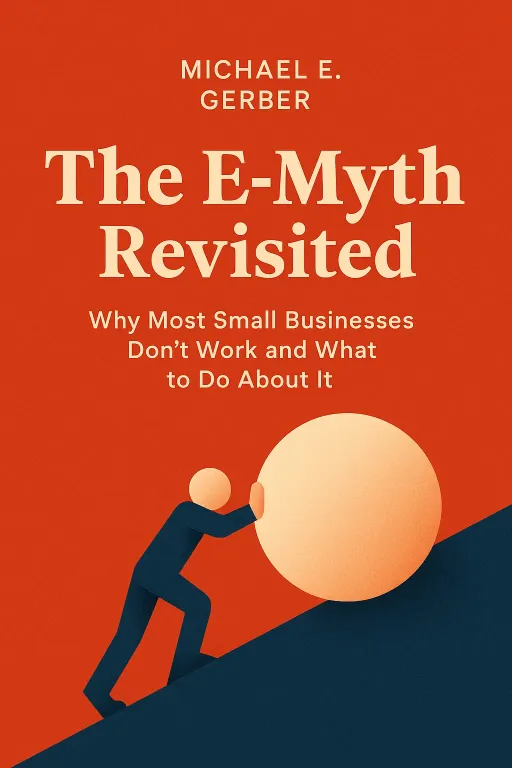
Nova: Not reverse psychology, Atlas, but a profound reorientation. We’re diving into a truth many brilliant innovators miss. They get trapped in the daily grind, becoming technicians instead of true entrepreneurs. The cold fact is, you need systems, not just skills, to scale your vision and avoid burnout. And today, we're unpacking that with the wisdom from a foundational text: by Michael E. Gerber.
Atlas: Ah,. I remember that one. It feels almost legendary in entrepreneurial circles. What's the story behind Gerber's insights?
Nova: Well, Gerber didn't just sit in an ivory tower and theorize. He built a multi-million dollar business coaching company precisely by observing so many small businesses—and their brilliant founders—fail. He saw firsthand that people were amazing at doing the work, whether it was baking pies or writing code, but terrible at designing a business that could run without doing all the work. His wisdom comes straight from the trenches of real-world entrepreneurial struggle. It’s about building a business that works you, not of you.
Atlas: Okay, that immediately resonates with anyone who's ever felt like their business owns them instead of the other way around. So, let's get into this entrepreneurial shift.
The Entrepreneurial Shift: From Doing the Work to Designing the System
SECTION
Nova: Exactly. Gerber's core argument is that most small businesses are founded by technicians—people who are excellent at the technical work of the business. Think of a brilliant chef opening a restaurant, or an incredible graphic designer starting an agency. Their passion is the craft.
Atlas: Right. And that passion is what drives them, initially. It's what makes the product or service great. So, what's the problem with being a technician? Isn't being good at the work essential?
Nova: It is essential, but it becomes a trap. The technician's mindset says, "I'm the best at this, so I must do it all." As the business grows, they become overwhelmed. They're still making every pie, designing every logo, writing every line of code. They confuse their skill with the business itself. The business becomes entirely dependent on individual effort.
Atlas: So, they're not building a business; they're building a job for themselves, just with more responsibilities and less vacation time. That sounds rough, but how do you even start building systems when you're already swamped? It feels like many of our listeners, the strategic innovators, are already juggling a dozen brilliant ideas and daily tasks.
Nova: That's the crux of it. The shift isn't about abandoning your skill; it's about elevating your role. It’s about moving from working the business to working the business. Imagine a baker, let's call her Sarah. Sarah makes the most incredible artisanal sourdough. People line up around the block. But she's exhausted. She's kneading every batch, managing every order, handling every customer service call. She dreams of opening more locations, but she can't even keep up with one.
Atlas: I totally know that feeling. I imagine a lot of our listeners feel that way about their marketing campaigns or product launches. They're the bottleneck.
Nova: Precisely. Sarah needs to document her process. How does she select her ingredients? What are the exact steps for kneading, proofing, baking? What’s the customer service script? If she can write down how she does what she does perfectly, suddenly that knowledge isn't locked in her head anymore. It becomes a system.
Atlas: So basically, you're saying, she's teaching someone else to make perfect sourdough, not version of sourdough. It's like creating a blueprint.
Nova: Exactly! And once that blueprint exists, she can hire and train others to execute those tasks consistently. This frees Sarah to focus on the entrepreneurial work: strategizing new locations, sourcing better ingredients, marketing, and innovating new products. She's no longer just a baker; she's a business owner who a baking enterprise. This fundamentally shifts her focus from individual effort to scalable, repeatable processes, freeing her to lead and innovate.
Atlas: That's actually really inspiring. It connects to that deep drive for self-mastery our listeners have. It’s about mastering the, not just the art of baking. And that's how you get long-term impact without personal burnout.
Building the Flywheel: Enduring Systems for Lasting Greatness
SECTION
Nova: Absolutely. And once you've made that internal shift, the next level of mastery comes from understanding how truly great companies build enduring systems that create unstoppable momentum. That brings us to Jim Collins' seminal work,.
Atlas: Ah, Collins. Another classic. I always think of it as the ultimate guide to corporate longevity. But Nova, it feels like many of our listeners are constantly looking for that 'one big thing'—the viral trend, the breakthrough AI tool, the next marketing hack that will change everything overnight. Is Collins saying that's not the path to greatness?
Nova: He's saying it's not the path to greatness. Collins' research fundamentally challenges the idea that great companies are built on charismatic leaders or revolutionary products. Instead, he found that truly great companies build enduring systems and disciplined cultures that far outlast any single leader or product. He calls it the "flywheel effect."
Atlas: The flywheel effect. So, it's not just about one brilliant idea or one charismatic leader then?
Nova: Not at all. Imagine a giant, heavy flywheel. To get it moving, you have to push it again and again, with tremendous effort. It moves barely perceptibly at first. But with consistent, disciplined pushes in the same direction, it starts to pick up speed. Eventually, its own momentum carries it forward, generating enormous power with less relative effort.
Atlas: Okay, so it’s like compounding effort over time. You're building up this incredible store of momentum. Can you give an example of what that looks like in a company?
Nova: Think of a company that consistently focuses on operational excellence, year after year. They might not have the flashiest products, but their processes for manufacturing, distribution, or customer service are meticulously designed and constantly improved. For example, a company like Nucor Steel, which Collins studied, didn't rely on a single invention. Their "flywheel" was built on a culture of disciplined cost reduction, innovation in mini-mills, and a unique employee compensation system. Each successful push—each system improvement—added momentum, making the next push easier and more impactful.
Atlas: That makes me wonder, how does this apply to a rapidly changing marketing landscape, where "trends" seem unavoidable? How do you build an 'enduring system' when the rules of the game are constantly shifting, and you feel like you to chase the next big thing?
Nova: That's a brilliant question, and it's where the nuance lies. The "system" isn't about rigid adherence to old methods. It's about building a. It's a disciplined approach to continually learning, adapting, iterating, and testing new trends, but within a structured framework. So, instead of randomly jumping on every new TikTok feature, you have a for evaluating new platforms, piloting campaigns, analyzing data, and integrating successful learnings back into your core marketing processes. That's what future-proofs a business.
Atlas: So, the system isn't the trend; the system is how you with trends effectively and sustainably. It's about being disciplined in your approach to change. That's a profound insight for anyone seeking a competitive edge in emerging tech.
Synthesis & Takeaways
SECTION
Nova: Precisely. It's about designing a future where you're not constantly putting out fires, but systematically building momentum. Both Gerber and Collins, in their own ways, are telling us to stop being mere technicians or trend-chasers. They're urging us to become architects of enduring systems. It’s about building a legacy, not just making a living.
Atlas: So it sounds like the real competitive edge isn't in chasing the next shiny object, but in mastering the internal processes that allow you to innovate consistently and without burnout. It's about designing a future where you're not constantly putting out fires. It truly is about self-mastery and long-term impact.
Nova: Absolutely. And with that in mind, here's a "tiny step" for our listeners this week: identify one repetitive marketing task you currently do. Document its exact steps as if you were teaching someone else to do it perfectly. It could be drafting social media posts, responding to common customer inquiries, or even organizing your files.
Atlas: That's a concrete action that immediately puts these ideas into practice. It's the first push on that flywheel, the first step in designing your way out of the technician's trap. Don't just think about it; do it this week.
Nova: What's one marketing task you do regularly that, if you documented its exact steps, could free up your time and energy to focus on leading and truly innovating?
Atlas: Take that tiny step. Your future self, the visionary leader, will thank you.
Nova: This is Aibrary. Congratulations on your growth!