Unmasking Power Dynamics: How History Shapes Our Present Choices
Golden Hook & Introduction
SECTION
Nova: Forget everything you thought you knew about money. What if I told you the entire story of how we got here, the very foundation of our economic lives, is built on a lie? A foundational myth that keeps us blind to the real power dynamics at play.
Atlas: Whoa, a lie? That's quite the opening, Nova. My ears are definitely perked up. Are we talking about some deep state conspiracy, or is this more about the textbooks I snoozed through in econ class? Because I'm leaning towards the latter, but intrigued.
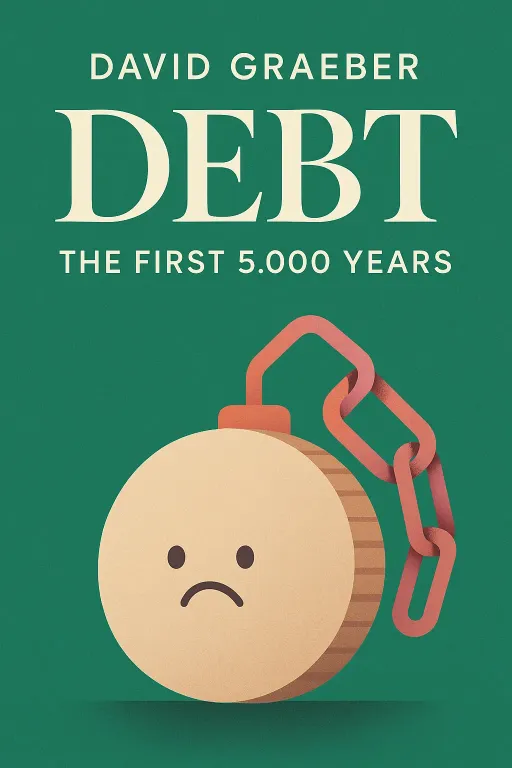
Nova: Definitely more the latter, Atlas, but with far more profound implications than just a dry textbook. Today, we're diving into the groundbreaking work of David Graeber, specifically his monumental "Debt: The First 5,000 Years," and then we'll expand into "The Dawn of Everything," co-authored with David Wengrow. Graeber was a fascinating figure—a brilliant anthropologist who was also a very vocal activist, which gave him this incredible lens to critique power structures. His work has been widely acclaimed for its scholarly rigor, yet it's also incredibly controversial because it completely upends so many of our ingrained assumptions about human history and economics.
Atlas: So he's not just observing history, he's challenging it from the inside out, essentially saying, 'You've got it all wrong'? That sounds like exactly the kind of deep dive our listeners, who love uncovering the 'why' behind things, are looking for.
Nova: Precisely. And it starts with what he calls the 'myth of barter.' We've all been taught that early economies started with simple barter, right? I have two chickens, you have a basket of apples, we trade. Then, it got complicated, so we invented money.
Atlas: Yeah, that's the story. It's in every introductory economics course. It makes perfect, logical sense.
Debt as the Origin of Economic Exchange & Social Power
SECTION
Nova: Well, Graeber argues that story is a complete fiction. He couldn't find a single historical or ethnographic example of a society that actually operated primarily on barter. Not one. Instead, he found something far more fundamental: debt.
Atlas: Okay, hold on. So you're saying before we were swapping goats for grain, we were... borrowing? How does that even work without a concept of money?
Nova: That's the brilliance of it. Graeber demonstrates that early economies weren't about anonymous transactions between strangers. They were about communities, about relationships. If your neighbor needed something, you gave it to them. Not because you expected an immediate, equivalent return, but because you were building a social bond, an obligation. A debt. And you trusted that when you needed help, they would reciprocate. Think of it less as a loan and more as a social credit system.
Atlas: So it's like, 'I'll help you with your harvest today, and I know you'll help me fix my roof next month,' without ever putting a price tag on it. That makes sense on a small, community level.
Nova: Exactly. And this was the dominant form of economic exchange for thousands of years. What's truly fascinating is how this understanding reshapes our view of power. When societies grew larger, these informal debts became more formalized. In ancient Mesopotamia, for instance, they had highly sophisticated credit systems and even detailed laws about debt. But here's the crucial part: they also had regular 'debt jubilees.'
Atlas: Debt jubilees? That sounds almost biblical.
Nova: It is! Every few decades, kings would declare a 'clean slate.' All debts would be forgiven, prisoners released, and land returned. This wasn't just some act of benevolence; it was a pragmatic way to prevent society from collapsing under the weight of insurmountable debt. It recognized that perpetual debt created instability and servitude.
Atlas: Wow. So our entire modern concept of debt as this ironclad, moral obligation that must always be repaid, no matter what, is actually a relatively recent invention? And before that, societies understood that sometimes you just had to hit the reset button to survive?
Nova: Precisely. Graeber argues that the idea of debt as a moral imperative, almost a sin to default on, really solidified with the rise of coinage and standing armies. Suddenly, debts could be quantified and enforced impersonally, often through violence. It shifted from being about a relationship to being about a numerical obligation. This changed everything: it created classes of debtors and creditors, fueled empires, and became a primary tool for social control.
Atlas: That's a powerful point. Doesn't this mean that even today, debt is more about social control than just financial transactions? I mean, when you look at national debt, student loan debt, credit card debt... it feels like it shapes so much of our behavior and opportunities. It’s like a quiet hand on the tiller of our lives.
Nova: It absolutely is. Graeber's work forces us to see that these 'financial instruments' are deeply embedded in historical power dynamics, not just neutral economic tools. They dictate who has agency, who is free, and who is bound. And understanding that history helps us see how our current political issues, like debates over financial inequality or economic stimulus, are not just about money, but about these ancient echoes of obligation and control.
Challenging Historical Narratives: Diverse Social Structures & Political Possibilities
SECTION
Atlas: So, if our economic history is built on a myth, what about our political history? Are we also misunderstanding how societies organized themselves, and does that open up new possibilities for how we could organize ourselves now?
Nova: That's the perfect segue into "The Dawn of Everything." In this book, Graeber and Wengrow absolutely demolish the conventional narrative of human history—the idea that we started as simple hunter-gatherers, then inevitably developed agriculture, then cities, then states, and with states, came hierarchy and inequality. It's this linear, deterministic story that suggests our current systems are simply the natural, unavoidable endpoint of human development.
Atlas: Yeah, I know that story too. It’s the one where we're told, 'Well, that's just how humans are, someone always ends up in charge, and that's how civilization works.'
Nova: They show that this narrative is also largely a fiction. Through incredible archaeological and anthropological evidence, they reveal that our ancestors were far more experimental, far more creative, and frankly, far more free than we give them credit for. They experimented with diverse social structures, often shifting between them seasonally or even generationally.
Atlas: Wait, so we've been told these early societies were 'primitive,' but Graeber and Wengrow are saying they were often more sophisticated in ensuring freedom than our own? What does that mean for our current political issues, like debates over universal basic income or decentralized governance?
Nova: It means we've been operating under false assumptions about human nature and political possibilities. Take Indigenous societies in North America, for example. The authors highlight groups like the Kwakiutl of the Pacific Northwest. In winter, they would organize into rigid, hierarchical structures for elaborate potlatch ceremonies, with chiefs and slaves. But in summer, they dispersed into smaller, egalitarian groups for foraging, abandoning all those hierarchies.
Atlas: That's incredible. So they could literally turn hierarchy on and off? Like a social light switch?
Nova: Exactly! Or consider the Haudenosaunee Confederacy, often called the Iroquois. They developed a complex system of governance that influenced the American founding fathers, emphasizing consensus, decentralized power, and the equality of women in political decision-making, centuries before European societies considered such ideas. They managed vast territories and populations without a centralized, coercive state as we understand it.
Atlas: That's mind-blowing. It really challenges the idea that hierarchy is an inevitable outcome of scale or complexity. So if these societies could manage large populations without centralized authority, what does that imply for our modern world, where we often feel trapped by massive, bureaucratic states? Does this historical 'flexibility' offer a blueprint for modern movements seeking more equitable systems, or is it just a romanticized view of the past?
Nova: It's not about romanticizing the past or trying to perfectly replicate ancient systems. It's about recognizing that the 'solutions' we often take for granted—like centralized states or permanent hierarchies—are specific historical choices. Graeber and Wengrow demonstrate that humans have always had the capacity for self-governance, for creating societies based on freedom and cooperation, even at scale. It offers a powerful counter-narrative to those who feel constrained by current political and economic systems. It tells us that our present is not an inevitable destination, but a choice, just like our ancestors made choices.
Synthesis & Takeaways
SECTION
Atlas: So, what I'm taking away from this is that by unpacking these historical 'lies' about debt and the inevitability of hierarchy, Graeber essentially gives us permission to imagine, and even build, different futures. It's not about being stuck with what we have.
Nova: Absolutely. The deep insight here is that our current political and economic systems are not natural laws; they are specific historical constructions, born from particular choices and power dynamics. When you understand that debt wasn't always a tool of subjugation, or that human societies experimented with radical freedom for millennia, it completely reframes how you look at today's challenges. It shifts the question from 'How do we fix this?' to 'What kind of society do we actually want to build, and what historical precedents show us it's possible?'
Atlas: It’s empowering, really. For our listeners who are constantly seeking to understand the 'why' behind things and want to contribute to a better future, knowing that our current structures aren't fixed destiny, but rather mutable choices, is a huge catalyst. It means informed engagement isn't just about tinkering at the edges; it's about fundamentally re-evaluating the foundations.
Nova: Exactly. It's about trusting your analytical depth and allowing yourself to synthesize, not just absorb. And then, sharing those insights, because even small conversations can spark change. What overlooked historical 'debt' or power dynamic might be quietly shaping a current political issue you care about? That's the question we're left with.
Atlas: That's a powerful question to sit with. It really makes you look at the news differently, knowing there's so much more under the surface.
Nova: It does. It shows that connecting past actions to present outcomes is the first step to unlocking new possibilities.
Atlas: This is Aibrary. Congratulations on your growth!